Today is a day off, going to the park to play, the lawn is full of people camping with tents, why have more people brought tents first? Is it because tents have some hidden small spaces? This reminds me of @MidnightNetwork
Why is it called a 'game changer'?
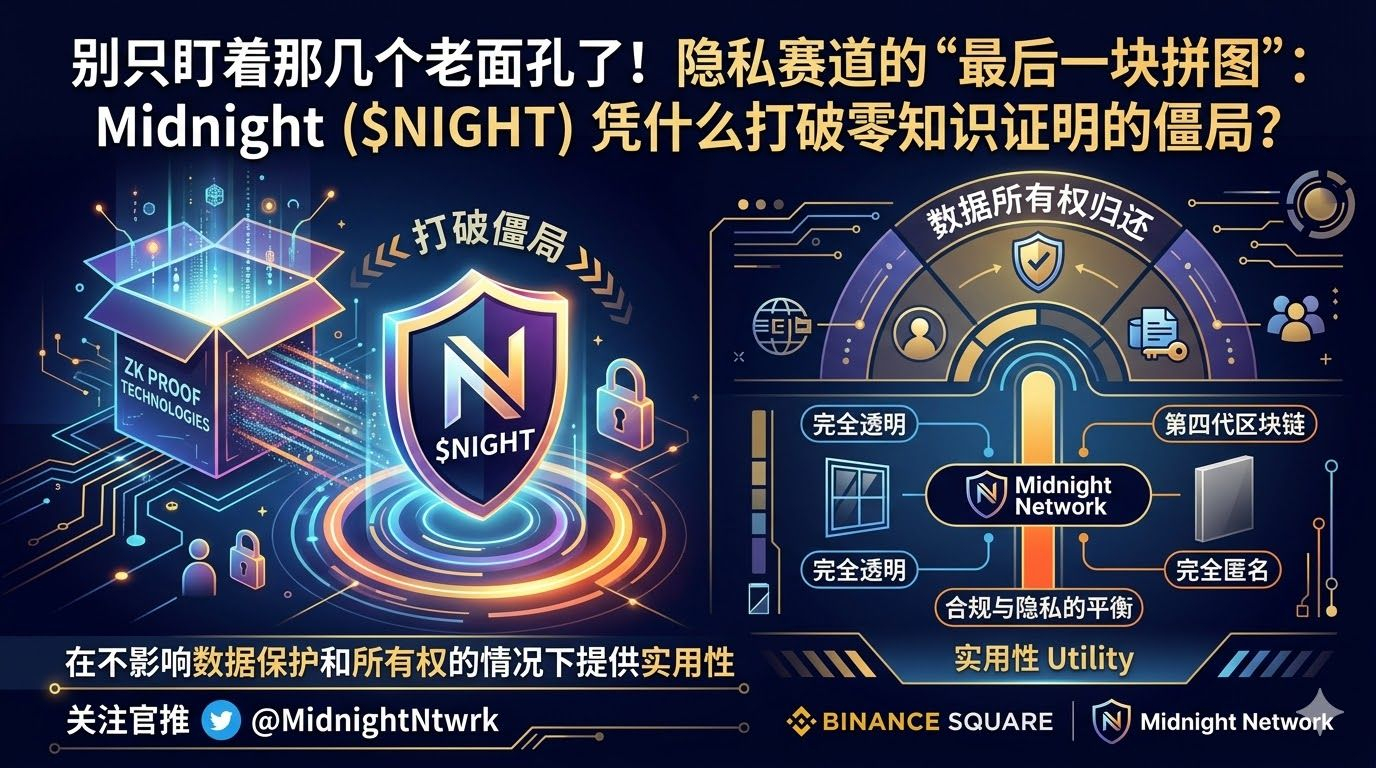
The current blockchain world faces an extremely awkward paradox:
Completely transparent: it's like taking a shower in a glass house, institutions and individuals are reluctant to put truly sensitive data online.
Completely anonymous: it easily becomes a gray area, and regulatory compliance becomes an insurmountable obstacle.
The emergence of Midnight is to break this deadlock. As a fourth-generation blockchain based on zero-knowledge (ZK) proof technology, its core logic is very hardcore: it only proves the authenticity of the results but does not expose the data itself.
$NIGHT: Not just a token, but a 'ticket' to data sovereignty.
In the ecosystem of Midnight, $NIGHT is not just a trading symbol. It represents a form of utility.
Data ownership restoration: You no longer need to 'sacrifice' your personal privacy to use a certain DApp.
Balancing compliance and privacy: It allows developers to build applications that protect user secrets while meeting compliance audits. This 'elastic privacy' is the stepping stone for future Web3 to enter the mainstream.
Casual talk: Why have I been paying attention to it recently?
To be honest, the current market lacks technology; what it lacks is 'warm and practical' technology. Midnight has a deep technological foundation (just look at the solid progress on the official Twitter @MidnightNtwrk), and it is not rushing to create hype, but quietly building a foundation where privacy and efficiency coexist.
While everyone is talking about ZK-Rollup speed improvements, Midnight is already thinking about how to enable global developers to build truly commercially valuable ecosystems without sacrificing data sovereignty.
To summarize: If you haven't added #night to your watchlist yet, you might really miss this wave of cognitive dividends in 'privacy infrastructure.' In an age where data is more valuable than gold, those who can protect privacy will hold the future's pricing power.