
I just stumbled upon a section in the midnight tokenomics whitepaper that completely changed my view on who can truly use this network…
Everyone is focused on the mechanism of night and dust. Holding the night, generating dust, executing trades. Simple enough. But hidden in Section 4 is a completely different access model, midnight is quietly being constructed—this has nothing to do with holding the night.
The part that surprised me:
Midnight is designing a capacity market. A system where holders of the night can rent out the dust generated beyond their personal needs to other users—those with zero nights, zero dust, and who may not even be aware of the blockchain existing beneath the applications they use.
The white paper clearly describes this. DApp operators running on Midnight require DUST to process user transactions. However, operators can lease DUST generation capabilities from NIGHT holders without requiring each user to hold NIGHT and absorb transaction costs on behalf of their entire user base. End users only need to use the application. They never interact with the tokens.
What caught my attention is:
The off-chain broker model is the first version of this. A NIGHT holder directly designates their DUST generation to the tenant's wallet. The tenant receives the available DUST. Payments between both parties are conducted entirely off-chain—cash, stablecoins, bank transfers, or any method they agree upon. The leasing arrangement itself does not require on-chain settlement.
Brokers can act as intermediaries. A dedicated broker manages the relationships between multiple NIGHT holders leasing capabilities and multiple DApp operators needing capabilities. Brokers coordinate designations, collect tenant payments, allocate payments to landlords, and charge fees for services.
This is essentially a B2B infrastructure market that operates on top of Midnight's token mechanism. It can run completely offline in its first version.
Still figuring out whether:
The off-chain model requires trust between the parties. A NIGHT holder designating their DUST generation to a tenant must trust that the tenant will actually pay. A broker in this relationship becomes a single point of failure—if the broker mismanages payments or disappears, the landlord loses income, and the tenant loses capability.
The white paper acknowledges this and describes future protocol upgrades that will enable ledger-native capability leasing—a mechanism on-chain where payments and designations happen atomically without trust assumptions. But that version does not yet exist. The launch version is a trust-based off-chain model.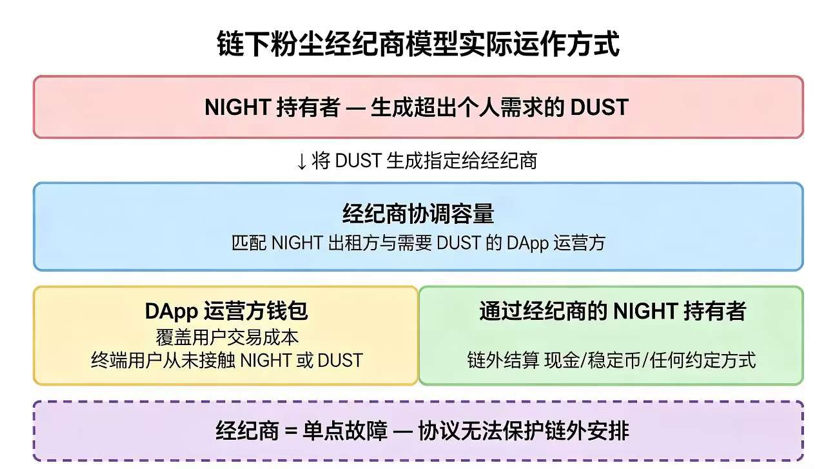
This is the part that has kept me thinking—Midnight also describes something called the Babel Station. A service that allows users to submit transactions using non-NIGHT tokens as payment. ETH, stablecoins, and possibly even fiat currency. Babel Station operators incur DUST costs and get reimbursed in any tokens provided by users. This pushes the concept of the capability market further—you don't need NIGHT, you don't need DUST, you don't even need to know what both are.
This vision is essentially a blockchain where the token mechanism is completely invisible to the end users. Developers build applications, operators acquire DUST capabilities from the market, and users pay with whatever they have. The entire NIGHT/DUST system operates underneath, while most users never interact with it directly.
Honestly, I don't know if this abstraction layer makes Midnight truly more accessible or just adds complexity and trust dependency, creating new failure points before the on-chain market version is ready.
What do you think—can elegant infrastructure design make Midnight invisible to end users, or does a trust-dependent off-chain layer introduce risks that the protocol itself cannot safeguard against?#night