Many people get excited about projects by looking at the big terms.
Privacy, mainnet, airdrop, ecology, institutional collaboration.
But now I find myself increasingly paying attention to those details that don't seem lively at first glance.
Because when you really want to use a chain, the final decision on experience often doesn't come from slogans, but whether the address format can be entered correctly and whether the data can be indexed stably. Developers often get stuck on the environment when they first start.
@MidnightNetwork Recently, it feels like they are seriously addressing these most inconspicuous but impactful areas.
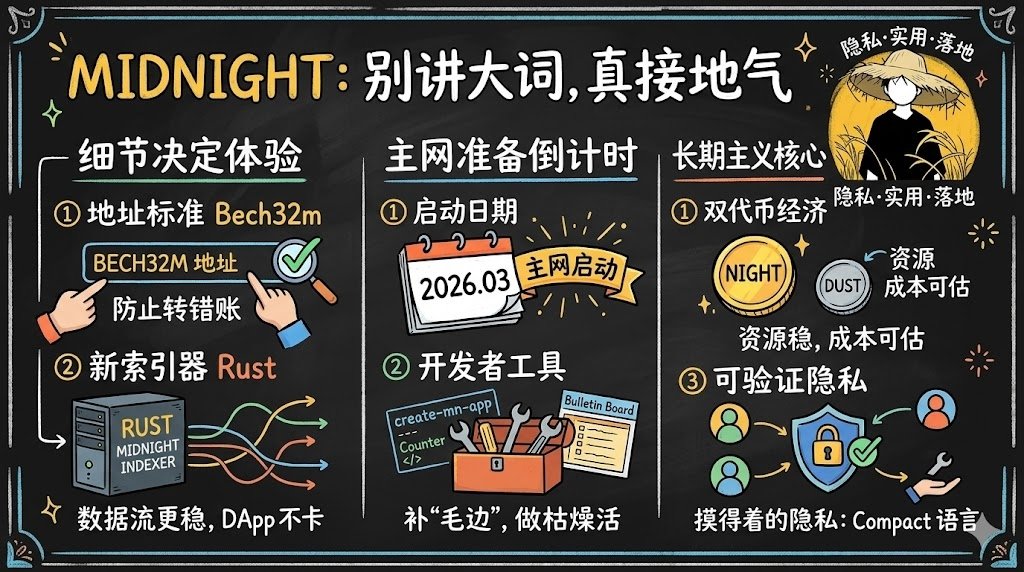
In April, the official changed the default address format to Bech32m, and the reason is straightforward: it's more human-readable and includes error detection. In simple terms, this isn't for aesthetics; it's to reduce the chances of entering an incorrect address or making a wrong transaction.
Many chains like to treat complexity as sophistication, but when it comes to real usage, the first step is to eliminate these basic errors.
Looking deeper, Midnight has officially replaced the original Scala Pub-Sub Indexer with the Midnight Indexer written in Rust.
This doesn't sound explosive, but those who have worked on products know that the stability of the indexer determines whether wallets, browsers, and DApp backends work smoothly.
On-chain, it's not just contracts; there’s a whole set of data flows behind it.
No matter how beautiful your front end is, if the data is slow, chaotic, or lost, users will just feel that this chain is unusable.
@MidnightNetwork Bringing these foundational components to the forefront is actually about saying something more practical; it aims to do more than just run a network but to build a network that can connect with products.
This line of thought connects with its recent preparations before the mainnet.
The official February update has made it very clear that the mainnet will launch in late March 2026.
At the same time, the developer team is pushing the preprod migration, updating examples like create-mn-app, Counter, and Bulletin Board, and unifying the core package versions to the latest environment.
You can feel that it's not just showing a bunch of visionary images, but doing the kind of tedious yet most useful work when the network actually goes live.
This also helps me better understand Midnight's core.
Many people will first see its privacy narrative, but the real weight of Midnight lies not just in discussing rational privacy but in its attempt to make this capability something both developers and regular users can grasp.
Compact language, updated sample DApps, indexers, address standards; although these seem scattered, they are all serving the same purpose. Don't let 'verifiable privacy' remain just on PPT.
Even the token design fits more smoothly from this perspective.
$NIGHT At the capital layer, DUST is the resource consumed during transaction and contract execution.
For the system to run long-term, developers will not only care about the coin price but also about the stability of resources and whether costs can be estimated well.
Midnight's approach is inherently about long-term service, not forcing all actions to be directly tied to the native coin price.
So when I look at Midnight now, my first reaction is no longer whether it can tell a story, but that it starts to have that 'ready for long-term use' vibe.
Many chains fail because from a distance, they seem to have everything, but up close, they are all rough edges.
What Midnight has recently addressed are precisely those most easily overlooked rough edges.
When users make their first transfer, developers deploy for the first time, and products connect to data for the first time, these issues matter more than any big terms.
@MidnightNetwork $NIGHT #night