
A few days ago, I came across news about the American medical technology giant Stryker, where tens of thousands of medical devices had their data remotely wiped by Iranian hackers. Even the digital medical logistics and life support system built by the U.S. military became useless scrap metal overnight. To be honest, I was stunned for quite a while after reading it. It's not that I've never seen news about cyberattacks, but this was the first time I felt so intuitively how dangerous it is that we are now stuffing all core data into centralized servers. Whether it's a medical giant worth hundreds of billions or a national-level support system, as long as hackers breach the core nodes of a centralized database, all accumulated core data can be wiped out in one go. This sense of powerlessness is really overwhelming.
After this incident, I revisited the white paper of @MidnightNetwork from start to finish. The first time I read it, I only thought its privacy design was clever. This time, in conjunction with the news, I truly understood that every line written in this white paper was not just technical gimmicks but genuinely addressed the critical issues faced by all physical industries today.
Many people’s understanding of Midnight is still stuck at the dual-token model and the label of a privacy public chain. However, if one takes the time to read the white paper carefully, it becomes clear that it never intended to create another fully transparent transaction public chain, nor did it follow the old anonymous coins in sealing all data. It’s not about creating a black box that regulatory bodies cannot touch.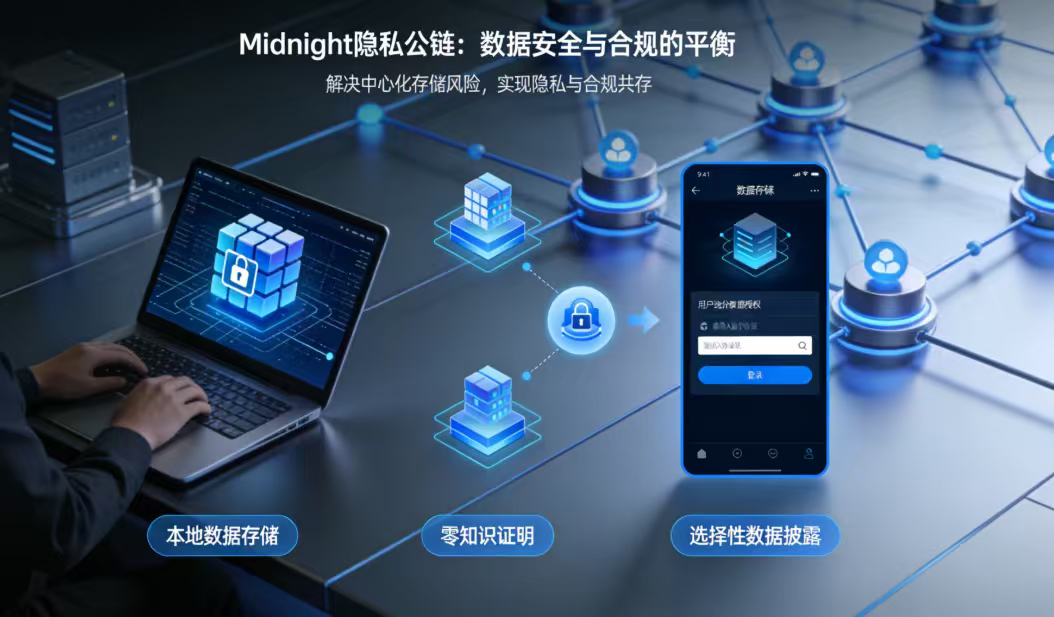
The core direction defined in the white paper is to create programmable privacy protection and selective disclosure. In simple terms, it means completely returning the control of data to the users. Who can see your data, how much they can see, and for how long, is entirely up to you. When I first read this part, I didn't take it to heart, but after combining it with the recent incident of medical data leaks, I realized this is the most crucial breakthrough point.
The white paper specifically mentions a core architectural design where all user private data is stored on local devices and is not uploaded en masse to the public ledger on the chain. When I saw this, I discussed with friends that this design is truly practical.
Currently, whether in traditional internet or many public chain projects, there is a tendency to centralize all data management. The result is that it naturally becomes a honeypot in the eyes of hackers. As long as one entry point is breached, everything can be taken away. Just like in the recent Stryker incident, data from tens of thousands of devices disappeared with no trace.
If using Midnight's logic, core operational parameters of medical devices and patient treatment data would all be stored on local terminals. Only a zero-knowledge proof that can verify authenticity would remain on the chain. Even if hackers breach the chain nodes, they would not obtain any core original data, let alone clear all device information at once, fundamentally cutting off the possibility of mass data leaks.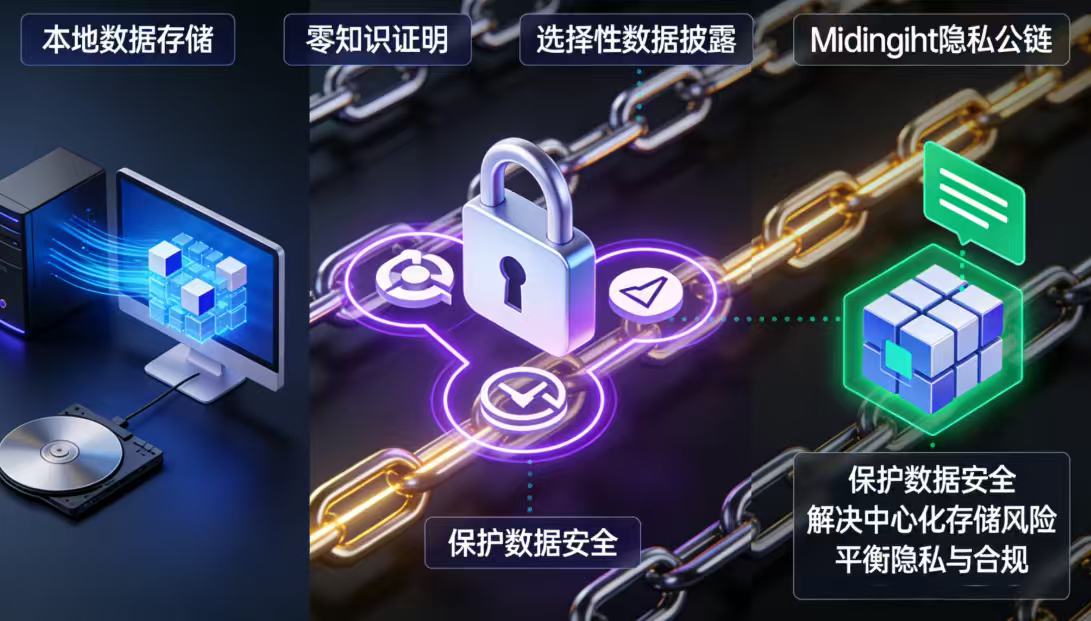
The white paper dedicates a significant portion to discussing its ZK technology architecture. When I first read the technical section, I found it somewhat convoluted, but now, in light of actual events, everything suddenly makes sense.
It did not follow the trend of creating a large and comprehensive general ZK circuit but rather customized circuit optimizations specifically for the scenario of private smart contracts based on the research results of the Kachina protocol. In simple terms, it avoids flashy parameter gimmicks and focuses on achieving the utmost transparency for the most critical proof of compliance in physical industries. For instance, in the medical industry, enterprises need to prove to regulatory authorities that their equipment meets safety standards and demonstrate their product's performance capabilities to partners without disclosing core technical parameters or patient privacy records. They only need to generate a ZK proof, and the other party can verify the authenticity of this matter, with no leakage of other core information.
The white paper also specifically mentions that this architecture, based on the Halo2 framework and BLS12-381 curve, supports cross-chain integration with other non-ZK public chains. In the future, even when interacting with other chains for data exchange, privacy protection will not be compromised. This consideration truly takes into account the long-term needs of enterprises.
What I find particularly valuable is the emphasis on selective disclosure capabilities repeatedly highlighted in the white paper. It truly balances privacy protection and regulatory compliance. Many physical enterprises currently face a dilemma: either disclose all data to meet compliance requirements, leaking business secrets and user privacy completely, or protect core information and fail regulatory scrutiny. This is especially true in highly regulated industries like healthcare, military, and finance, where both ends have strict requirements, making it impossible to find a win-win solution.
Midnight's programmable selective disclosure provides enterprises with ample room for flexible operations. During audits, corresponding permissions can be opened to regulatory authorities, and during cooperation, only the relevant content is shown to partners, keeping core data firmly in one’s hands. The white paper explicitly states that this design can adapt to regulatory requirements in different jurisdictions, which is something other privacy chains have not adequately achieved.
The easily overlooked design of development thresholds is clearly stated in the white paper. It uses TypeScript, currently the second most popular language globally, as the smart contract development framework, and has self-developed the Compact language, encapsulating complex ZK encryption operations at the underlying level.
Previously, I have encountered many privacy chain projects with development barriers so high that ordinary enterprises' technical teams could hardly approach them, let alone traditional physical industries like healthcare, where technical teams have no energy to tackle niche programming languages and obscure cryptographic knowledge. Midnight's design directly flattens the development threshold for privacy applications. Enterprise development teams do not need to understand the underlying logic of zero-knowledge proofs; they can write privacy-protected applications using familiar programming languages. This is truly about wanting technology to move out of the lab and into real commercial scenarios instead of just indulging in the cryptocurrency circle.
Many people only talk about Midnight's dual-token model, but if you really read through the white paper, you will find that the design of NIGHT and DUST has been deeply bound to its privacy protection system from the very beginning. The white paper clearly states that DUST, as the fuel for on-chain transactions, is in a shielding state throughout the process, meaning no metadata is leaked during transactions, completely eliminating transaction correlation analysis. Moreover, it is non-transferable and will decay over time, fundamentally alleviating regulatory concerns about masked tokens.
NIGHT, as a non-masking equity token, is responsible for network governance, consensus participation, and node block rewards. Its publicly transparent attributes allow for unobstructed circulation while ensuring the decentralization and security of the network. More importantly, holding $NIGHT can continuously generate DUST, and transactions only consume DUST without touching the holder's NIGHT principal. For enterprises, operating costs are completely controllable, eliminating daily worries about fluctuations in token prices affecting transaction fees. The white paper even considers future fiat currency payment transaction fees, addressing all the concerns of enterprises in advance.
After reading through the entire white paper and then looking back at the recent data leak incident involving Stryker, I really feel that many people's understanding of privacy public chains is too narrow. They tend to think it is just an additional layer of anonymity for speculative trading, but that is not the case at all. All the designs written in this white paper by Midnight ultimately aim to enable blockchain to genuinely penetrate into physical industries and meet the real needs of core fields like healthcare, finance, and military, rather than merely engaging in zero-sum games of existing funds within the cryptocurrency circle. This hacking incident is merely a wake-up call; our lives will become increasingly digital, and data security will become a lifeline for all industries. The path laid out in the white paper by Midnight is precisely the one that is most likely to succeed. #night