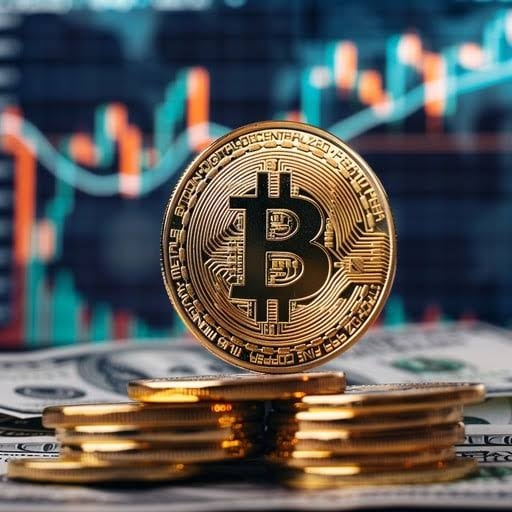
In the early days of the internet, when most people still thought of money as something you could fold, count, or lock in a vault, there was a whisper—an idea passed quietly between coders, dreamers, and skeptics.
It began with a message.
No one knew who truly wrote it. The name attached—Satoshi Nakamoto—felt more like a mask than a person. But the message was clear: what if money didn’t need a bank? What if trust didn’t need a middleman?
At first, almost no one paid attention.
A small group of curious minds gathered in obscure forums, testing this strange new system. They called it $BTC . It wasn’t backed by gold, governments, or anything physical. It was just code—lines and lines of it—running across a scattered network of computers.
To most, it sounded absurd.
But to a programmer named Arjun, sitting in a cramped apartment in Bangalore, it felt revolutionary.
Arjun had grown up watching his parents struggle with bank delays, fees, and paperwork. Money moved slowly, and always with friction. When he first read about Bitcoin, he didn’t fully understand it—but something about it clicked.
It was… free.
Not free in cost, but free in spirit.
He began mining Bitcoin on his old computer, the fan whirring loudly as it struggled to keep up. Back then, each coin was worth almost nothing. His friends laughed when he told them about it.
“You’re wasting electricity,” they said.
Maybe he was.
But Arjun wasn’t just chasing money. He was chasing an idea—the idea that value could exist without permission.
Years passed.
Bitcoin grew, slowly at first, then all at once. What had once been dismissed as a hobby for geeks began appearing in headlines. Prices surged, crashed, and surged again. Governments argued about it. Banks criticized it. Entrepreneurs embraced it.
And Arjun?
He kept going.
Not obsessively, not blindly—but steadily. He learned how the blockchain worked, how every transaction was recorded in a chain of blocks that no one could alter without rewriting the entire history. It was messy, imperfect, and sometimes chaotic—but it was also honest in a way traditional systems weren’t.
One day, during a massive price surge, Arjun checked his old wallet.
The coins he had mined casually years ago—coins he almost forgot about—were now worth more than he had ever imagined.
He stared at the screen, heart racing.
This wasn’t just money.
It was proof.
Proof that an idea, once ignored, could reshape the world.
But instead of cashing out everything, Arjun made a different choice.
He used some of it to build.
He started a small company focused on helping local businesses accept digital payments without heavy fees. Street vendors, freelancers, small shop owners—people who had always been at the edges of the financial system—now had a new way to participate.
Not everyone trusted it.
Not everyone understood it.
But some did.
And that was enough.
Years later, when people talked about Bitcoin, they often focused on its price—the highs, the crashes, the volatility. But for Arjun, that was never the real story.
The real story was simpler.
It was about a question that refused to go away:
What if trust didn’t have to be given—but could be built into the system itself?
And somewhere, in the vast network of computers still running the Bitcoin protocol, that question continued to echo—block after block, transaction after transaction—unchanged, unstoppable, and still a little mysterious.
#Binance #Bitcoin #satoshiNakamato