
#102-2026.03.21
Core Information
Starting from January 4, 2026, Guangzhou officially launched the 'Guangzhou Real Estate Blockchain Financial Service Platform', which uses blockchain technology to achieve the full process online handling of real estate registration-related services. This platform relies on the advantages of blockchain's immutability, full traceability, multi-party authentication, judicial evidence preservation, and other technical advantages to achieve secure and trusted data sharing between real estate registration institutions and financial institutions. Financial institutions submit electronic application materials online, and after confirmation by the applicant, the registration institution accepts, reviews, and generates electronic real estate registration certificates based on the on-chain information, realizing 'zero run, no face-to-face' processing.
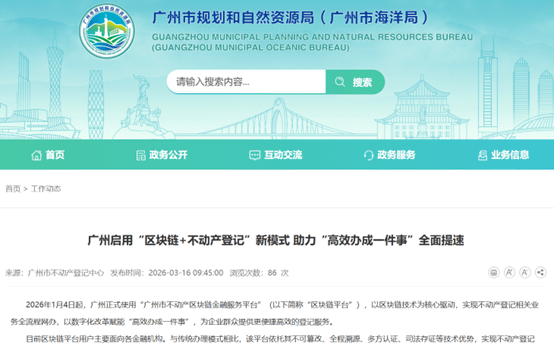
The platform currently supports the first registration and cancellation of housing mortgage rights, the change, transfer, and correction registration of pre-sold commercial housing mortgage rights, as well as the inquiry of real estate registration result information and other services. In the two months since its launch, financial institutions have processed more than 14,000 registration transactions and over 86,000 inquiry transactions through the blockchain platform, significantly improving the efficiency and security of loan approval for financial institutions.
Evaluation and analysis
Guangzhou's practice reveals the key path from 'proof of concept' to 'scaled application' for blockchain technology: choosing scenarios with multiple participants, high-frequency transactions, and high trust costs as breakthroughs. Real estate registration just happens to meet these three conditions, involving multiple parties such as registration agencies, financial institutions, and property owners, with huge annual transaction volumes, and any data tampering at any link could lead to enormous economic losses or property disputes.
Under the traditional model, banks require borrowers to travel back and forth between the real estate registration center and the bank to submit paper materials for mortgage loans. There is a lack of real-time data synchronization mechanisms between registration agencies and financial institutions, leading to issues of 'information islands' and 'duplicate verification.' The blockchain platform resolves the 'trust cost' issue in multi-party collaboration fundamentally by putting registration information on the chain, allowing all parties to share trustworthy data on a unified distributed ledger. Any party's actions will leave an immutable timestamp record, alleviating concerns about the authenticity of registration information for financial institutions, and property owners no longer need to repeatedly provide proof materials; the review process by registration agencies is also more transparent due to data traceability.
It is noteworthy that the data of 14,000 registration transactions in two months indicates that the platform has entered a substantive operational phase, rather than remaining at the level of a 'pilot demonstration.' This reflects China's pragmatic approach to the application of blockchain in government affairs: not pursuing the extreme form of 'decentralization,' but achieving multi-party data collaboration while maintaining controllable regulation.
From the perspective of technical characteristics, the platform should adopt a consortium chain architecture. Users are directed to specific financial institutions, requiring multi-party authentication, and involving regulatory requirements such as judicial evidence storage. These characteristics align closely with the permissioned access mechanism of consortium chains. In contrast, similar attempts in Western countries are often constrained by privacy regulations (such as GDPR restrictions on cross-border data flow) and the interests of institutions, making projects difficult to implement. The replicability of the Guangzhou model lies in that it does not disrupt existing processes but instead embeds blockchain as 'trust middleware' into the original business systems. Financial institutions still operate through their respective business systems, with the underlying data verification logic upgraded from 'manual review of paper materials' to 'automated verification of electronic credentials on the chain.'
This incremental innovation path may have more practical significance than the radical 'de-intermediation' approach. If this model expands to scenarios such as corporate credit and cross-border trade financing in the future, it will have a profound impact on the construction of China's digital economy infrastructure.
Main references:
https://ghzyj.gz.gov.cn/xwzx/gzdt/content/post_10723103.html