
I carefully analyzed the white paper $ROBO — and, frankly, the entire document can be reduced to a single phrase.
Not about loud stories of 'decentralized robotic networks'.
Not about futurism.
But about this:
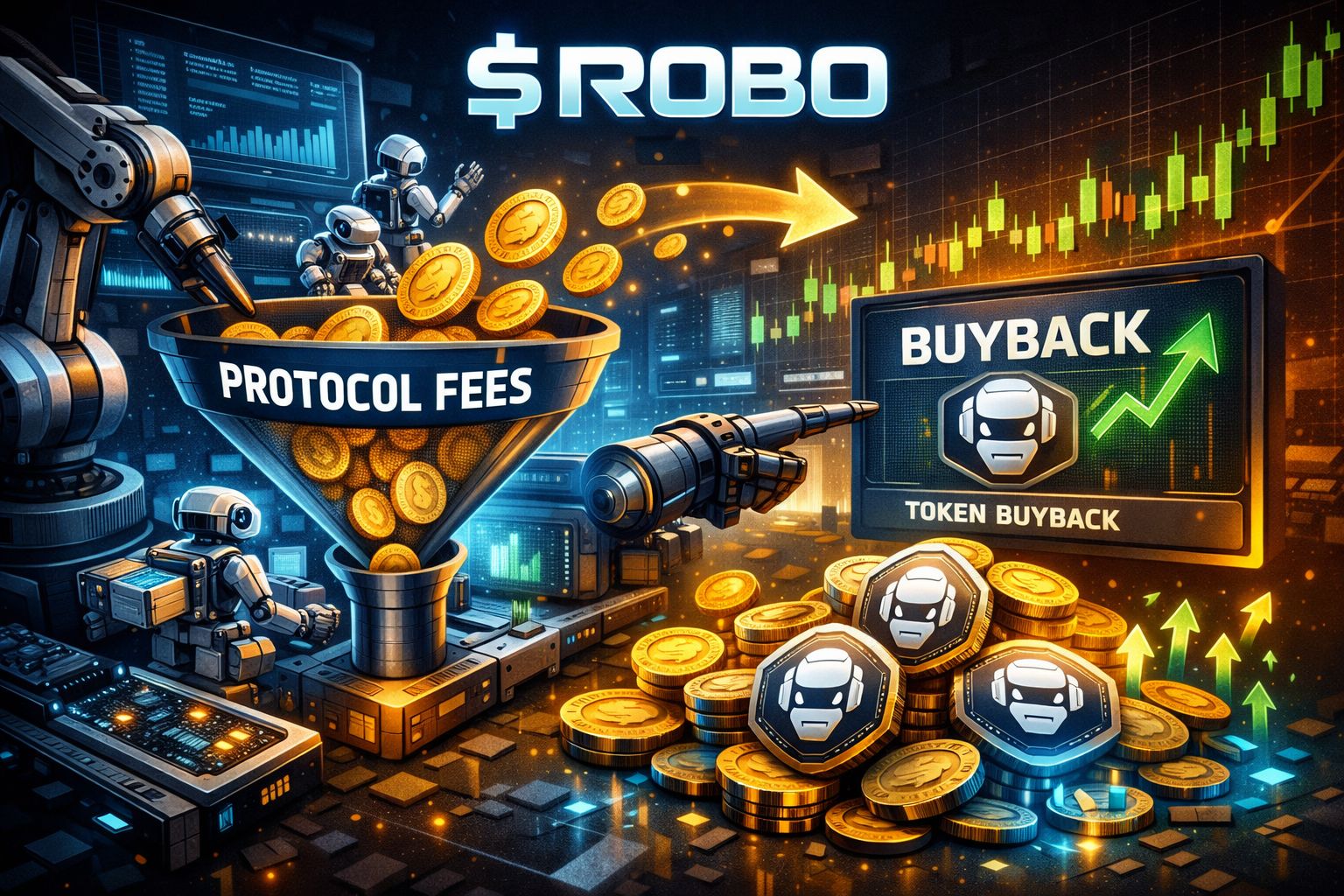
the protocol's revenues will be used for buybacks on the open market.
This is exactly where the most interesting things begin.
Because this detail radically changes the nature of the token.
$ROBO ceases to be just a 'governance token' — and transforms into an asset backed by buyback.
And we already know what's wrong with governance tokens:
the right to vote is not particularly needed by anyone,
there is no real demand,
the price is sustained by narrative and belief.
Here — another model.
If the protocol generates income →
this income goes to buyback →
buyback reduces supply →
pressure on the price becomes systemic rather than speculative.
At Fabric Foundation, everything is tied to real activity:
robots perform tasks → commissions are paid → protocol income is generated.
More machines → more tasks → more income → stronger buyback.
This is no longer a story about 'we believe / we don't believe'.
This is an attempt to build a closed economic model where demand is generated outside the crypto market — in the physical world.
And this is a key point.
Such a mechanism does not require constant emotional fueling.
It works if the network itself works.
But here lies the main risk.
If by 2026 the network does not reach a critical mass of connected devices —
all this logic will remain a beautiful theory.
Without real income, buyback is just an empty sound.
But if the model does launch…
these six words — 'protocol income buyback' — may turn out to be more important than everything else in the document.
The question remains open:
how sustainable and honestly designed do you think such a mechanism is?