

Last year, my junior helped a friend solve a problem in a digital transformation project. The situation was as follows: a Middle Eastern country wanted to promote the distribution of digital welfare. From identity verification to disbursing funds to post-audit, it took nine months. Identity verification was in one system, eligibility review in another, and funding records in a third. When issues arose, no one could clarify which link had gone wrong. At that time, I thought the problem wasn't a lack of people, but a lack of infrastructure that could allow the three systems to speak the same language.
These past few days, I have been studying @SignOfficial , which reminded me of this matter. There is a chapter in the S.I.G.N. white paper titled (Sovereign Infrastructure for Global Nations), which discusses: Money, ID, Capital, three systems, one proof language. Isn't this precisely what my friend needed most at that time?
Many people think of 'digital identity' as simply putting a scanned copy of an ID card on the blockchain; this understanding is off by an order of magnitude.
@SignOfficial The New ID System in the white paper follows the SSI (Self-Sovereign Identity) route.
The underlying standards are W3C Verifiable Credentials and W3C DID (Decentralized Identifiers).
What do these two things combined mean? It means that the citizen's identity credential is held on their own device, without needing to query a central database in real-time.
When the verifier receives your credential, it relies on cryptographic signatures for verification: confirming whether the issuing institution's DID is in the trust registry, checking if the VC's issuer signature is valid, and verifying the revocation status. The entire process does not require a phone call to the issuer to 'help me check this person's record', which represents a qualitative leap in both privacy protection and system decoupling.
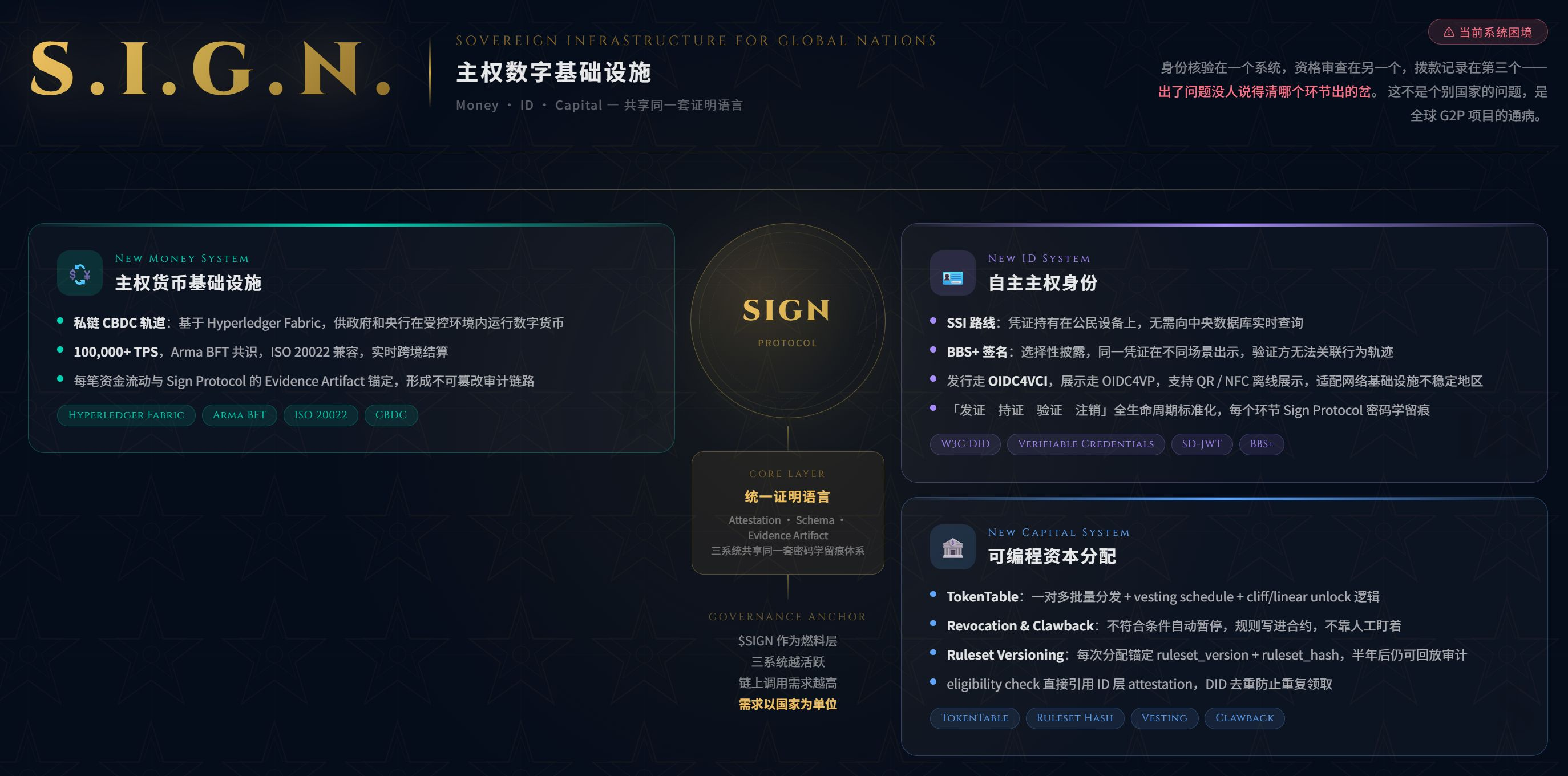
What's even more interesting is selective disclosure; the solutions supported in the white paper include SD-JWT VC and BBS+ signing schemes. The latter supports 'unlinked credentials', which means:
The same credential presented in different scenarios cannot be linked together by the verifier through associated session identifiers.
For example: a citizen applies for a subsidy, and the system only needs to know 'this person is between 18-60 years old and resides in Area A'. BBS+ allows them to prove just these two facts without exposing their complete birthdate or exact address; this is the cryptographic principle of minimal disclosure, not relying on 'trust us not to misuse it'.
The issuance protocol follows OIDC4VCI, the presentation follows OIDC4VP, and it also supports offline display via QR and NFC, which is especially critical in regions with unstable network infrastructure, as many remote areas in the Middle East have this demand.
Honestly, I believe the most perfect aspect of this ID system is that it standardizes the entire lifecycle of 'issuance-holding-verification-revocation' into a streamlined process, and each link has an Evidence Artifact anchored by the Sign Protocol.
Who verified what credential using what version of schema at what time, all traceable through cryptography, auditable and replayable. For government agencies that need to report to higher-level regulators, this is not a bonus, it is a necessity.
Not only that, traditional government subsidy programs have several classic bad issues:
The list of beneficiaries is not transparent.
Repeated Collection
Capital Tracking Disconnection
Post-Audit Relies on Manual Verification of Excel
This is not just an issue for individual countries; it is a common problem for global government G2P projects.
And @SignOfficial the New Capital System is redesigning this with programmable capital allocation. The core components are the TokenTable (allocation and execution engine) plus the Sign Protocol (proof anchoring layer).
What can TokenTable do?
Support for one-to-many bulk distribution
vesting schedule
cliff and linear unlock logic
revocation and clawback mechanisms
delegated claiming
These functions combined mean that the government can set 'this batch of subsidies will be released monthly to those who meet condition A, and will be automatically paused once they no longer meet the conditions'—the rules are written into the contract, not relying on manual oversight.
But more critically, it is ruleset versioning.
The white paper explicitly states that each allocation must anchor the ruleset_version and ruleset_hash, meaning that even if someone questions 'what standards were used to distribute this batch of funds' six months later, the rules version at that time can be replayed for auditing, and the rules themselves are immutable historical records. This provides hard guarantees against corruption and denial.
Adding the identity layer provided by the New ID System: each beneficiary's eligibility credential is a cryptographically verifiable VC, and during eligibility checks before allocation, it directly references the attestation reference address (eligibility_ref: attestation:0xabc...), with repeated claims relying on DID deduplication, eliminating the need to depend on 'manually matching ID card numbers' as a primitive method.
Personally, I feel that this system has great potential in the Middle Eastern context, as many countries are vigorously promoting digital economic transformation. Programs like government subsidies, entrepreneurial incentives, energy subsidies, and education vouchers are substantial, but the existing execution and auditing systems are generally lagging. The New Capital System does not mean 'you must first revolutionize', but rather 'you can continue using your current funds, but I will help you make the distribution process verifiable, fraud-proof, and auditable afterwards'. This approach faces much less resistance from the government.
But if we look at Money, ID, and Capital as three separate entities, each one actually has competitors. But@SignOfficial the truly irreplaceable aspect is that the three systems share the same proof language:
The Attestation and Schema system of the Sign Protocol.
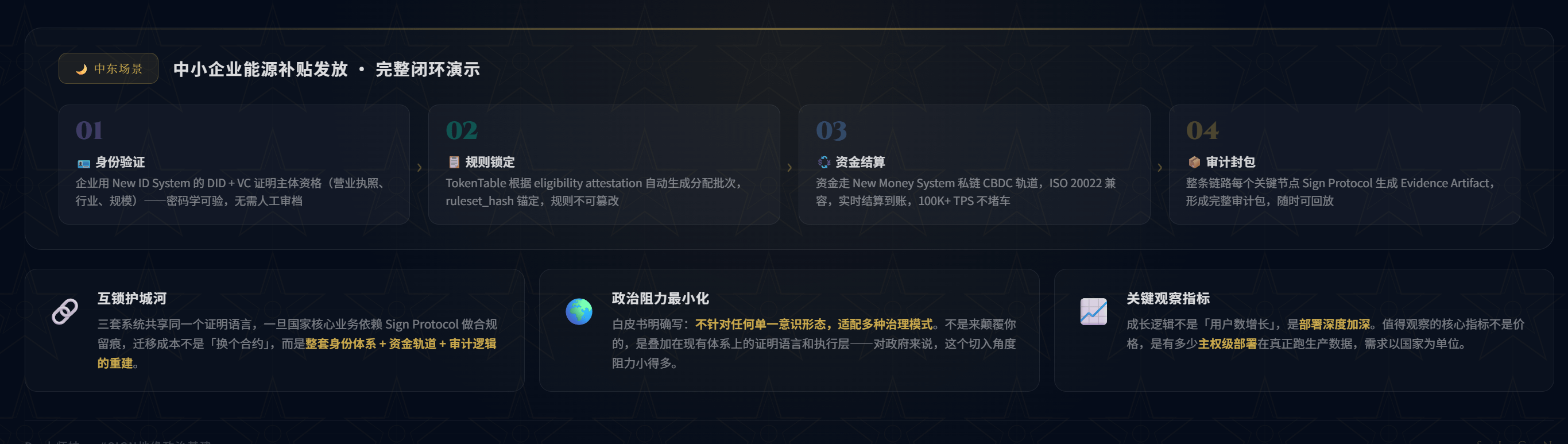
To illustrate how deeply this interlock is: a government in a Middle Eastern country wants to provide energy subsidies to eligible small and medium enterprises. The process is:
Businesses use the New ID System's DID + VC to prove eligibility (business license, industry type, scale)
The TokenTable of the New Capital System generates allocation batches automatically based on eligibility attestation, with ruleset hash anchoring.
Funds operate on the private chain CBDC track of the New Money System (based on Hyperledger Fabric, 100,000+ TPS, Arma BFT consensus, ISO 20022 compatible), with real-time settlement.
At each critical node of the entire chain, the Sign Protocol generates corresponding Evidence Artifacts, forming a complete audit package.
Once this complete closed loop is operational in a country, the migration cost cannot be solved by 'switching to a cheaper contract'; it involves the reconstruction of the entire identity system, funding tracks, and auditing logic. This depth of binding is what truly matters.
$SIGN The value becomes evident; it serves as a fuel layer and governance anchor point. The more active the three systems are, the greater the demand for on-chain Attestation, the more frequent the protocol calls, and the higher its hard demand becomes, relying on the daily operation of national-level systems!!! This is not small-scale, have you seen other projects whose demand is measured at the national level? No, right? I certainly haven't....
Interestingly, the design philosophy of S.I.G.N. is directly stated in the white paper: 'not targeting any single ideology, adaptable to multiple governance models'. This is quite an accurate positioning for countries that want both technological modernization and to firmly control data sovereignty. It is not here to subvert you, but to help you run your existing logic more clearly and credibly.
After studying for so long, I believe $SIGN that what has been hit is not a narrative window, but a structural infrastructure gap:
Many countries around the world are in the awkward stage of 'wanting to promote digital economic transformation but finding that the existing identity, payment, and capital allocation systems cannot communicate at all'. S.I.G.N. is specifically designed to fill this gap, and it does so not by building a large, comprehensive new platform for you to migrate to, but by providing a set of proof languages and execution layers that can overlay on existing systems, facing little political resistance and offering technical composability.
The growth logic of such projects is not 'user growth', but 'depth of deployment deepening'. Once a core business system in a country begins to rely on the Attestation of the Sign Protocol for compliance traceability, this dependency is more stable than any token lock-up mechanism.
I think the core metric worth observing next is not the price, but how many sovereign-level deployments are genuinely running production data. What do you all think?