
Hello Binancer~, I am KAMI.
The (Digital Asset Proof Act) promulgated by Saudi Arabia in 2026 is not just a piece of paper; it is a rule reconstruction for global capital entering the 'deep water zone' in the Middle East. When courts no longer accept paper contracts as the highest evidence and only recognize digital contracts with 'on-chain proof anchor points,' @SignOfficial $SIGN 's identity has magnificently transformed from a cryptographic protocol to a digital notary office.
Many people think this is just another victory for bureaucracy, but from those obscure legal clauses, I smell a huge judicial arbitrage space...
In Riyadh in 2026, if you are still trying to complete a $500 million FDI (Foreign Direct Investment) through traditional legal due diligence, you have already lost at the starting line.
With the implementation of the (Digital Asset Proof Act), the Saudi Ministry of Justice has officially launched a blockchain-based 'Digital Court.' This means that trust is no longer explained by lawyers' words but adjudicated by the proof (Attestation) of the code.#Sign地缘政治基建
1. 'Legal friction' is the most expensive tax in 2026.
In the past, when I was doing cross-border settlement of bulk commodities, the most troublesome thing was the back-and-forth of lawyer letters. If you have a $500 million project in Riyadh, once there is a problem with the contract, traditional judicial procedures can make you wait in the desert for two years.
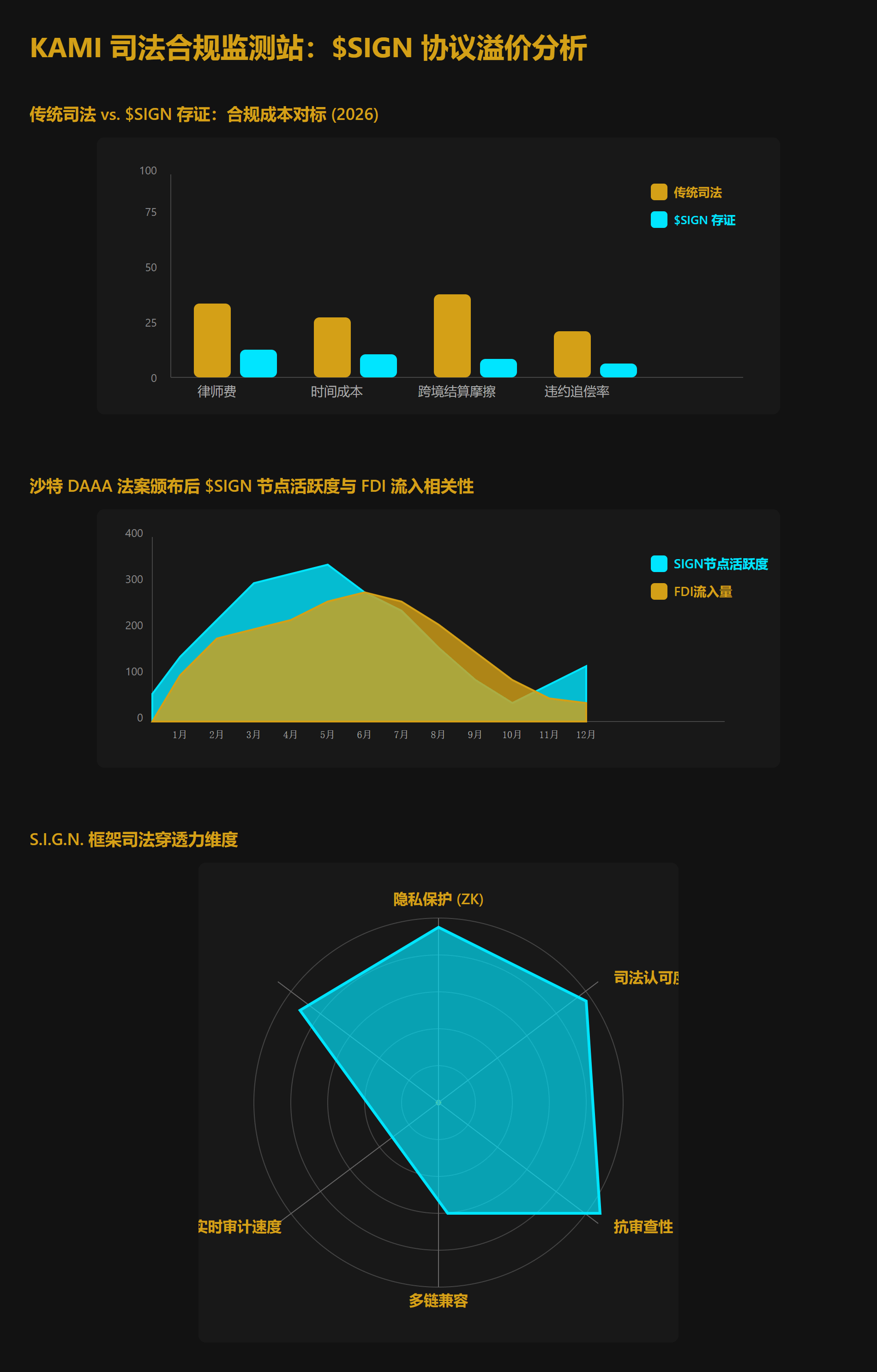
But the S.I.G.N. Framework of SIGN is simply a 'cheat code.' It directly encodes the 'judicial effectiveness' required by the DAAA Act. This is no longer just a simple Web3 protocol; it is the Bretton Woods system of the digital age. The current arbitrage logic is simple: whoever first uses SIGN to 'seal' the contract saves that damn 5% lawyer fee and 24 months of opportunity cost.
SIGN creates a perfect 'judicial arbitrage space' here: through it, enterprises can complete compliance proof at the moment of signing.
When disputes arise, the smart contract directly calls the proof snapshot on the SIGN node. This 'zero-delay adjudication' reduces friction costs by more than 80%. This sudden drop in costs is essentially a form of risk-free liquidity premium.
2. Only ZK can enable the Saudi royal family to shake hands with Wall Street.
Everyone knows that in 'deep water zone' investments, the greatest fear is the leakage of bottom cards due to excessive transparency. SIGN's ZK-Attestation has been a big help. I discovered last week while testing a compliance interface that it can 'prove I am compliant, but never tell you how much money I have in my account.' This privacy isolation is the only reason sovereign funds (PIF) dare to move trillions of assets onto the chain. Those still advocating for fully transparent proof protocols can really go to sleep.
3. Stop looking at PNL, focus on the 'trust premium.'
Currently, several NEOM projects supported by the Saudi Public Investment Fund (PIF) have begun to mandate the use of SIGN for asset confirmation. In my quantitative model, the value growth formula of SIGN can be represented as:
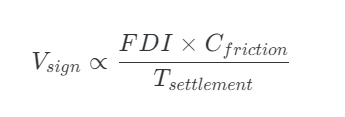
Among them, institutional friction costs are being transformed into protocol revenue under the push of the Act. When code becomes the only 'Great Judge,' $SIGN is not just a token; it is the digital sovereign tax revenue channel of the 40 trillion economy in the Middle East.