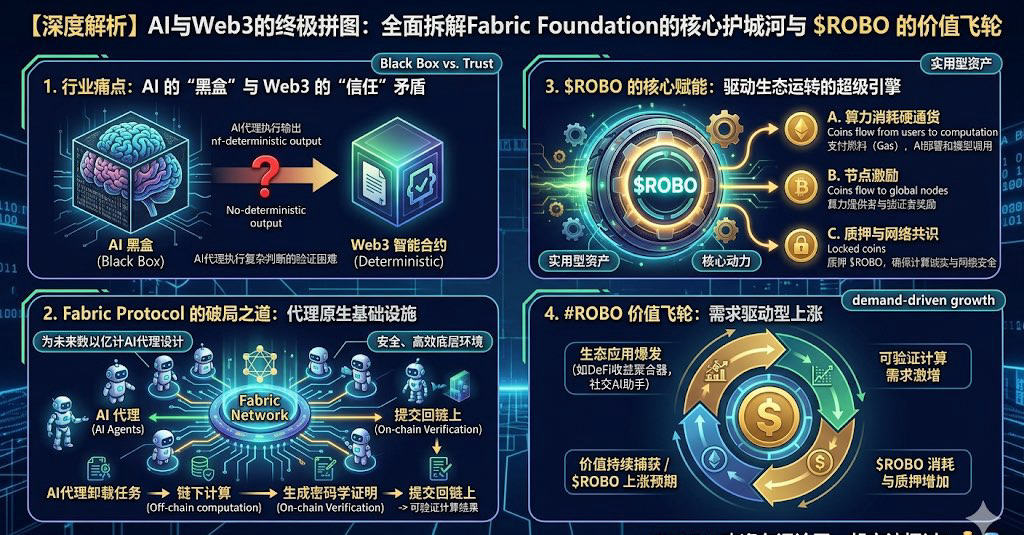
Standing at the year 2026, #ROBO if there is any track in the crypto market that has the potential for exponential growth, it must be 'AI + Web3'. However, with the tide of many conceptual projects receding, the market is returning to rationality, and funds are frantically searching for truly robust infrastructure supported by fundamental hardcore technology. Against this backdrop, I have recently focused on @Fabric Foundation in my in-depth research, and today I will detail why I believe it could become the cornerstone of the next generation value internet.
1. Industry Pain Points: The contradiction between AI's 'black box' and Web3's 'trust'
We all know that the execution of smart contracts is deterministic, while the current mainstream AI large models are like a 'black box', making it difficult for the decentralized network to directly verify their computational processes. If we want AI agents to freely manage assets, execute high-frequency trading, or make complex logical judgments on the blockchain, we must solve a core issue: how to prove that the results given by AI are real, reliable, and unaltered?
This is precisely the ultimate pain point in the industry that @FabricFND aims to solve.
2. The breakthrough path of Fabric Protocol: Proxy native infrastructure
Unlike ordinary decentralized computing projects on the market, Fabric Protocol's positioning is extremely precise and grand—it is a globally open network built with the support of the Fabric Foundation, focusing on providing 'verifiable computation' and 'agent-native' infrastructure.
What is agent-native? This means that Fabric is designed from the ground up specifically to serve billions of AI agents in the future. Through Fabric's network, AI agents can securely offload heavy computational tasks (Off-chain computation) and submit cryptographic proof of computation results back on-chain upon completion. This not only breaks the performance bottleneck of the blockchain itself but also endows smart contracts with unprecedented 'intelligence' and 'trust'.
3. Core Empowerment: The super engine driving ecosystem operation
In a decentralized network, no matter how strong the technology, a perfect economic model is needed to drive it, and it is the soul of the Fabric ecosystem. It is not just a governance token but also a practical asset deeply rooted in the entire network's bloodstream:
• Hard currency of computational consumption: In the future, whether developers deploy AI agents or users call complex off-chain computing models, they will need to consume 12345678901 to pay for gas. The more frequently the network is used, the greater the token consumption.
• Incentives for nodes and validators: Global computing power providers and validating nodes maintain network security by contributing hardware resources and generating verification proofs; they will receive substantial block rewards.
• Staking and Network Consensus: To ensure the honesty of computation results, nodes participating in the network must stake. This mechanism not only locks a large amount of the market circulation but also gives the token the value of a secure moat.
4. Summary and Market Outlook
In the current cryptocurrency market, the era of purely speculative concepts has passed. What #ROBO relies on is addressing the rigid demand for the integration of AI and smart contracts. As more and more Web3 native AI applications (such as automated DeFi yield aggregators, decentralized social AI assistants, etc.) connect to the Fabric network in the future, we will welcome a truly 'demand-driven' upward flywheel: explosion of ecological applications ➔ surge in demand for verifiable computation ➔ consumption and staking increase ➔ reduction in market circulation ➔ continuous value capture.
For investors, finding quality targets with a long-term moat is key to navigating bull and bear markets. The solid technical foundation of the Fabric Foundation combined with a highly potential economic model is definitely worth our long-term strategic attention.
What do you think about the potential of 'verifiable computation' in this cycle? Do you believe #ROBO can stand out in the AI infrastructure track? Feel free to leave your insights in the comments section, and let's discuss together!