
At first, I thought DUST was just a gas token with a cooler name.
But reading the whitepaper of @MidnightNetwork closely reveals a completely different story.
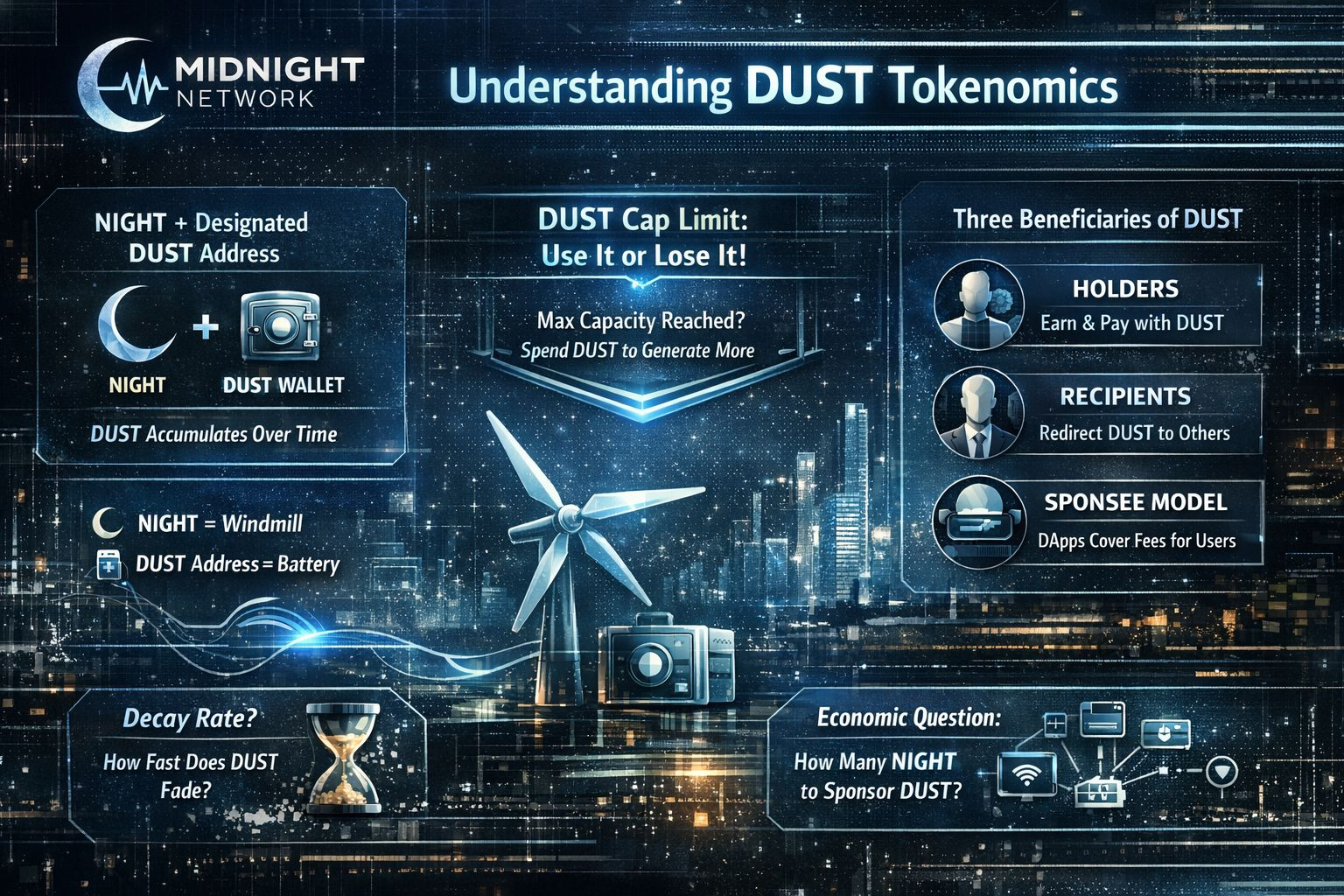
First is the mechanism for creating DUST.
Holding NIGHT does not automatically mean you will have DUST in your wallet. Holders must create a designated DUST address and link it to the amount of NIGHT they hold. Only then does DUST begin to accumulate over time.
The whitepaper provides quite an interesting example.
NIGHT is like a windmill.
DUST address is like a power bank pin.
Time is wind
Without wind, the pin cannot charge.
One detail I find interesting is that each address has a maximum DUST limit.
That is to say, when it is full, no matter how much more NIGHT you hold, it will not generate more DUST. To create more, you must use some DUST.
This design clearly wants to limit circulation rather than allow hoarding.
But the least talked about part is the 3 types of beneficiaries of DUST:
Type 1 is holder
The simplest way. Hold NIGHT to receive DUST and pay transaction fees yourself.
Type 2 is recipient
NIGHT holders can redirect DUST to another wallet. The recipient does not need to hold NIGHT to still have gas to use.
Type 3 is sponsee
This is what I find noteworthy.
dApp operators can pay all transaction fees for users with their DUST. Users only interact with the app, do not need to know what NIGHT is, and do not need a crypto wallet.
For enterprises, this is almost a mandatory condition.
I have talked to several Vietnamese businesses about blockchain. The question is always
“Do our employees have to buy crypto to pay fees?”
Just that sentence alone is enough for many projects to fail at the starting line.
The sponsee model of @MidnightNetwork seems to solve that issue.
But I still have a few concerns:
First is the decay rate of DUST.
When the NIGHT and DUST addresses are disconnected, the amount of DUST will decay linearly over time. However, the whitepaper does not specify the decay rate.
If the decay is too fast, average users will be at a disadvantage because they do not trade frequently.
If the decay is too slow, then the anti-hoarding mechanism is almost meaningless.
The second point is the economic problem for the operator.
For example, Pairpoint builds an IoT application and sponsors DUST for millions of devices
To create enough DUST, how much Night do they have to hold?
Currently, no public model exists for this number.
Personally, I find the design of DUST quite elegant.
But everything on paper looks good. We have to wait for real data from the mainnet to know how it operates.
I will continue to monitor Midnight when the network has more activity.
What do you think is a reasonable decay rate to set for $NIGHT ?
