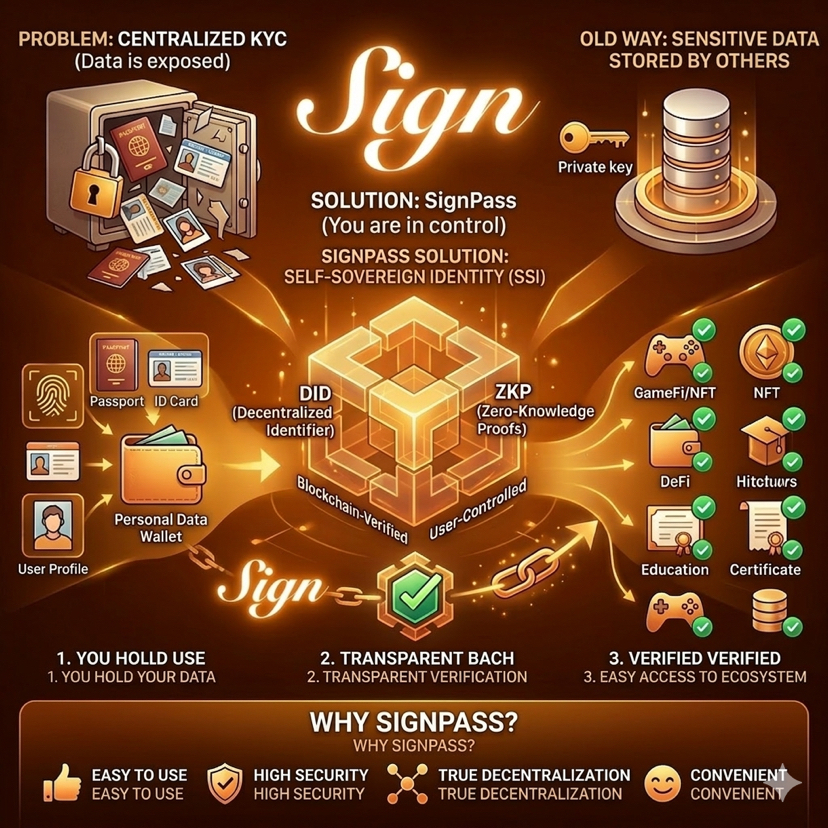
Web3 promises you control over your identity. But every time you do KYC… you're sending it to someone else to hold? Decentralized… but the data is still centralized?
Honestly, I've done KYC 5 times for 5 different platforms, and each time I go through KYC, there's another round of anxiety because hearing about personal information leaks is no longer unusual.
Each time I upload documents, it's a gamble. I feel a bit nervous about it.
And that's when things like SignPass appeared
Simply put: SignPass is still identity verification but does not require revealing all information. It belongs to the ecosystem @SignOfficial – like a kind of infrastructure for digital identity on the blockchain.
What I find most noteworthy is: You keep the data, not the platform, no need to upload all documents again every time you register, no more situation: every time you register = resend all info. Hearing this makes me feel... lighter already
So how does SignPass protect you?
With SignPass, your identity is directly linked to you through DID, protected by a private key that only you hold, and all verifications are recorded on a transparent blockchain, no one can alter it.
In fact, this area is not new, because before there was:
. Civic → has been around for a long time, but adoption is unclear
. Hyperledger Aries → powerful, but quite “hard to play” with developers
. Zyphe → leans towards enterprise
. SignPass chose a different direction: Not the latest technology — but easier to use, and this is the bigger issue of Web3. Web3 lacks great ideas. It lacks real users.
But I ask myself a big question: practical application – can it be used? This is the biggest scoring case here:
Some quite reasonable use cases:
DeFi: No need to KYC repeatedly 10 times, reducing the risk of data exposure each time you register
Game / NFT: Anti-bot (a huge headache), making the whitelist “better”
More than (still a bit “on paper”): Degree number, national identity, 1 identity used for many platforms
Sounds very smooth but adoption is still a big question mark
What is $SIGN token for?
Not just for trading. Users pay verification fees in SIGN, service providers are rewarded creating economic incentives for the system. But I must say clearly: Tokens only have value when there are real users, without adoption it can easily become a narrative token
So is DID really the future?
In Web2: You live thanks to Google, Facebook
In Web3: You own your own identity. Sounds great but in reality: UX is still difficult, average users are not interested. DID like SignPass could be an important piece but may not be the thing that explodes right away
I see SignPass as a quite reasonable direction: Solving real problems (KYC, data), trying to simplify the experience, having tokens to bootstrap the ecosystem
But in the end, it still comes back to 3 questions:
Is there any project really using it?
Do users find it more convenient?
Can it overcome the UX of Web3? Web3 is not lacking in great ideas. The biggest lack is still real users. What do you think?
Web3 does not lack technologies to protect identity. What is lacking is users who trust enough to give their identity to it
I lean towards: potential but not enough. How do you feel about this new project?
$SIGN #SignDigitalSovereignInfra #BinanceSquareCreator