
In our Pilot, you saw Ethereum as a powerful Gateway to Adoption. But what keeps this gateway from getting blocked by the pressure of millions of transactions while maintaining low fees? It's thanks to Layer 2 (L2).
Their role in the ecosystem is crucial: they process operations cheaply and quickly off the main chain (off-chain), and then send a bundled, cryptographically secured report for validation on the Ethereum Mainnet.
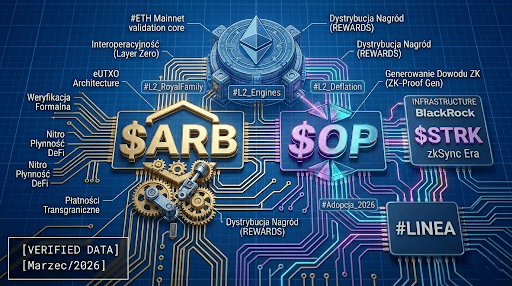
In March 2026, the united 'Royal Family' sits on the L2 throne:
Arbitrum ($ARB ): The king of liquidity and DeFi.
Optimism ($OP): The architect of the Superchain.
Linea: The power of ZK from the creators of MetaMask.
Starknet ($STRK): A mathematical genius.
Polygon ($POL ): A multifunctional giant.
A deeper look: Two paths to one goal
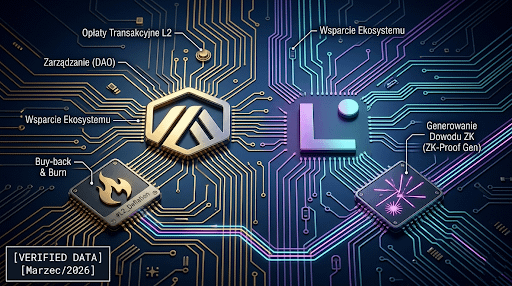
Although these projects serve for scaling, they differ in technology. Arbitrum ($ARB) uses Optimistic Rollup, assuming the correctness of transactions until someone reports an error. On the other hand, Linea relies on ZK-Rollup, where each data package is mathematically proven instantly.
Beyond technology, economics is key. In the Arbitrum model, there is a 'Buy-back & Burn' mechanism – part of the network fees is used to burn $ARB tokens, creating deflationary pressure.
Curiosities
Fact 1:
Arbitrum does not have its own validators – all security is derived directly from the decentralization of Ethereum.
Fact 2:
Linea is seamlessly integrated with MetaMask, making the transition to L2 unnoticed for newcomers.
Summary
Layer 2 is today an integral part of the ETH architecture. Thanks to them, Ethereum is becoming a futuristic metropolis of finance.
#L2 #Linea #Web3education #Layer #Zeroknowledge @Arbitrum Foundation @Linea.eth $LINEA