
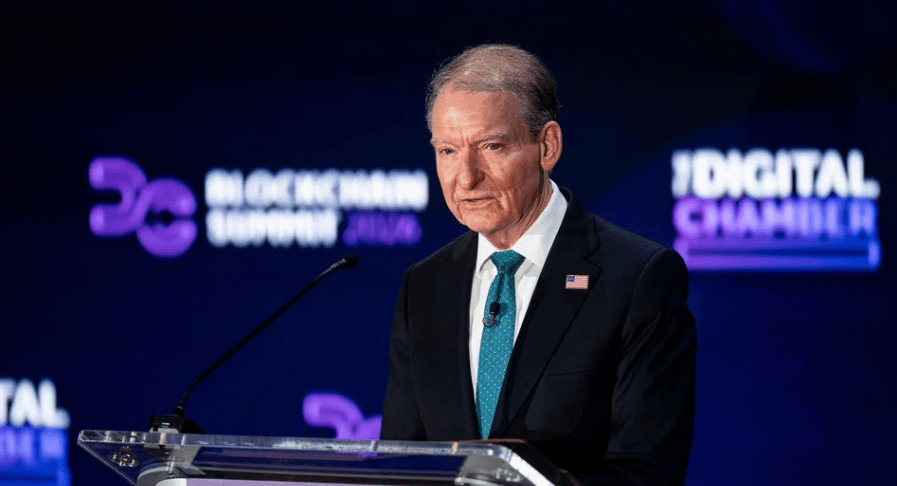
On March 17, 2026, Paul Atkins, the Chairman of the SEC, delivered a keynote speech titled (Regulation Crypto Assets: A Token Safe Harbor) at the DC Blockchain Summit in Washington, D.C. This speech is viewed by the market as a "watershed moment" in the history of cryptocurrency regulation, marking the SEC's official shift from the "regulation by enforcement" of the Gensler era to "guiding development through transparent rules."
Breaking the situation where "everything is a security"
Atkins clearly stated that the SEC is no longer the "Securities and Everything Commission" and, together with the CFTC (Commodity Futures Trading Commission), issued new interpretive guidance that categorizes crypto assets into five categories, of which the first four are generally not considered securities:
1. Digital goods: such as Bitcoin, Ethereum, etc.;
2. Digital collectibles: such as NFTs.
3. Digital tools: utility tokens with actual utility.
4. Payment stablecoins: stablecoins defined by the (GENIUS Act).
5. Digital securities: traditional securities that have been tokenized.
"Crypto asset" safe harbor program
Atkins proposed establishing a brand new 'safe harbor' mechanism to provide innovators with a compliant 'starting line':
1. Allow project parties a 'regulatory buffer period' of several years to raise funds and develop technology before reaching 'decentralization,' without immediately incurring heavy securities compliance costs.
2. Acknowledge that the attributes of assets are evolving. A token may initially involve an investment contract, but once the development team ceases 'core management efforts' and the network achieves decentralization, it no longer qualifies as a security.
End 'Enforcement-Driven Regulation'
Atkins stated in his speech: 'We have taken too long to diagnose the problem; now it is time to deliver solutions.' He emphasized that the SEC should draw a clear line rather than intimidate the industry through vague legal actions.
Call for Congressional legislation
Although the SEC is actively relaxing its grip, Atkins emphasized that only Congress, through market structure legislation such as the (CLARITY Act), can fundamentally ensure the long-term stability of the regulatory framework and prevent future 'regulatory overreach.'
The following is the full text of the speech (excerpted):
I am pleased to discuss a topic today that sits at the intersection of American innovation, capital formation, and the long-standing principles of securities law.
For more than a decade, market participants have been operating in an environment lacking clear guidance, continually grappling with a fundamental question: Under what circumstances do crypto assets trigger the applicability of federal securities laws?
Today, I am pleased to announce that the SEC’s long-standing failure to provide clarity on this issue has ended. At this moment, the committee is advancing a classification system for tokens and a framework for interpreting 'investment contracts.'
Our interpretive framework is grounded in existing law and incorporates a broad range of public input, establishing four categories of assets that are not considered securities: digital goods, digital collectibles, digital tools, and payment stablecoins as defined by the GENIUS Act.
After establishing the above categories, the explanation further clarifies: The only category of crypto assets still subject to securities laws is digital securities, which are traditional securities that have been tokenized. This distinction brings the committee back to its core mission and statutory authority, which is to protect investors participating in securities transactions.
In fact, the proposal I will discuss today, which is my vision for the (crypto asset regulatory framework), I think many present are tired of hearing about the 'harm of uncertainty' again and again. Frankly, so am I.
In my view, what a 'safe harbor' proposal could encompass. Such a safe harbor would provide a tailored financing pathway for crypto innovators in the U.S., while also giving investors appropriate protections.
First, I believe the committee should consider establishing a 'startup exemption' for 'adapted use,' specifically for investment contracts involving certain crypto assets, granting a time-limited registration exemption.
Such exemptions could set a certain time limit, providing developers with a regulatory buffer period to mature their projects. Importantly, this exemption could be designed non-exclusively, meaning that other available exemption arrangements under federal securities laws for financing could still apply.
This exemption would also allow entrepreneurs to raise funds up to a certain limit over a four-year period and require them to submit notifications to the commission when relying on this exemption and when exiting it.
Secondly, what I envision is that the committee could consider establishing a 'financing exemption' as a new type of issuance exemption applicable to investment contracts involving specific crypto assets. During any continuous 12-month period, entrepreneurs could raise funds up to a certain limit while retaining the ability to continue using other registered exemption arrangements under federal securities laws.
Third, I hope the committee will consider establishing an 'investment contract safe harbor,' which grants a safe harbor arrangement that separates certain crypto assets from the definition of 'securities.' This safe harbor could apply once the issuer has completed, or otherwise permanently ceased, all key management efforts that they have stated or promised to undertake under the investment contract.
What I envision here is a safe harbor that provides clear standards based on rules, allowing issuers and other market participants to more confidently determine under what circumstances a crypto asset is no longer subject to federal securities laws.
As we look ahead to the next chapter of American economic history, we should remember that what has truly made America exceptional is not merely the size of its market or the sophistication of its financial institutions, but rather our willingness to trust individuals with the freedom to innovate, to let them take risks, and to build new systems that can expand opportunities for others.
Our securities laws were originally designed to amplify this vitality, not to suppress it. As regulators, we must ensure that our rules remain faithful to the original intent of inspiring these principles.
If we can achieve this, then the next generation of entrepreneurs will no longer need to ask: Is innovation possible in America? They will clearly know that the answer is yes; and they will build the future here.