
Breaking news: The U.S. Securities and Exchange Commission and the Commodity Futures Trading Commission issue a new regulatory framework for digital assets: Classification of 16 cryptocurrencies as "digital commodities"
Date: March 19, 2026
Prepared by: [Sniper]
The world of cryptocurrencies witnesses a historic event on Thursday, March 19, 2026, as the U.S. Securities and Exchange Commission (SEC) in collaboration with the Commodity Futures Trading Commission (CFTC) issues a new interpretive document that, for the first time, establishes a clear and comprehensive regulatory framework for classifying digital assets.
This step comes to put an end to a long era of regulatory ambiguity that lasted for more than a decade, which primarily relied on pursuing projects and violators instead of providing clear rules for all. In this detailed report, we will highlight the main components of this new framework and how it will affect the future of the market.
Firstly: The new five-tier classification of digital assets
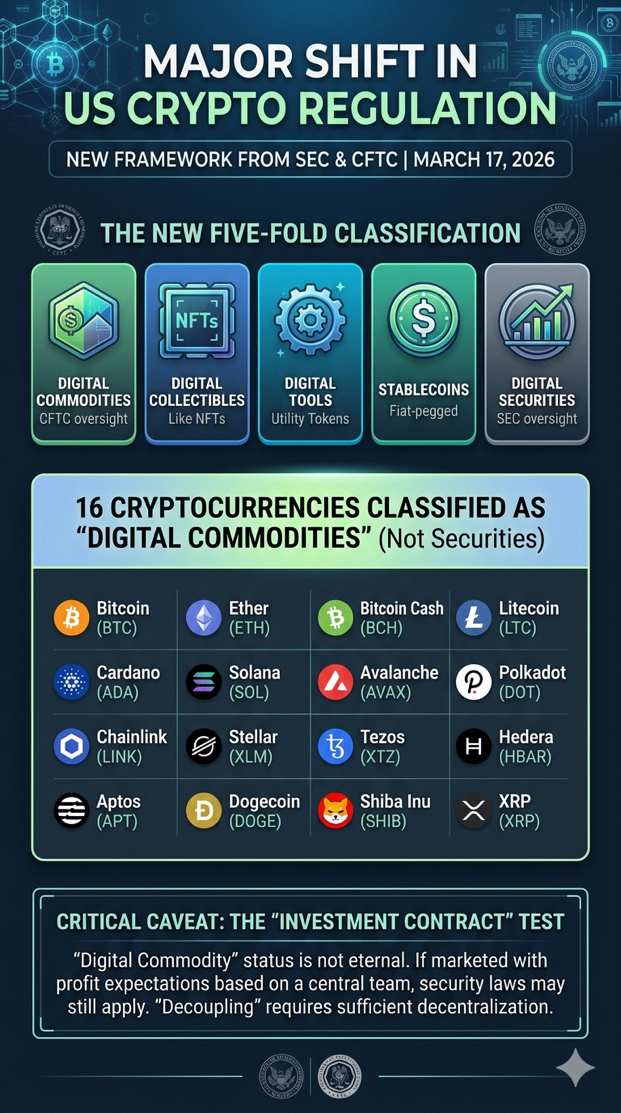
The new explanatory document divides digital assets into five main categories, each specifying the responsible regulatory body and applicable legal standards. These categories are:
1. Digital Commodities: These are decentralized digital assets that are not controlled by a single entity and do not grant their holders traditional financial rights like dividends or shares. They are overseen by the Commodity Futures Trading Commission (CFTC).
2. Digital Collectibles: This includes non-fungible tokens (NFTs) and currencies whose value is based on rarity and demand, such as meme coins.
3. Digital Instruments: These are tokens that grant their holders access to a specific service or application within a digital ecosystem, such as membership tokens or event tickets.
4. Stablecoins: Cryptocurrencies designed to maintain a stable value linked to an external asset like the dollar, and are subject to specific laws like the GENIUS Act.
5. Digital Securities: These are digital assets that essentially represent traditional securities like stocks or bonds, and are overseen by the Securities and Exchange Commission (SEC).
Secondly: The official list of currencies classified as 'Digital Commodities'
In a long-awaited step, the document revealed a list of 16 major digital currencies officially classified as 'digital commodities', meaning they are no longer under the direct regulatory oversight of securities laws. The list is as follows:
Number Currency Name Symbol
1 Bitcoin BTC
2 Ethereum ETH
3 Solana SOL
4 Ripple XRP
5 Cardano ADA
6 Polkadot DOT
7 Avalanche AVAX
8 Chainlink LINK
9 Dogecoin DOGE
10 Shiba Inu SHIB
11 Litecoin LTC
12 Aptos APT
13 Hedera HBAR
14 Stellar XLM
15 Tezos XTZ
16 Bitcoin Cash BCH
The document also indicated that other currencies like ALGO and LBC also fall under this category.
Thirdly: The concept of 'Separation' – When does a digital asset turn into a commodity?
The concept of 'Separation' is one of the most important legal innovations in this document. According to this concept, a digital asset can 'graduate' from being a security (at the initial funding stage) to a digital commodity (once the project becomes decentralized).
This separation occurs in the following cases:
· Roadmap Completion: When the founding team fulfills its commitments and the network operation becomes community-driven.
· Developer Abandonment: If developers officially announce their abandonment of the project and cease its development.
· Trading in the Secondary Market: When buyers in the secondary market do not rely on the efforts of a central team to make profits.
Fourthly: Clarifying the legal status of key on-chain activities
The document provided clear and reassuring explanations for the daily activities carried out by millions of users around the world:
1. Mining: The authority confirmed that mining digital currencies, whether individually or through pools, is not considered an activity subject to securities laws.
2. Staking: The document clarified that the staking process, whether directly or through brokerage platforms (as long as there is no discretionary action with the assets), is purely an administrative activity and does not constitute an offering of a security.
3. Wrapping: If the underlying asset is a digital commodity, then the process of wrapping it for use in other applications does not transform it into a security.
4. Airdrops: In a positive gesture, the authority confirmed that airdrops to users without compensation do not constitute a securities offering, as long as the recipient did not provide money or service in exchange for the tokens.
Fifthly: Why is this development important?
· For projects: Startups now have a clear roadmap for legal compliance, transitioning smoothly from the 'security' stage to 'digital commodity'.
· For exchanges: These classifications provide greater legal protection for exchanges when listing digital currencies, which may encourage the return of many currencies that were previously delisted due to regulatory concerns.
· For investors: The era of ambiguity ends, allowing investors to understand the legal risks associated with each asset more clearly, paving the way for more major financial institutions to enter the market.
· For the market as a whole: It puts an end to the era of the 'Wild West', establishing a new era of organized and sustainable growth in a clear rules environment.
 ---
---
In summary: This explanatory document shared between the SEC and CFTC represents a pivotal moment in the history of digital currencies. It not only provides a clear classification for currencies like BTC, ETH, XRP, and SOL as digital commodities but also lays the foundations for a more mature and stable industry in the coming years.
Sniper