

If the bottleneck of AI is computing power
Then the bet made by Oklo, heavily led by OpenAI founder Sam Altman, is that the end of computing power is energy, and the end of energy is nuclear energy
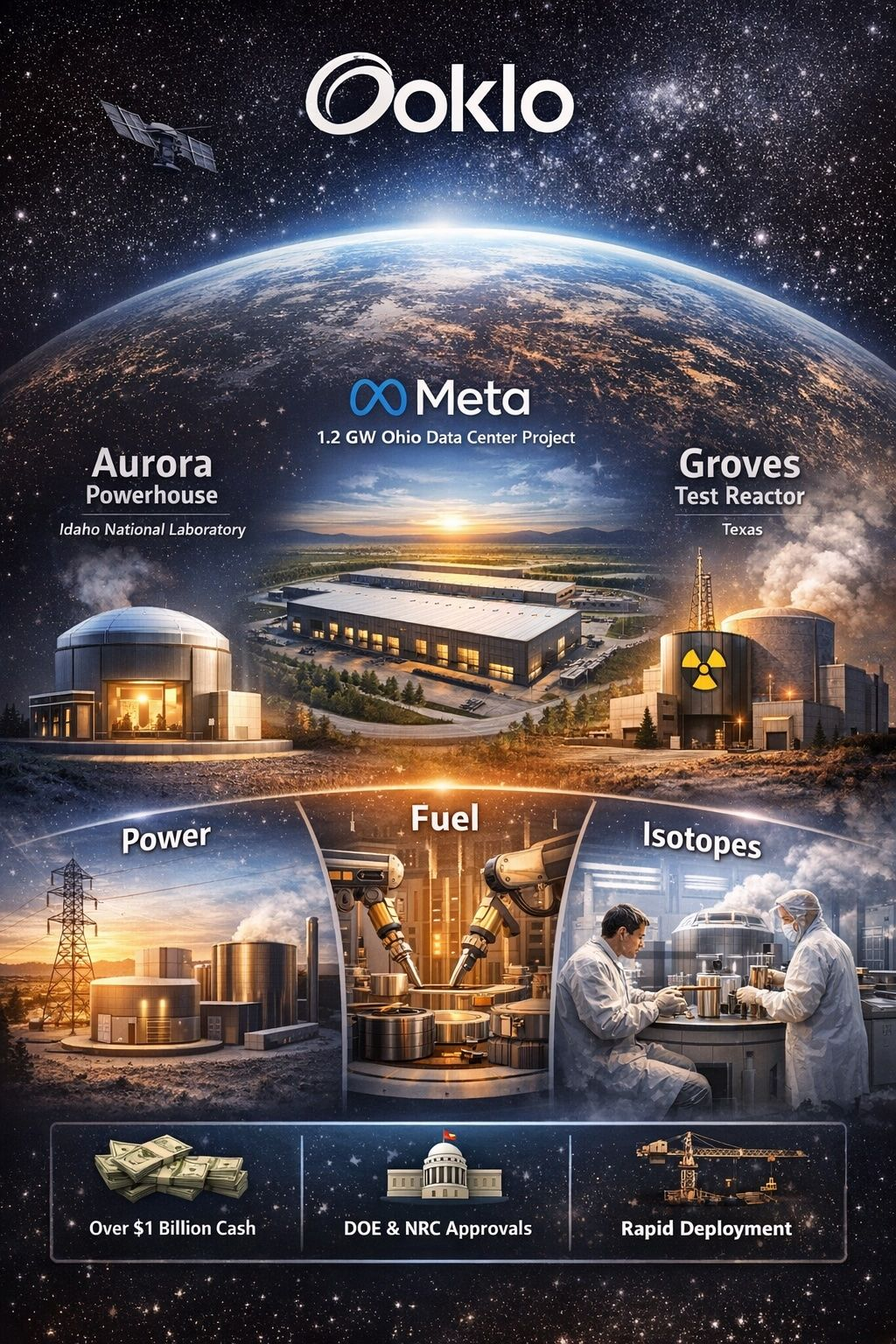
then Oklo in 2025 officially shifts from 'designing reactors' to 'deploying nuclear power assets + building a closed-loop nuclear industry chain'.
The core actions are very clear:
·Initiate the construction of the first reactor in Aurora, Idaho (from 0 to 1)
·Signed a prepayment agreement for a 1.2GW clean energy park with Meta (locking in long-term demand)
·Acquire Atomic Alchemy (to strengthen isotope capabilities)
·Simultaneously promote the infrastructure of fuel, recycling, and isotopes on multiple fronts
One, business model: the nuclear version of 'Tesla + TSMC'?
Oklo's core is not a single reactor, but three major business loops:
· Power: Aurora power station → selling electricity (similar to long-term PPA)
· Fuel: manufacturing + recycling → solving the bottleneck of nuclear fuel supply
· Isotopes: high-value-added by-products → medical/industrial/national defense
The key to this model is:
Reconnecting the 'disjointed chain' of the traditional nuclear industry into a closed-loop system.
Looking deeper:
· Electricity = cash flow
· Fuel = control costs & position the supply chain
· Isotopes = profit elasticity
This is actually no longer the logic of traditional power companies, but rather: platform-type energy companies.
Two, the biggest change: demand has been locked in (Meta is key)
The biggest concern in the past was: whether anyone would buy small modular reactors (SMR)?
Now the answer is becoming clearer:
· Meta directly signs a prepayment agreement (not a regular intention)
· Project scale: 1.2 GW (far exceeding pilot level)
· Initial capacity of about 150 MW, aiming for deployment around 2030
The focus is not on scale, but on structure—this is a new type of nuclear power business model.
Not waiting to sell electricity after construction, but having customers bind first + pay in advance.
Essentially similar: 'data center + integrated power infrastructure'
Three, technical route: why sodium-cooled fast reactors
Oklo has chosen sodium-cooled fast reactors instead of mainstream light water reactors.
The core advantages actually boil down to three points:
1️⃣ More flexible fuel (even recyclable fuel can be used)
2️⃣ Higher safety (low-pressure system)
3️⃣ Stronger thermal efficiency (suitable for industry + data centers)
Additionally: the U.S. has a large amount of 'spent fuel inventory' (90,000 tons)
This means: Oklo is essentially doing 'energy re-extraction.'
Four, the most underestimated point: the 'construction speed' of nuclear power is being rewritten
Traditional perception: nuclear power = 10-year cycle + extremely high cost
But what Oklo is doing is: Groves isotope reactor—completing construction + starting verification path within 10 months
If this model holds: the core constraints of nuclear power (time & CAPEX) will be completely rewritten, which is one of the reasons the market is beginning to reprice SMR.
Five, finance: a typical 'heavy capital early stage'
The data for 2025 itself is not complex:
· Operating loss: $139 million
· Cash consumption: approximately $70 million (within guidance)
· Year-end cash and securities: $1 billion
· Early 2026, refinancing: $1.1 billion
The current state is very typical: no revenue yet, but accelerating towards reactor assets.
The key is not in profit, but in: whether the funds are sufficient to support the first batch of projects going live
Currently: no short-term financing pressure, mid-term will shift to 'project financing'
Six, the truly core variable: policy cycle
Nuclear energy cannot be separated from policy.
In 2024-2025, a key change in U.S. policy: from 'support' to 'promote execution'
Including: accelerated approval—tax credits—DOE loans—fuel independence strategy
This means: Oklo is not a single point company, but 'a part of a national-level industry.'
Seven, the most important judgment
Oklo is transitioning from: 'nuclear technology company' to 'nuclear power asset operator + platform company.'
But what the market really needs to price is:
1. Can Aurora be delivered on schedule (2028 is a key node)?
2. Whether the Meta model is replicable
3. Whether the construction cycle of nuclear power has truly been compressed