
#098-2026.03.17
Event Overview
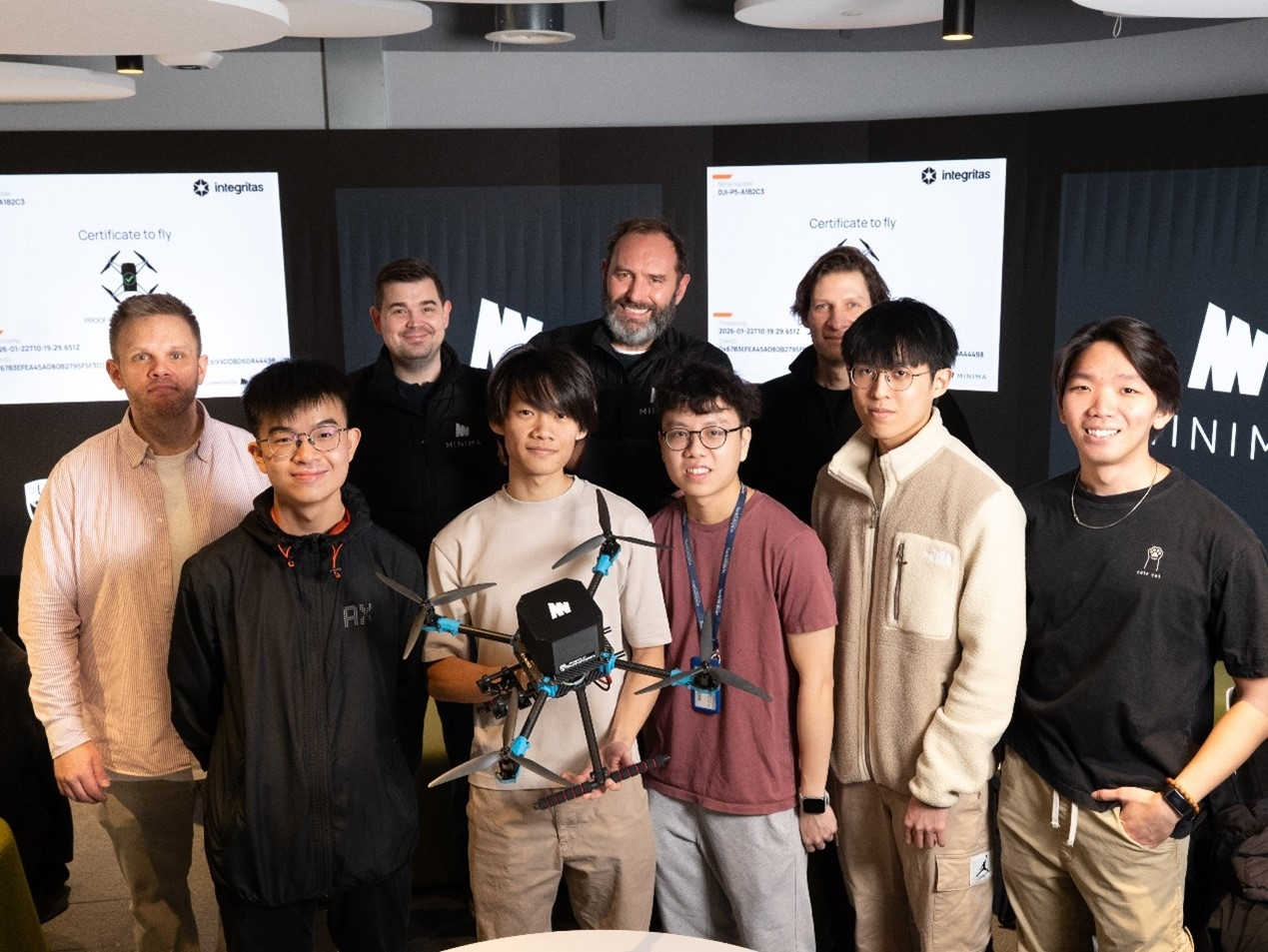
Students engineers from the University of Southampton achieved a historic breakthrough on March 4, 2026, successfully recording critical operations and sensor data on the blockchain during a drone's real-time flight, creating a secure and tamper-proof activity log. The system uses the Minima blockchain protocol, with each device running a full blockchain node, data stored locally but verifiable by everyone on the network.
This is the first time a complete verification system has been run during real-time autonomous flight under such constrained hardware conditions. The project, led by Yi Cherng Tan, was completed in collaboration with industry partners such as Minima, ARM, and Siemens, demonstrating the reliability of blockchain verification systems under extreme environmental conditions (vibration, movement, limited power, and variable signal strength).
Opinion Evaluation
This groundbreaking achievement marks a new development in the transition of blockchain technology from proof-of-concept to practical engineering applications. By embedding the Minima compact blockchain directly into microprocessor system chips, a 500-fold performance increase and up to 10,000% energy efficiency optimization have been achieved, clearing the technical barriers for the widespread deployment of blockchain in the Internet of Things and autonomous systems.
As AI and autonomous systems rapidly integrate into daily life, this 'edge blockchain' solution will become a critical infrastructure for regulatory compliance, insurance verification, and public trust. The applications of this technology are extremely broad, including verifiable driving records for autonomous vehicles, safety standard compliance proofs for industrial robots, transparent operational data for energy systems, and auditable records of AI system decision-making processes. Especially in the context of the upcoming EU AI Act, this embedded security verification capability may become the defining standard for future regulation, with significant commercialization prospects and strategic value.
About the University of Southampton
The University of Southampton is a public research university in Southampton, England, and a founding member of the Russell Group. The university has seven campuses, with the main campus located in the Highfield area and specialized campuses such as the National Oceanography Centre and Southampton General Hospital. It has an international branch in Malaysia and became the first UK university to receive permission to establish a campus in India in 2024. As the largest higher education institution in the Southeast of England, the University of Southampton ranked 80th in the QS World Rankings for 2025, with particularly strong performance in STEM fields—Computer Science and Electronic Engineering ranked 7th and 1st respectively in the 2016 UK (Guardian) rankings, enjoying an international reputation in cutting-edge technology research areas such as distributed systems, semiconductor design, and artificial intelligence.
Main Reference:
https://www.southampton.ac.uk/news/2026/03/student-engineers-achieve-worldfirst-in-blockchain-black-box-for-drones-.page
https://en.wikipedia.org/wiki/University_of_Southampton