


Featuring insights from YOM & Peaq.
The cloud infrastructure market generated $400 billion in 2025. AWS, Azure and Google Cloud took two thirds of it. Everyone else competes for what's left.
DePIN generated $72 million that same year. The entire sector, combined. Messari put that number in their annual report. A 5,500x gap.
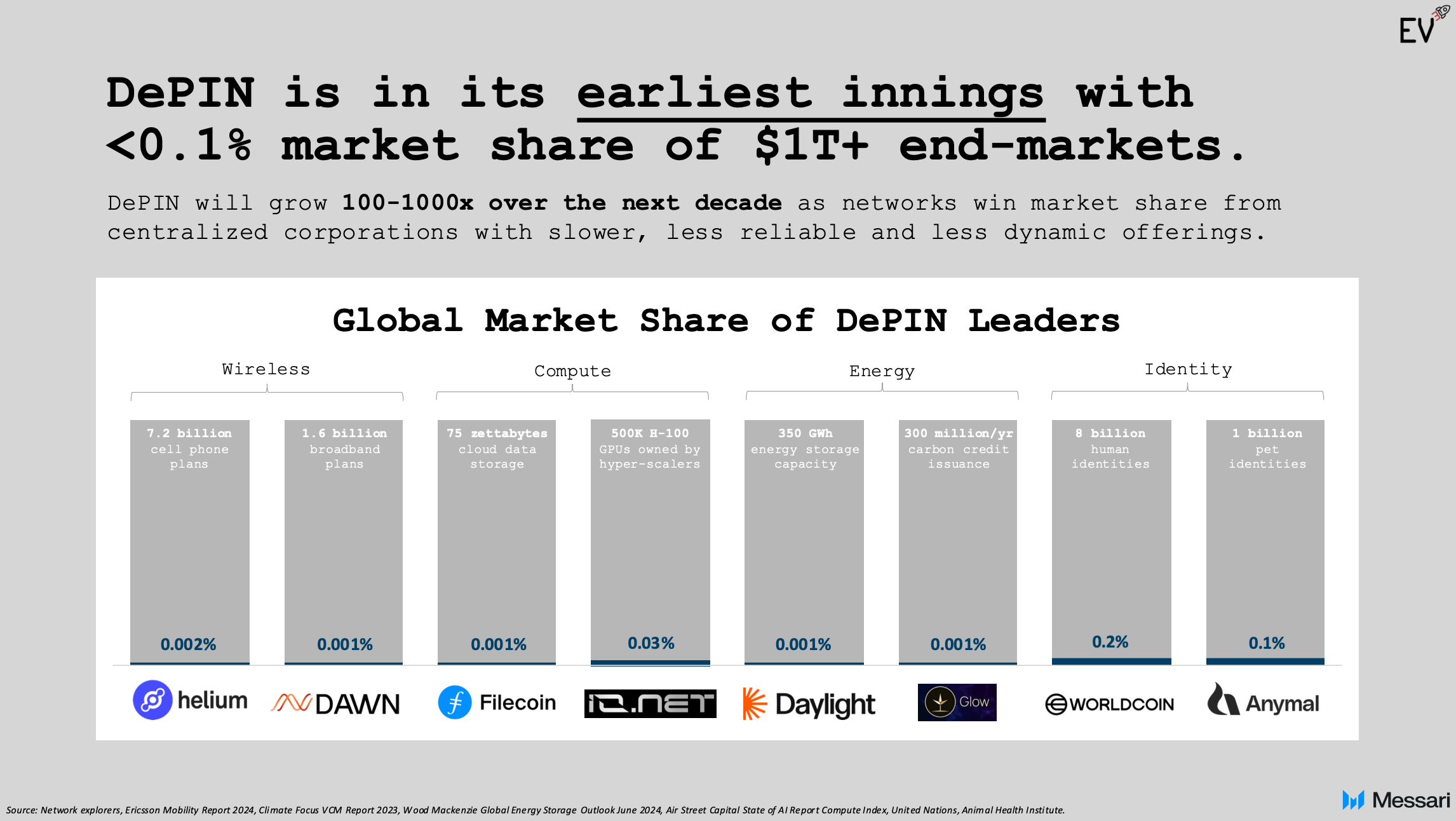
We could stop there. That comparison misses the point entirely, though. DePIN is not going after AWS. It's building for the cases where AWS is overkill, too expensive, or simply the wrong tool.
What's Already Working
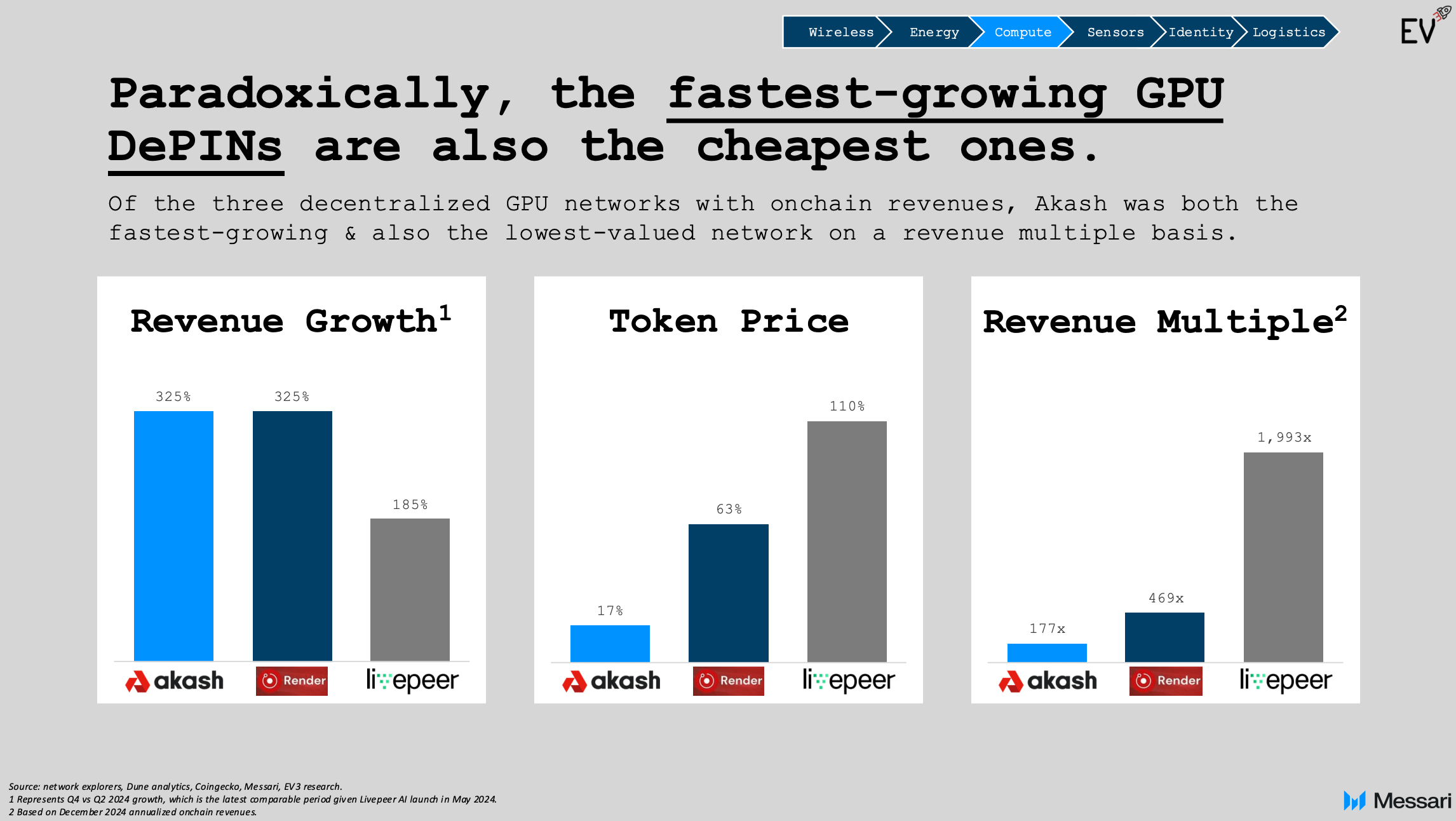
Akash launched a reverse-auction marketplace for GPU compute. You set your price, providers compete.
Q1 2025 results:
$1 million in lease revenue
Around 70 providers onboarded
Over 1,000 GPUs in the network
By cloud standards, that number doesn't even register. Large markets rarely start large and the people who built them were almost never established players looking to diversify. They were outsiders with nothing to protect.
Render operates GPU rendering for creators and AI workloads. Participants share compute resources and earn $RENDER tokens in return. Weekly revenue peaked at $126K. A focused, affordable service with real traction in its niche, though not yet at scale.
The more mature parts of the sector tell a different story. Filecoin stores over 2 exbibytes of data. Helium has 380,000 hotspots and carrier agreements with AT&T, T-Mobile and Telefonica. The SEC dropped its case against Helium in April 2025, which suggests the sector is moving past its experimental phase.
Why Enterprises Pass
The reasons are structural: businesses need contracts and 24/7 support that DePIN does not offer yet. Token volatility makes long-term financial planning unreliable and the total GPU capacity across every DePIN network combined is still smaller than a single AWS availability zone.
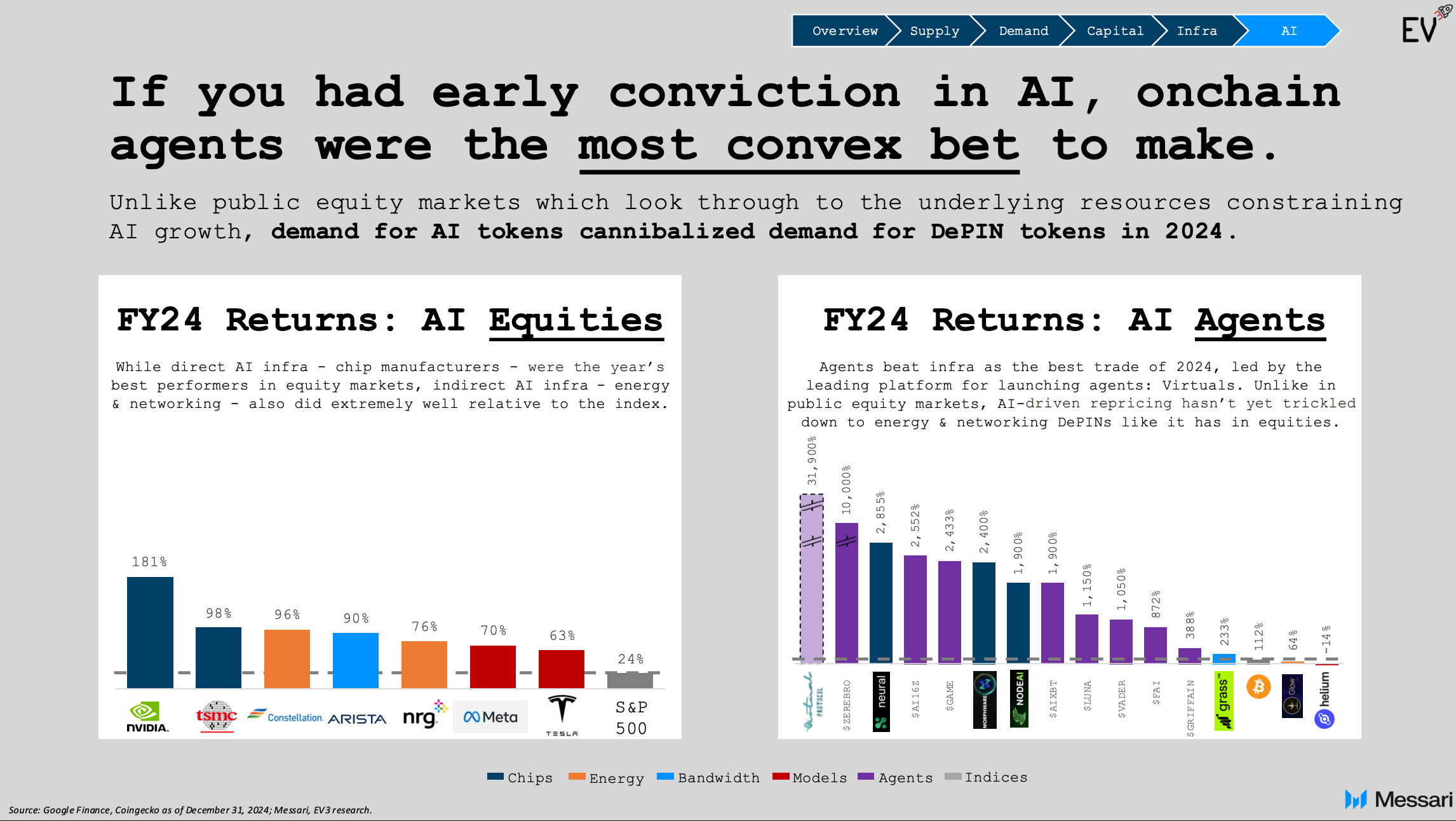
DePIN cannot replace cloud infrastructure today. What it can do is give smaller startups, especially in AI, access to compute that is fast, affordable, and doesn't come with a three-year commitment.
Insights from YOM & Peaq
To get a closer look at where the sector is heading, we reached out to the teams building the infrastructure. Andy Pringle from YOM shared their perspective on the current gaps and the shift in Web2 understanding:
Q: Where do you see the biggest untapped demand for decentralized infrastructure right now?
I have to say… gaming! There are loads of companies doing storage/AI etc., but literally no one doing “real” DePIN for gaming... only us.
Q: What's the single biggest technical limitation holding DePIN back right now?
My opinion is it’s not technical but understanding in the Web2 space. Imagine when people realize they can make money off their underutilized assets. This will be a game changer and it’s coming soon.
Q: Most DePIN projects are still paying providers more than they earn from customers, when does that math change? How can your project help?
That’s exactly the problem. They have no real demand, they print/distribute tokens to pay providers. YOM is different - for a start we have 400 games ready to go and have 1k nodes to distribute… they can handle 10 games! Demand far outstrips supply….
At the same time, Martin El-Khouri, Chief Business Officer at Peaq, highlighted the massive scale required by the emerging Machine Economy when asked about the biggest untapped demand:
The Machine Economy has infrastructure needs that are orders of magnitude larger than the economy we are used to. Autonomous robots, fleets, vehicles and devices create demand for data, compute, energy, etc., that traditional systems can simply not support.
Through projects like Combinder, Share, and SkyX, the DePIN sector is proving its ability to deploy decentralized global infrastructure at scale. Now, it’s in for a pivotal moment as it asserts itself as a critical enabling layer for robotics, on the agentic side, through projects like Teneo, but also on the data side through projects like Silencio and Over The Reality.
Decentralized infrastructure is well-positioned to crowdsource training data for robots and work as their extended nervous system, providing them with the eyes and the ears, letting them charge up from community-owned grids, and otherwise bolstering the robotics ecosystem, both Web3 and Web2.
Note from Cicada CEO Maxim Moris
Reflecting on the evolution of data and the current state of the market, Maxim Moris, CEO of Cicada Market Maker, shared his take on why the massive gap between traditional cloud and DePIN is actually an opportunity:
I remember floppy disks with 1.4 MB - and that felt like serious storage. Then CDs, then flash drives. Today physical media barely makes sense: network speeds have blurred the line between "file on my device" and "file in the cloud."
DePIN is the next logical step in that evolution. Not to replace AWS, but to give access to compute where AWS is overkill or simply too expensive. Early-stage startups, AI projects at the beginning of their journey - for them this is a real tool right now.
Many of these projects have their own tokens with actual utility as a working mechanism inside the network. And that genuinely makes me happy.
The 5,500x gap looks scary. But it's not a lag - it's the size of a market that's yet to be built.
Conclusion
The 5,500x gap between cloud giants and DePIN is an opportunity. While Big Tech serves the enterprise, DePIN is becoming the essential plug for gaming, robotics, and AI startups that need flexible, affordable compute without the corporate red tape.
As the Machine Economy grows, centralized systems won't be enough. DePIN is building the accessible, community-driven infrastructure to fill those gaps, proving that the sector is a practical tool for the next digital era.