
Sitting in a café over the weekend, flipping through the GSUI Staking ETF introduction just disclosed by Grayscale Investments, my mind was racing with excitement because the #Sui ecosystem is among the top 5 in our crypto holdings, and this milestone will bring new opportunities!
In the past two years, the market has been debating the public chain route. Some have bet on the L2 system of ETH, while others have bet on the high-performance route of Solana. But by 2026, Sui seems to be quietly taking a completely different path.
I have been increasingly feeling that Sui's 'S2 Strategy' + ETF launch could be the core storyline worth long-term tracking and research this year. Here are some of my fragmented thoughts as a reflection📒.
1️⃣ #Sui no longer plays with 'modularization', but instead creates a complete system
A few years ago, the most popular term in the blockchain industry was modularization. Simply put, it means breaking down different functions, for example, transactions on one chain, data on another layer, and computation on another layer.
The theory is very elegant, but the practical use is quite troublesome. Users and developers often have to shuffle back and forth between different L2s, cross-chain, bridges, and fragmented liquidity... the experience is not ideal.
Sui's approach is exactly the opposite; instead of breaking it down, it's better to integrate everything.
Currently, Sui's protocol stack looks like this: #Walrus is responsible for data storage, #DeepBook does on-chain order books, and #Seal builds privacy infrastructure for the ecosystem, stacking high-performance execution layers, all done within the same architecture.
This logic feels somewhat like the evolution of operating systems. In the early days of computers, many functions required plugins, but later systems integrated them directly, making it easier for users and developers, and giving big companies more confidence. For traditional institutions, the simpler the underlying architecture, the better; they often fear that overly complex assembly at the bottom will lead to uncontrollable stability issues.
2️⃣RWA+Privacy is actually the key for institutions to enter the market
Many people have been discussing RWA, but very few have seriously considered a question: 'If everything on-chain is completely transparent, why would institutions come in?'
Imagine if a fund buys government bonds, corporate bonds, or private equity assets on-chain, and all competitors can see the positions in real-time; basically, no one would dare to play.
So in the past two years, many public chains have been researching ZK privacy. Sui's development approach is very pragmatic; Seal has created dedicated privacy infrastructure for the Sui ecosystem, employing cutting-edge cryptographic technologies such as ZKP, homomorphic encryption, and multi-party secure computation to solve privacy issues. As an intermediary layer, it allows the integration of privacy functions into existing DApps through simple API calls, allowing users to autonomously choose the level of information disclosure on-chain. What should be shown to regulators can be shown, while what should remain private stays private, which is undoubtedly of great significance to traditional institutions.
If a public chain can be the first to complete such a Web3 environment in the future, where assets can go on-chain, transaction efficiency is higher, privacy is protected, and compliance is not an issue, then traditional institutions like Goldman Sachs or BlackRock will truly be able to move funds on-chain. Many people think the difficulty of RWA lies in technology, but in fact, it is more about institutional and privacy boundaries.
3️⃣AI Agent + Blockchain, Sui's structure has a natural fit
One of the hottest narratives in 2026 is not AI itself, but AI Agents. For example, this year's hugely popular Openclaw shrimp 🦞 allows AI to execute tasks by itself, such as automatically subscribing to data, automatically trading, automatically settling accounts, and automatically paying service fees.
But the problem is that most blockchains are not designed for the 'machine economy'. However, Sui has a very special structure: the Object Model. In this system, each asset is an 'object'. Just like files in a computer, they can be directly called, transferred, and combined.
This is very friendly for AI. A simple case scenario: your AI assistant purchases a dataset online: AI automatically places an order — pays with stablecoins — completes asset transfer.
If the GAS fee is zero (subsidized by Sui), then it can be said that the user experience throughout the entire process is essentially seamless. When machines begin to trade frequently, this efficiency becomes very important.
4️⃣GSUI Staking ETF, truly changing the entry point of capital
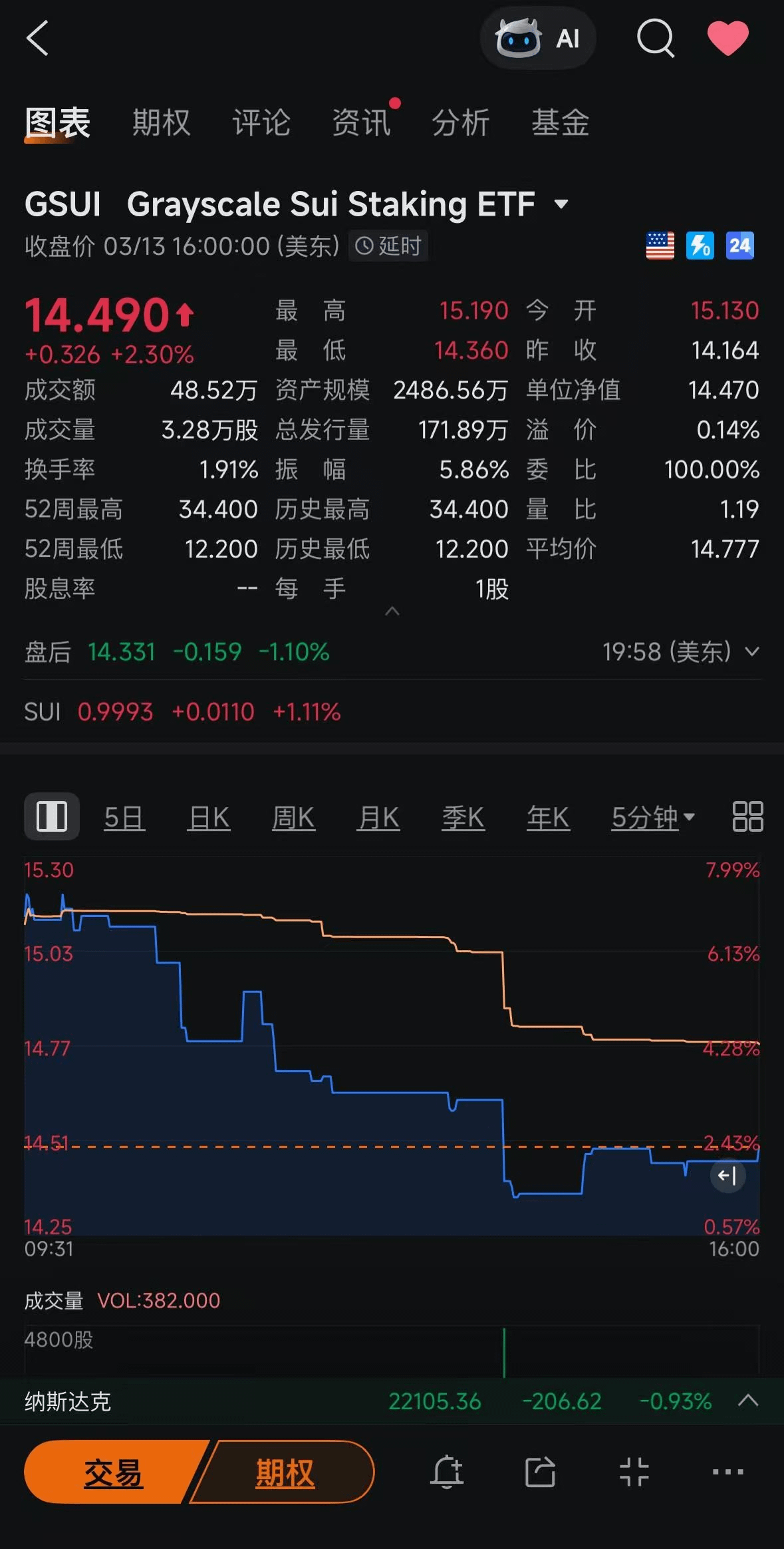
What made me stop and think for a long time in the café is actually this matter: Grayscale launching the GSUI staking ETF on the NYSE Arca. I believe the impact of this event is underestimated by many.
First, Wall Street can buy public chain assets now. The biggest issue for traditional capital is not cognition, but operational thresholds. Many institutions are unwilling to manage private keys + use on-chain wallets + do their own staking.
The emergence of GSUI is equivalent to hiding all these complex operations; you only need to buy it in your brokerage account.
Secondly, the ETF includes staking rewards. Previously, many crypto ETFs only tracked prices. But if the ETF can include staking rewards, then the logic changes.
It is more like a digital asset with cash flow. For institutional investors, this is crucial, especially during market downturns, as stable cash flow returns are essential.
Finally, the emphasis institutions place on the entire Sui ecosystem. Currently, the market is not only focusing on SUI itself. The ecosystems surrounding Sui: #Walrus and #DeepBook are also starting to be viewed as a whole. If future funds are allocated based on 'ecosystems', then Sui's positioning will resemble a blockchain operating system.
In summary, I am currently heavily invested in #Sui and its ecosystem. The core logic no longer views it as an ordinary public chain. It resembles an infrastructure for future finance and AI.
If viewed from different perspectives: from a technical standpoint: the automatic payments of AI agents and machine economy. From a funding standpoint: the capital inflow of GSUI ETFs. From an ecological macro perspective: Sui Stack (storage + liquidity + privacy). It is rare to see such a complete logic of public chains in the entire Web3 ecosystem.
My own investment thinking is very simple. This level of infrastructure project is often not about making money through short-term trading. It requires holding slowly and waiting for the narrative to mature. Moreover, Sui's institutional unlock will be fully completed this year, and there will be no institutional selling pressure in the future, so I am willing to wait for its fruitful results in the next four-year cycle. 🧐