
After experiencing several rounds of bull and bear markets in the cryptocurrency market, we must face a brutal reality: purely relying on the stock game of 'human attention' and 'human capital' has already hit a ceiling. Whether it's the endless stream of Meme coins or the homogenization of narratives in public chains, they are all competing for extremely limited retail liquidity.
However, beyond the clamor of this market, a powerful undercurrent brought about by the fusion of DePIN (decentralized physical infrastructure) and AI (artificial intelligence) is surging. Today, we will deeply analyze the core driver of this 'paradigm shift' — Fabric Foundation (@Fabric Foundation ), #ROBO and its core hub aimed at building a settlement layer for billions of smart devices globally: $ROBO .
If Ethereum is the financial infrastructure for humans entering Web3, then Fabric Foundation is the native economy awakened by machines and AI.
1. Industry pain points: AI's 'brain' is strong, but it lacks 'limbs' and 'wallets'.
To understand the greatness of @FabricFND, we first need to grasp the biggest pain points in the current technology field.
Currently, large language models like GPT-4 have demonstrated astonishing intelligence; they can write code, draft articles, and even create business plans. However, they are trapped in servers.
An AI agent, if it wants to perform tasks in the real world (for example: purchasing computing power, renting cloud storage, or even hiring a drone to capture data from a location), encounters an insurmountable gap—AI has no bank account and cannot register for Alipay or Visa cards through KYC.
The existing financial system is designed for 'carbon-based life (humans)', not for 'silicon-based life (machines/programs)'. This gap in identity rights and value settlement directly locks the upper limit of the explosion of AI and DePIN tracks.
This is the grand background of the birth of @FabricFND: it aims to issue 'Digital IDs (DID)' for machines, sensors, and AI agents across the internet, providing a settlement network that requires no permission and offers instant confirmation.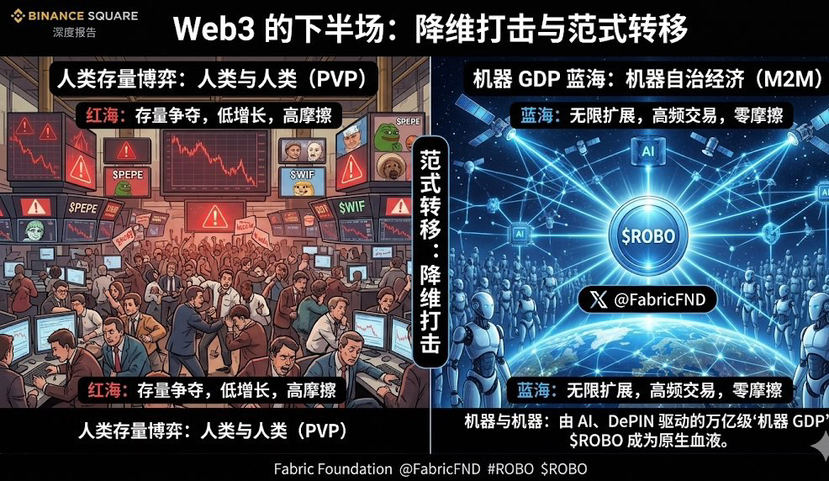
2. Breakdown of the core architecture of Fabric Foundation (@FabricFND)
Fabric is not just a simple token issuance project; it is a set of rigorous underlying protocols. It builds an indestructible barrier for the 'Machine Economy' through the following three pillars:
1. Machine Decentralized Identity (Machine DID).
In the Fabric network, every connected device—whether it is a million-dollar AI computing server or a temperature and humidity sensor costing a few bucks—will generate a unique cryptographic identity on the chain. This means that machines finally have 'sovereignty'. They can act as independent commercial entities and sign smart contracts.
2. The Settlement Layer for IoT & AI.
When two machines need to collaborate (for example: an autonomous vehicle purchasing charging services from a roadside smart grid), they do not have to wait for a human to click 'confirm payment', nor do they need to go through a bank system's lengthy settlement process. They directly use microsecond-level value settlement through the network. This 'streaming payment' technology greatly reduces transaction friction between machines.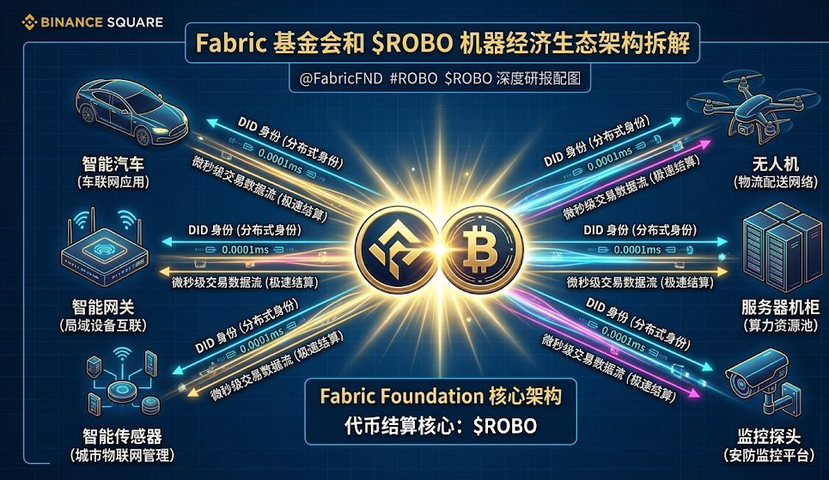
3. Trusted Data Oracle Network.
The core of the DePIN network is the data on the physical world being put on-chain. Fabric Foundation provides a cryptographic verification mechanism to ensure that the data uploaded by sensors (such as geographic location, weather, and computing power contribution certificates) is real and not tampered with. This is the cornerstone for building trust in the machine economy.
3. Token economics: Capturing the absolute value of 'Machine GDP'.
Understanding the underlying logic, let's take a look at the token model that investors care about the most. In Web3 investment, good technology must be paired with Tokenomics that can capture value.
Playing an indispensable 'blood' role in the entire ecosystem, its value capture mechanism is textbook level:
• The only settlement fuel (Gas & Settlement): In the Fabric network, all communications between machines, data purchases, computing power rentals, and task distributions are conducted in settlement units. As the number of devices connected to the network grows exponentially (it is predicted that by 2030, there will be hundreds of billions of IoT devices globally), the real business demand for $ROBO will experience explosive growth.
• Node staking and security consensus (Staking & Security): To become a senior validator or data provider on the Fabric network, a certain amount of $ROBO must be staked. This not only guarantees the security of the network (malicious acts will be penalized), but also locks a large amount of tokens in circulation, creating a natural deflationary effect.
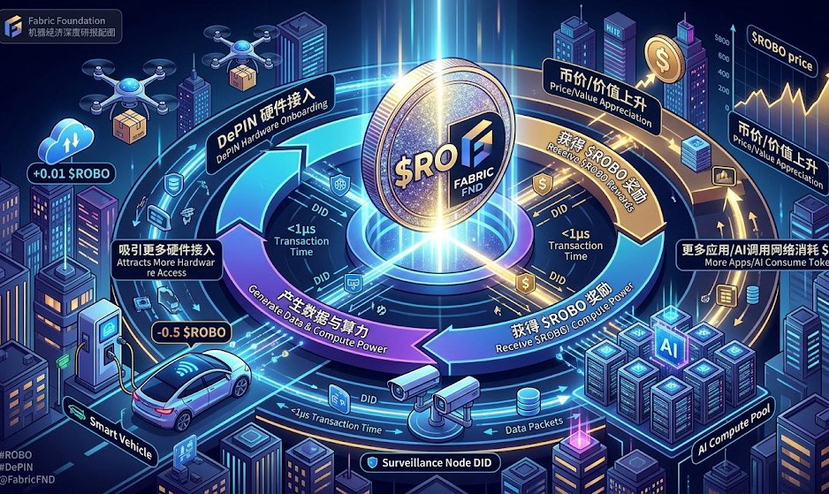
• Hardware mining and incentive mechanisms (DePIN Rewards): Early participating hardware miners and equipment providers will receive $ROBO rewards by contributing real-world data or computing power. This is a healthy 'labor for reward' model, rather than a Ponzi structure of left foot stepping on the right.
• Governance: Voting can be conducted on major upgrades, parameter adjustments, and fund distribution of the Fabric Foundation, truly achieving community autonomy.
4. Commercial landing scene simulation: How to change the world?
To help everyone understand more intuitively, we will simulate several real scenarios that are about to explode in the Fabric ecosystem.
Scenario A: Efficient matching of AI computing power.
A startup AI team needs to train models, and their AI agents will automatically search for idle GPU computing power globally on the Fabric network.
After a successful match, AI agents directly pay these GPU nodes $ROBO by the second, and the settlement is automatically disconnected after training is completed. No intermediaries, no high cloud service commissions.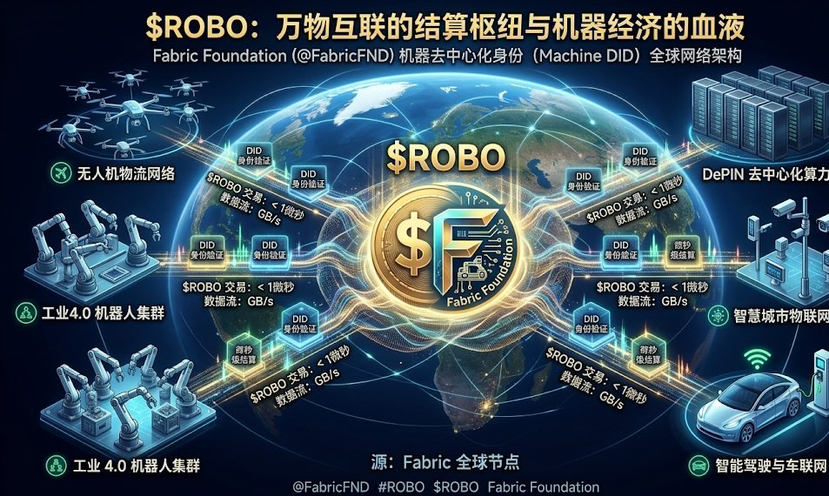
Scenario B: Data crowdsourcing in smart cities.
The weather company needs real-time microclimate data from a city street corner. Smart sensors installed on local residents' balconies automatically take orders, and each time they upload valid data, the built-in wallet of the sensor will chime, receiving a small reward.
Scenario C: Fully automated drone logistics.
A delivery drone autonomously lands on a decentralized charging station when its battery is low.
The drone's machine wallet automatically pays the charging station's machine wallet for charging, and then continues its task without human intervention.
 5. Macroeconomic outlook: Why is this Beta a must-have allocation in this bull market?
In the current crypto market, DePIN and AI are recognized as the two core tracks most likely to bring 'real yield' from outside the circle. And @FabricFND is precisely positioned at the golden intersection of both.
When we assess a project's potential, we cannot only look at its current market value, but also its benchmarked economic scale. Traditional internet giants are competing for the economic scale of 8 billion humans (human GDP); while the Fabric Foundation aims at the future trillion-level machine GDP generated by the collaboration of smart devices and AI agents.
This is currently in its very early stages but has a ceiling so high it is beyond estimation—a trillion-level blue ocean. When you buy in, you are investing not just in a string of code, but in the underlying clearing central bank of the entire future automated world.
In the upcoming super cycle, infrastructure projects that can perfectly stitch together the physical world (DePIN), artificial intelligence (AI), and blockchain (Web3) will undoubtedly usher in their starry sea.
💡 [Hardcore discussion, welcome to exchange in the comments]
Dear crypto researchers and investors, do you think that in the next five years, the number of on-chain transactions between machines (M2M) will completely surpass the number of transactions initiated by humans?
If AI can autonomously control assets, what impact will this have on the existing financial order?
Feel free to leave your in-depth insights in the comments; I will select quality comments for interactive discussions! Let's witness this productivity revolution together!