

In the past few days, as one of the first batch of internal test users, I specifically conducted a practical test with Binance's built-in assistant.
It's not about having it chat with me, nor is it about having it write a few analyses,
But instead, I gave it a tougher task: to help me set up a funding fee arbitrage process from scratch, and then execute it in reality to see if it can actually get the job done.
Let’s get to the results first:
It indeed ran through the process.
From opportunity scanning, strategy organization, order execution, funding fee settlement, to post-mortem review and program iteration, it can complete a round in just a few hours.
Moreover, my biggest takeaway after testing it wasn't "whether it will make chatting smarter," but rather something more practical:
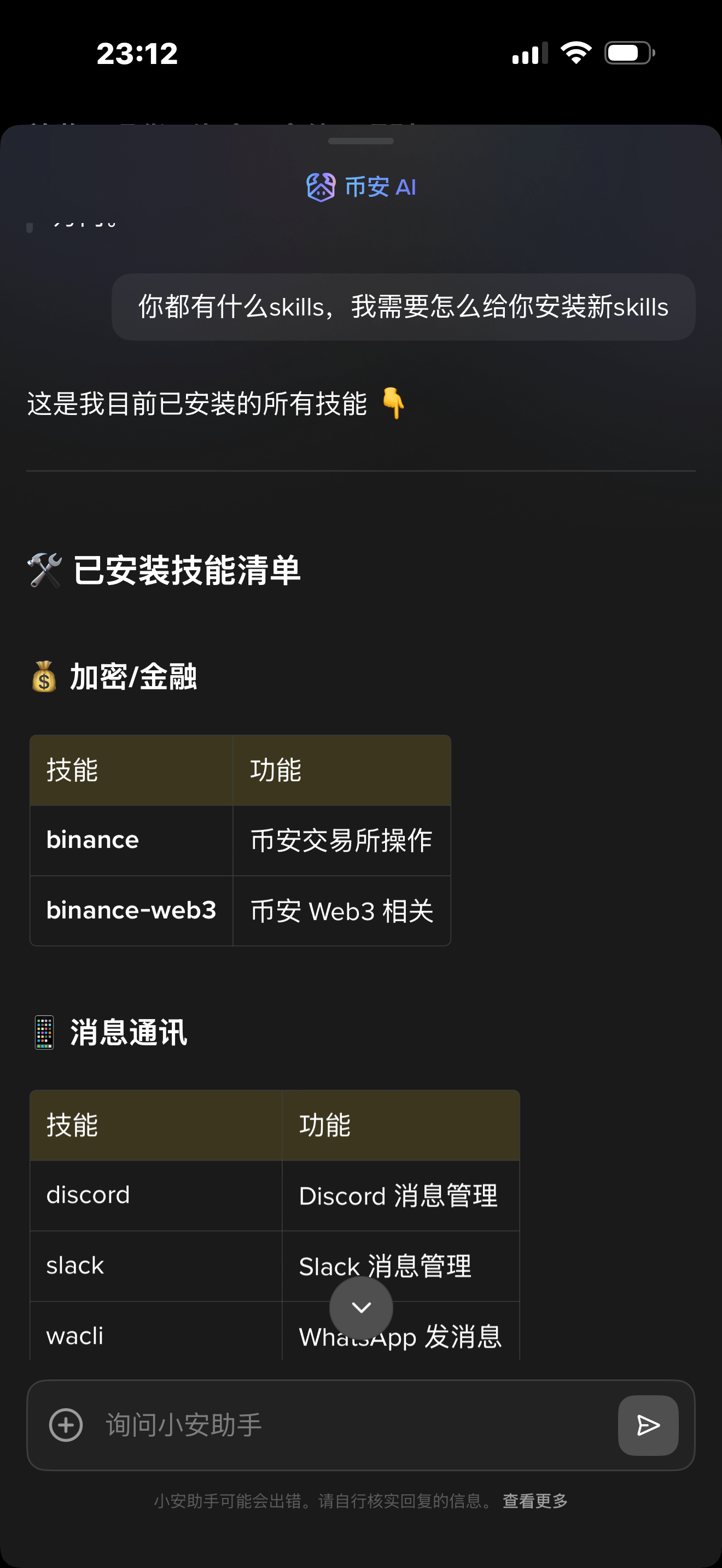
Xiao An Assistant is essentially a built-in, out-of-the-box version of OpenClaw, which is built into Binance.
It's not a completely separate new thing, nor is it a simplified toy that can only be clicked. Instead, it directly handles the entire process that originally required users to deploy, configure, connect, and debug themselves.
More importantly, it doesn't lose its scalability just because it's "out of the box," which is crucial.
If I had to summarize my conclusion in one sentence, it would be:
The most praiseworthy aspect of XiaoAn Assistant is not that it has suddenly gained some magical capabilities, but that it has brought the Agent capability, which was originally only truly usable by people who know how to deploy, integrate, and troubleshoot, to ordinary Binance users for the first time in a way that is accessible to a very low level.
This is a huge difference from building OpenClaw from scratch.
I had previously studied the path of deploying OpenClaw myself, but I didn't continue to experiment with it.
The reason is not that it is completely impossible, but that it is too easy to waste time on things other than trading.
You need to prepare a machine that can be online for a long time.
To handle environment and architecture compatibility
You need to install the runtime dependencies.
Requires interface access to stock exchanges and the necessary skills and abilities.
In the end, I still had to test, troubleshoot, and fix the problems myself, round after round.
For those with technical skills, this path is not "completely impossible," but rather very time-consuming.
For users with no prior experience, what often deters them is not the strategy itself, but rather the pre-existing issues such as environment, dependencies, permissions, and interfaces.
That's why I'm even more eager to see what Xiao An Assistant has solved this time.
Based on my actual testing, my current judgment is very clear:
Its real strength lies not in changing the set of capabilities, but in turning similar capabilities into products.
The entire process that would have taken you a lot of time to establish yourself when working with OpenClaw has been made a built-in capability by Binance.
The difference lies not in "whether it can be done", but in "how much cost an ordinary user has to pay to get started".
For those with technical skills, this means saving a significant amount of time that is not related to trading.
For users with no prior experience, this is hardly a difference of "being a little more convenient," but rather a difference of "being able to start directly now that they couldn't access it before."
Instead of using it for regular question and answer, I had it handle a complete task directly:
Scan all contracts on the site to find arbitrage opportunities in funding fees, then provide an execution strategy and complete a real test.
The reason for choosing capital fee arbitrage is not because it is a sure-fire way to make money, but because this scenario is very suitable for testing the system.
Because it naturally covers several key aspects:
First, scan the market.
To determine the rate and basis
To handle the hedging execution of spot and contract markets,
Finally, we need to look at the settlement, review, and subsequent iterations.
In other words, this is not a question of "whether one can speak well," but a question of "whether one can truly connect multiple tasks together."
It first scanned all U-based contracts on the site, picked out those with high funding fees, and then sorted them based on liquidity and basis.
Here's a point I think is very valuable:
It didn't just focus on the high funding costs themselves, but reminded me to look at the basis.
For example, COSUSDT had very high funding fees at the time, which seemed very attractive.
However, it also noted that the contract price for this asset is significantly lower than the spot price, with a basis of approximately -1.86%.
This means that while you may appear to be earning capital fees, you've actually already incurred a hidden cost the moment you establish your position.
To put it bluntly, a high fee does not necessarily mean it's worth doing.
If the basis is too poor, you may already be at a disadvantage from the very beginning.
At the time, it preferred me to choose assets with smaller basis spreads, such as DOTUSDT and TRUMPUSDT.
But this time I didn't completely follow its advice; I deliberately used COSUSDT for my first live trading test.
The reason is quite simple.
My primary concern was whether this link could actually function.
The subsequent execution logic is not complicated:
Buy COS in the spot market.
Simultaneously short COS perpetual contracts on the contract side.
Use directional hedging to exchange for funding fee income.
After the first settlement of the funding fee, the account did receive the funding fee.
This shows that the most basic link is working: it's not just about logic, it can at least push this transaction path to actual execution and settlement.
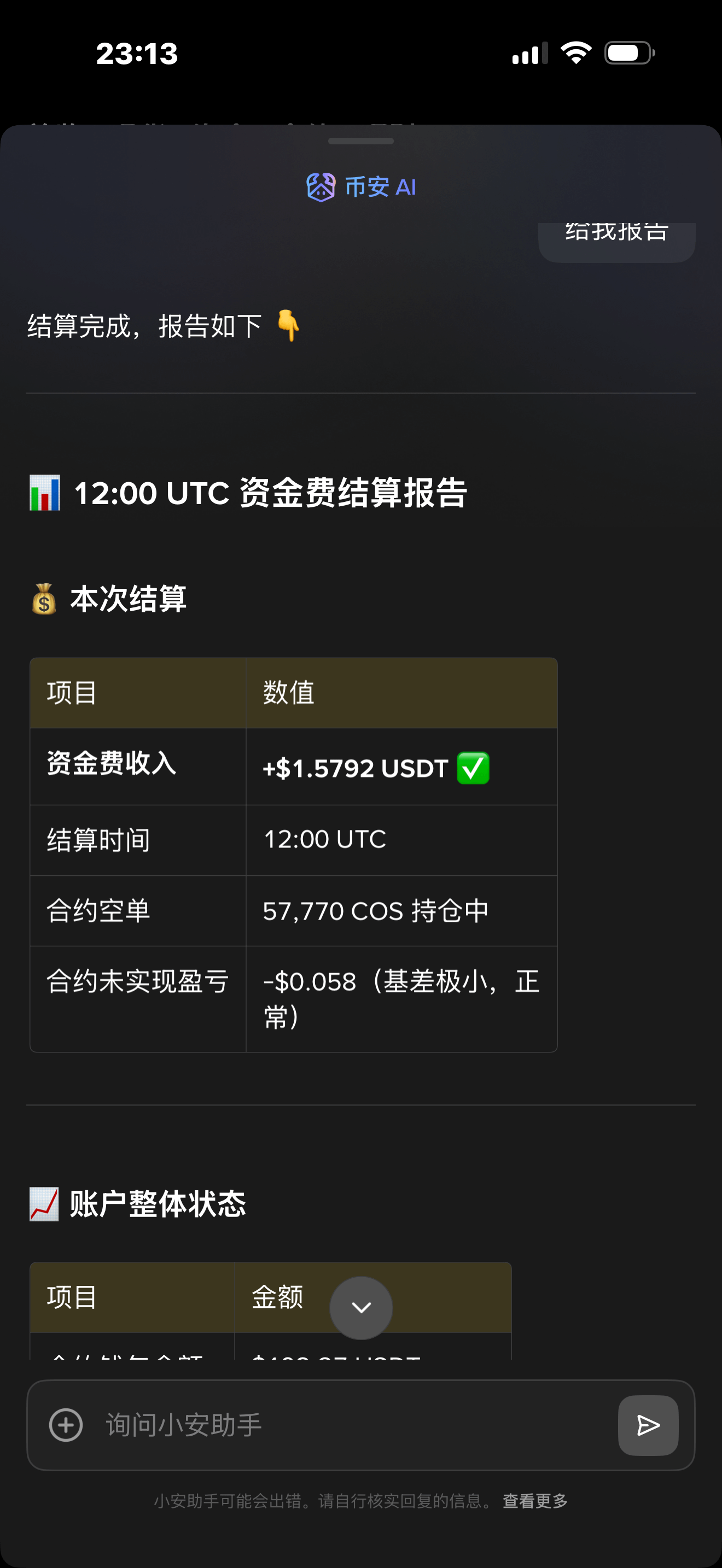
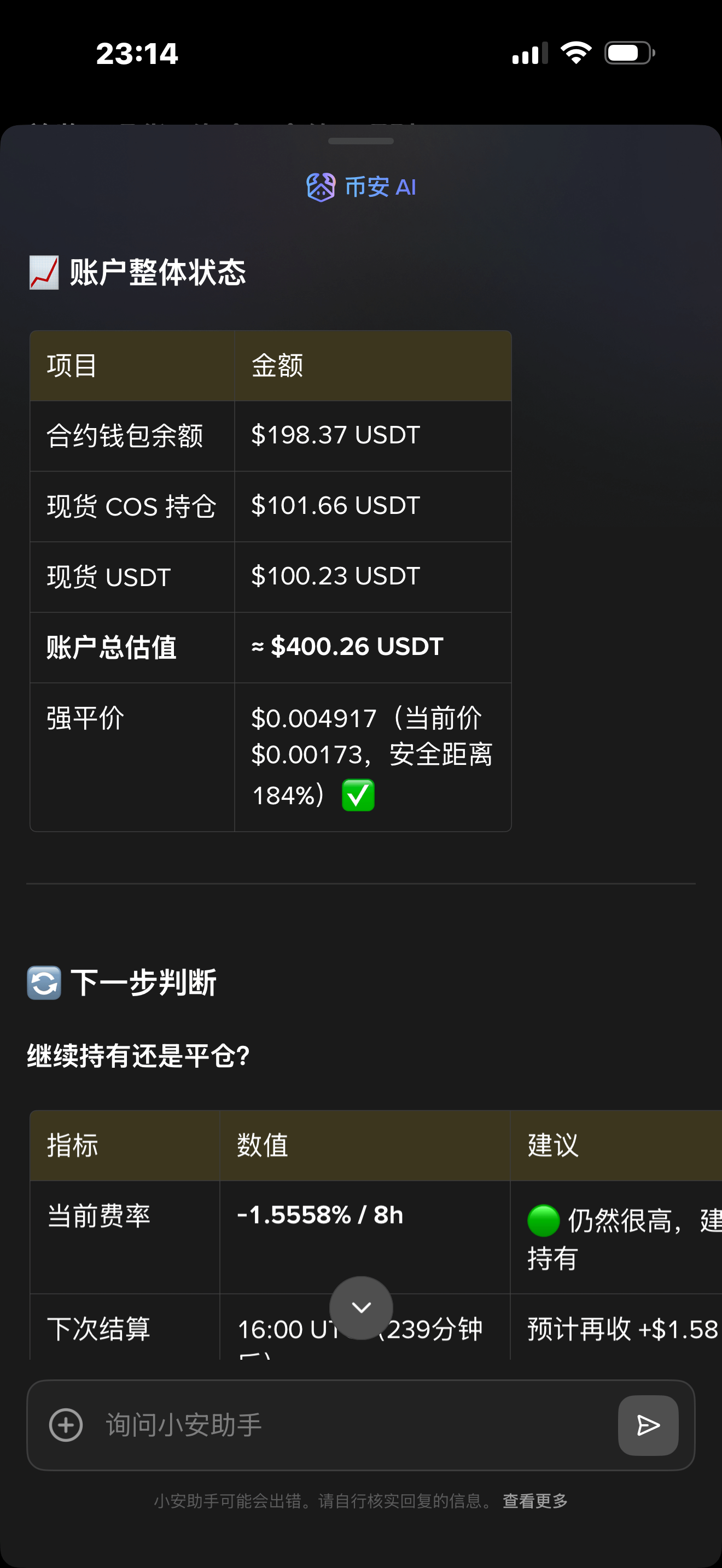
But what's truly interesting isn't "its ability to place orders," but rather the final, reviewed results.
This test did not generate any profit.
The final account comparison before and after is as follows:
The contract wallet went from $200 to $197.69, resulting in a loss of $2.31.
The spot account grew from $200 to $202.24, resulting in a profit of $2.24.
After the merger, total assets decreased from $400 to $399.93, resulting in a final value of -$0.07.
In other words, this actual test basically broke even, but strictly speaking, it resulted in a slight loss.
I actually find this result more valuable.
This is because it demonstrates that this is not a presentation that only displays visually appealing results, but a test case that actually measures the problems.
The reason for the loss is not complicated; it's the same problem that it had already warned me about at the beginning: the basis was too large.
When the position was established, the spot price was approximately $0.001755, the contract price was approximately $0.001729, and the basis was approximately -1.86%.
This means that once you enter the market, you've already incurred a significant hidden cost.
Although funding fees of approximately 1.58 USDT were received later, this single payment was insufficient to cover the basis costs. Combined with the profit and loss fluctuations on both the long and short sides due to price volatility, the overall result was a small loss.
This incident itself is quite telling.
This illustrates two things:
First, Xiao An Assistant can indeed set up a real transaction chain, not just by giving advice, but by assisting you in completing scanning, execution, settlement, and review.
Second, it doesn't eliminate the inherent risks of the transaction itself.
If you choose the wrong target, the basis is too poor, or the execution conditions are unsuitable, you'll end up paying the price anyway.
That's why I think the most praiseworthy aspect of this review isn't "how much money it directly made for me," but rather:
It compresses the originally difficult-to-start process into a path that ordinary users can truly begin testing.
Many people failed to do it in the past not because they had no ideas at all, but because they failed due to environment, dependencies, permissions, and interfaces before they even started to verify them.
The most practical value of Xiao An Assistant is to eliminate this friction first.
After completing this round, I asked another question:
If we consider this system as a product, how far is it from maturity?
Its response actually made me more willing to continue giving it a positive review.
Because instead of praising itself, it explicitly acknowledged that the current version is still far from being a mature product.
The problems it itself pointed out included:
After the program restarts, the position identification and status synchronization are still not stable enough;
When the direction of funding fees reverses, the processing logic is not yet complete.
Some order data and status queries are unstable;
The supporting capabilities for notification, recording, and tracking still need to be improved.
Based on these issues, it later revised the V2 solution, adding key capabilities such as position persistence, fee reversal processing, transaction records, P&L tracking, and message push.
I also used it to conduct a round of simulation tests.
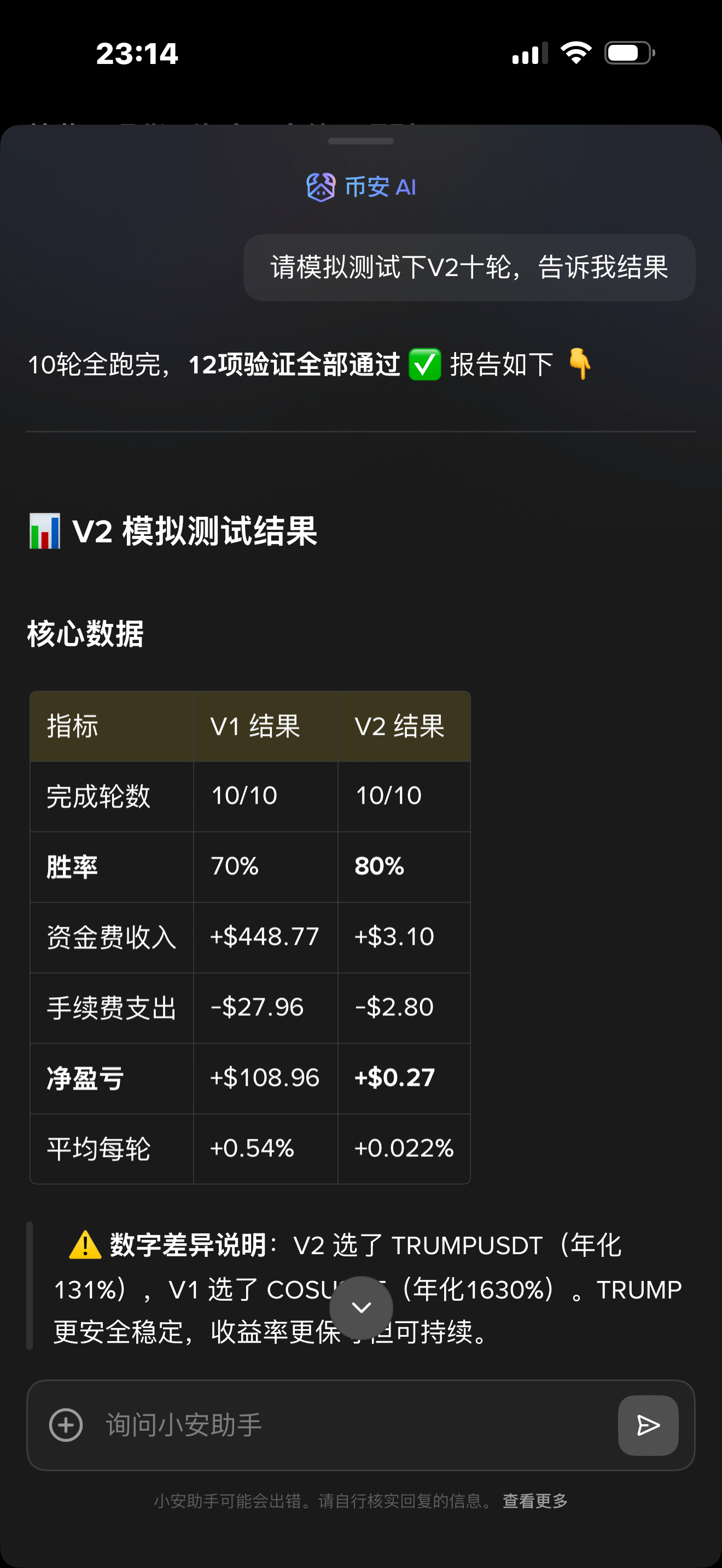
This only shows that it is moving towards a more complete direction, not that it is already a mature quantitative platform.
But from another perspective, this is precisely why I am willing to give it a high rating—because it can not only run, but also continue to iterate based on the actual test results, which is what makes it a truly capable agent.
So if we must consider XiaoAn Assistant and our own deployment of OpenClaw together, my current judgment is quite clear:
They are not in a "one replaces the other" relationship.
It's more like a relationship of "same capabilities, different delivery methods".
The difference lies not in whether the degree of freedom or scalability is higher or lower, but in the barrier to entry for use.
OpenClaw prefers to build the entire process from scratch.
And the value of Xiao An Assistant lies in:
It has directly turned the already valuable Agent capability into a built-in, pre-integrated, and ready-to-use product within Binance.
The underlying logic of the capabilities remains unchanged, but the barrier to entry for using them has been significantly lowered.
Moreover, it doesn't reduce the capabilities, but rather it hides the complexity.
This is more important than simply "saving trouble".
Because what has truly changed is not just the experience, but the expanded user base.
In the past, these kinds of things were mostly for people who liked to experiment and make things happen.
Now, for the first time, Xiao An Assistant has delivered this type of capability to ordinary Binance users in a relatively complete manner.
For users with no prior experience, this is hardly an experience optimization; rather, it's a true opening up of new capabilities.
So if you ask me what the final conclusion is after this test, I will give you a very direct answer:
The most commendable aspect of Xiao An Assistant is not that it solves your profitability problem, but that it brings the OpenClaw-style Agent capability, which was originally only usable by a few, to ordinary users for the first time in a sufficiently low-barrier and smooth manner.
That's what deserves the most praise this time.
Of course, the boundaries still need to be clearly defined.
This was just a small-scale real-world test to verify that the process worked, and it does not represent long-term stable profitability.
V2 is currently more about functional enhancements and simulation verification, and does not mean that it has reached the standards of a mature product.
Funding fee arbitrage is by no means a risk-free strategy. Basis, slippage, rate reversal, liquidity, and execution errors can all directly wipe out profits.
In addition, in any scenario involving APIs and transaction permissions, you are ultimately responsible for things like permission isolation, least privilege, and account security.
But if we return to the core question of this article:
Is it really worthwhile for Binance to integrate capabilities like OpenClaw into its XiaoAn Assistant?
My answer is:
Yes, and it is very significant.
Because it didn't just create a chat portal; it took the first step towards making capabilities that were originally more technical, more tinkering, and more accessible to a select few truly available to ordinary users.
For those who already know how to build, it saves time;
For those who don't know how to use it, it simply opens the door.
If you've always been interested in this type of capability but were deterred by the deployment, configuration, and access hurdles, then the official version of Xiaoan Assistant is definitely worth paying attention to.
All data is from this actual test process and does not constitute any investment advice.