
On March 14, 2026, the cryptocurrency market welcomed a long-awaited surge—$BTC Bitcoin saw a strong intraday rise, reaching a peak of $73,980. As of the time of writing, the price stabilized around $70,750, with a 24-hour increase of 2.1%, officially returning above the $70,000 threshold. The 24-hour trading volume exceeded $110 billion, and the total network leverage liquidation amount significantly decreased by over 60% compared to the previous day. Market sentiment quickly rebounded from the earlier low volatility to an optimistic range. This milestone price return not only ignited investor enthusiasm but also sparked widespread discussion in the market: Why was Bitcoin able to rebound against the trend and return to $70,000? Can this wave of increase be sustained? How should ordinary investors rationally respond and maintain risk control during the celebration?

Reviewing the recent market trends, the rebound of Bitcoin is not coincidental but an inevitable result of multiple factors resonating together. From the low point of $66,500 at the end of February to now returning to the $70,000 mark, it took only 10 trading days to complete nearly an 8% rebound, driven by the collective push of institutional funds, halving cycles, macro policies, regulatory environments, and geopolitical risks. Each supporting point has clear data and market dynamics to corroborate, rather than being mere blind speculation by short-term funds.
The frenzied entry of institutional funds is the most direct driving force behind this Bitcoin surge and the most core supporting power. After a prolonged five-week outflow of funds, the recent US spot Bitcoin ETF has seen a notable inflow, successfully achieving a consecutive second week of net inflow last week, with a total net inflow scale reaching $56.845 billion. Last Monday to Wednesday alone attracted over $1.1 billion in cash flow, breaking a five-month market silence. In addition to the ETF fund inflow, the buying actions of major companies have directly boosted market confidence—MicroStrategy, the publicly traded company holding the most Bitcoin globally, invested approximately $1.28 billion to purchase 17,994 Bitcoins from March 2 to March 8, with an average purchase price of about $70,946 per Bitcoin. After the increase, its total Bitcoin holdings rose to 738,731, maintaining its position as the largest Bitcoin holder among companies worldwide. Furthermore, traditional financial giants like BlackRock and Fidelity have also seen continuous net inflows into their ETFs, with BlackRock's IBIT seeing a single-week net inflow of $660 million, bringing the total net inflow to $62.47 billion. The recognition of the long-term value of crypto assets by institutions continues to provide solid financial support for Bitcoin's price.
The scarcity brought about by Bitcoin's unique halving cycle constitutes the underlying logic of this price increase. In April 2024, Bitcoin will complete its fourth halving, reducing block rewards from 6.25 BTC to 3.125 BTC, with a new daily supply of only about 450 coins, significantly slowing the supply growth rate. As of March 2026, Bitcoin's annualized inflation rate has dropped to 0.8%, far below gold's 1.7% annualized inflation rate and also lower than the past five years' average M2 growth rate of 4% for the dollar. This marks the first time in Bitcoin's history that its long-term annualized inflation rate is below that of gold, further highlighting its scarce value as "digital gold." Currently, over 95% of Bitcoin's total supply has been mined, and the hard cap supply limit of 21 million coins cannot be altered by any central authority. Against the backdrop of continued institutional accumulation, the contraction on the supply side further amplifies price elasticity. Historical data shows that 12-18 months after Bitcoin halving often corresponds with a bull market's main upward wave, and 2026 is at this critical window. The value reassessment driven by scarcity continues to push prices higher, which is one of the core logics for long-term investors' continued optimism about Bitcoin.
The expectation of macro liquidity easing and the improvement of the regulatory environment have cleared obstacles for Bitcoin's rise. Since 2026, the Federal Reserve's policy direction has provided sufficient liquidity support for the crypto market. On March 3, the Federal Reserve concluded its monetary policy meeting, announcing it would maintain the federal funds rate target range at 3.5% to 3.75%. Although it has paused its easing steps, the overall trend of easing has not changed. The market generally believes there is still space for about two rate cuts in 2026. The expectation of rate cuts means "money is cheaper, and liquidity is more abundant," leading investors to naturally shift funds from low-yield assets like government bonds and deposits to high-elasticity risk assets like Bitcoin. Additionally, the recent fluctuations in the dollar index, which is overall at a relatively low level, have also provided a favorable environment for Bitcoin's rise. Meanwhile, the greatest barrier to institutional entry, regulatory uncertainty, is gradually being eliminated—on March 3, the SEC officially removed cryptocurrencies from the priority list of enforcement and review in its 2026 regulatory focus document. On March 7, the White House held a summit on cryptocurrencies, clearly supporting the development of compliant stablecoins, while the SEC submitted cryptocurrency regulatory guidelines, clarifying the applicability of federal securities laws to crypto assets. The gradual clarity of the regulatory framework has greatly boosted institutional confidence in entering the market, also clearing the final barrier to Bitcoin's sustained rise.
The combination of geopolitical risks and asset rotation has become an important catalyst for Bitcoin's breakthrough of the $70,000 mark. Recently, the geopolitical situation in the Middle East has remained tense, with hardline statements from Iran's new supreme leader combined with surging oil prices, heightening market concerns regarding inflation and growth, and increasing the global demand for safe-haven assets. Notably, the gold market has recently experienced volatility, with funds beginning to shift from gold to Bitcoin in search of a hedge, showing a significant negative correlation in the flow of funds between Bitcoin and gold. More and more institutions view Bitcoin as "digital gold," using it to hedge against geopolitical risks and fiat currency depreciation risks. This asset reallocation behavior has brought a large influx of new funds to Bitcoin, becoming a significant driving force for its breakthrough at critical thresholds, and allowing the narrative of "digital gold" to transition from marketing language to real-world validation.
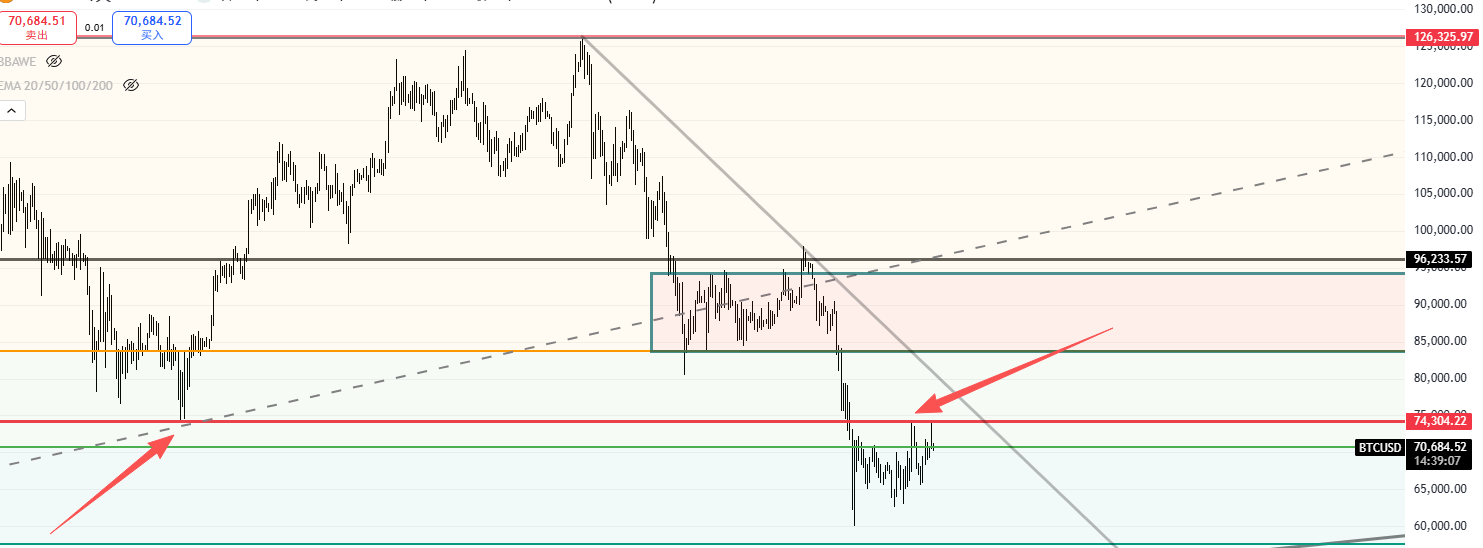
Although Bitcoin has returned to $70,000 and market sentiment is euphoric, we must remain sober and recognize that after this price surge, there are still hidden worries in the market; short-term correction risks and medium- to long-term uncertainties still exist. Blindly chasing highs will only leave investors in a passive position. In the short term, Bitcoin's rebound from the low point at the end of February to now has shown a high short-term increase, leading some short-term speculative funds to take profits, causing the price to slightly retreat from the $72,000 peak. This is a normal phenomenon of the market digesting short-term gains and does not indicate a large-scale capital exodus, but it does suggest that the short-term market will enter a phase of consolidation. Technically, $72,500 serves as a strong short-term resistance level, with considerable selling pressure from previously trapped positions. The hourly MACD shows a dead cross at high levels, indicating a weakening of bullish momentum, and the battle between bulls and bears will unfold fiercely around the $70,000-$72,500 range, with whether the trading volume can effectively expand becoming the key to breaking through.
What is even more concerning is that Bitcoin's "hedging properties" have not yet been fully established, and its inherent high volatility has not changed. Ray Dalio recently emphasized again that gold remains a stronger long-term value storage tool, while Bitcoin is more like technology stocks—following risk appetite rather than hedging risk. Recently, during the outbreak of geopolitical conflicts in the Middle East, Bitcoin saw over 300 million dollars in liquidations, and the price fell simultaneously, showing a stronger correlation with the stock market rather than strengthening alongside gold. This is enough to explain that Bitcoin cannot yet be considered a true safe-haven asset, as its price fluctuations are still dominated by factors such as risk appetite and capital flow, and a short-term rise does not mean the disappearance of risks. Furthermore, there remains a risk of a macroeconomic shift, with rising oil prices driving up inflation expectations. If inflation proves stubborn, central banks may maintain tightening policies, and the bear market of 2022 was directly caused by the Federal Reserve's interest rate hike cycle. Whether history will repeat itself remains unknown.
For ordinary investors, Bitcoin's return to $70,000 is both an opportunity and a test—one that tests not the ability to predict market trends, but the determination to adhere to risk control and discipline. In light of the current market environment and risk control principles, here are three actionable suggestions to help everyone stay clear-headed amid the frenzy and protect their principal amid volatility.
First, refuse to blindly chase highs and insist on building positions in batches. Currently, Bitcoin is in the fluctuation range of $70,000 to $72,500, with obvious short-term resistance. Blindly chasing highs can easily lead to buying at short-term peaks, facing the risk of losses during corrections. It is recommended to adopt a batch position-building strategy, only investing idle money, not borrowing or over-leveraging, and controlling the proportion of cryptocurrency investment to within 10%-20% of personal investable assets, so losing it will not affect normal life. For example, if planning to invest 100,000 yuan, one could first invest 30% as a base, and when the price corrects by 5%, buy another 30%, when correcting by 10%, buy another 20%, and when correcting by 20%, buy another 20%. By building positions in batches, one can smooth out costs and avoid risks associated with timing errors while maintaining a calm mindset during corrections, not panicking.
Second, strictly control positions and resolutely stay away from high leverage. The high leverage characteristic of the cryptocurrency market amplifies losses. In February 2026, Bitcoin fell 13% in a single day, leading to over 580,000 people across the network facing liquidation of $2.6 billion. This stark data serves as a warning that leverage is like "playing with fire." Ordinary investors should avoid using leverage whenever possible. If there is a genuine need, the leverage ratio should not exceed 3 times, with invested funds not exceeding 5% of total funds, and establishing strict stop-loss lines—when a single coin's loss reaches 5% of total positions, one must exit the market. One must not hold onto positions or rely on luck, safeguarding the last line of defense for principal. At the same time, adopt a "core-satellite" position allocation strategy, with core positions (70%) allocated to mainstream assets like Bitcoin and Ethereum, and satellite positions (30%) spread across other quality tokens, with no single coin's proportion exceeding 5%, thus avoiding the enormous risks brought about by the volatility of a single asset.
Third, set take-profit and stop-loss points, maintaining a rational mindset. The core of investing is not to pursue huge profits, but to protect existing gains and avoid significant losses. Against the backdrop of Bitcoin's return to $70,000, it is recommended to set take-profit and stop-loss points in advance: for take-profit, one can adopt a "ladder take-profit" strategy, selling 30% to recover part of the principal when rising 50%, selling another 30% to lock in profits when rising 100%, and holding the remaining 40% for long-term gains; for stop-loss, a combination of "hard stop-loss + technical stop-loss" should be used, reducing positions by 50% when falling below the short-term support level of $71,000, and fully stopping losses when falling below the secondary support level of $69,200-$69,600, avoiding fighting for positions or fantasizing, thus preventing profit retracement or deep entrapment. At the same time, one should abandon the illusion of "getting rich overnight," avoid frequent trading and chasing highs or selling lows, understanding that investing is a marathon, not a sprint, and that slow is fast and stable is winning. Only by maintaining a rational mindset and adhering to trading discipline can one go further in the crypto market.
Looking back at Bitcoin's development journey, from being obscure to breaking through $70,000, it has experienced countless surges and falls, witnessing the revelry and desolation of countless investors. Some have lost everything due to blindly following trends and neglecting risk control, while others have reaped growth through disciplined and rational positioning in long-term holdings. This return of Bitcoin to $70,000, whether in short-term fluctuations or medium-term upward trends, cannot change its inherent nature of high risk and high volatility, nor can it alter the investment logic of "risk control first, discipline is key."
The market is always full of opportunities; what is lacking is clear awareness and steadfast discipline. Bitcoin's return to $70,000 is not the beginning of a frenzy, nor the end of positioning, but a test of every investor's risk control ability. May we all remain clear-headed amid the market's clamor, not be swayed by emotions or tempted by huge profits, invest with idle money, guard with discipline, and proceed rationally, protecting our principal and steadily profiting in the waves of the crypto market, walking steadily and far.