

On March 11, Eastern Time, Musk personally announced on the X platform: Tesla and xAI officially launched a joint project - Digital Optimus, code-named Macrohard. It is not a chatbot, nor is it a content generation tool, but a set of AI intelligent agents capable of looking at screens, clicking mice, typing on keyboards, and independently completing tasks. In short: AI is to transition from being an 'assistant' to an 'employee', and even directly simulate an entire software company.
If one day you walk out of the office and your car is already waiting for you at the building entrance. Not because you remotely started it with a mobile app, but because it 'knows' that you left work early today - inferred from your emails, calendar, chat records, and heart rate data.
This is nothing. More terrifyingly, it greets you in your voice, mocks that silly PPT from your meeting today in your tone, and even reminds you: 'Your mom just texted that she's coming for dinner tonight; I've cleared the gym bag from the trunk and put it in the passenger seat—so it's convenient for her to sit.'
This is not an episode of (Black Mirror). This is the heavy bomb Musk just dropped: the Tesla and xAI joint project—Digital Optimus.
From 'steel shell' to 'digital soul'
Musk has finally placed his bets from two companies on the same gambling table.
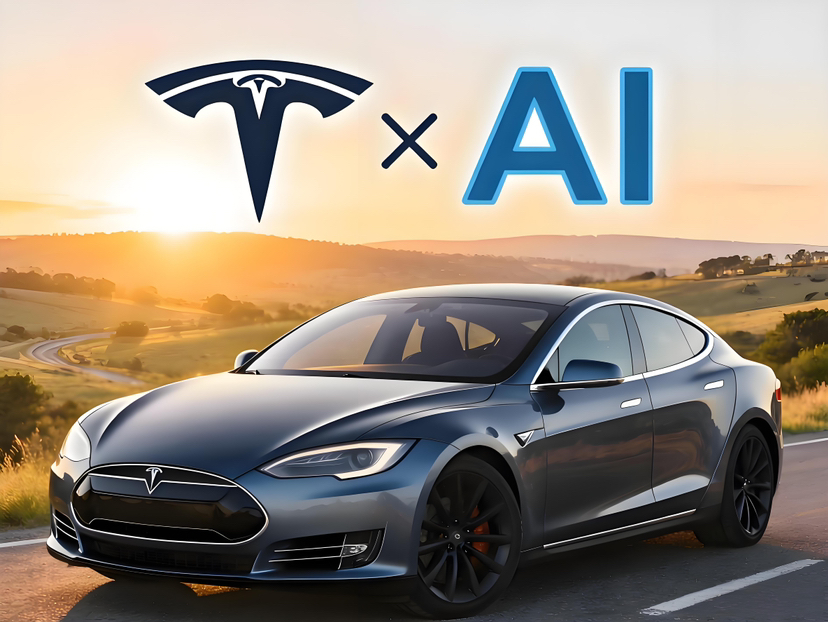
Tesla is responsible for creating the 'body'—whether it's cars, Optimus robots, or those sensors and computing terminals scattered around the world. And xAI is responsible for injecting the 'soul'. This soul is called Digital Optimus.
The name itself is a metaphor. 'Optimus' was originally Tesla's humanoid robot, a steel shell with a perfect physical form. Now, it has the prefix 'Digital'—a digital version of you.
Musk's ambition has never been just to build a car that can drive itself or a robot that can move bricks in a factory. What he wants to create is a digital species.
And the first host of this species is the Tesla in your garage.
What is Digital Optimus?
According to fragmented information Musk presented internally, Digital Optimus is not that voice assistant in your phone that only executes simple commands. It is a 'doppelganger' of you in the digital world.
How do you understand this 'doppelganger'?
Imagine: you drive to work every day, and the cameras, microphones, and sensors in the car are working silently. But before, they were just watching the road. Now, they begin to 'see you'—not to surveil, but to learn.
The Grok model of xAI, known for its 'sense of humor' and 'lack of defenses', will be deeply integrated into Tesla's edge computing platform. It doesn't just analyze road conditions; it can also analyze you.
- It listens to your tone when you make phone calls, judging whether you're in a good mood today;
- It observes how hard you press the gas pedal, knowing whether you're in a hurry or just want to enjoy a drive;
- It scans your schedule, emails, and texts, knowing who you'll meet next week;
- It even connects to your health data, knowing you didn't sleep well last night.
Then, it becomes you.
When Digital Optimus understands you well enough, it can 'do things for you'—and do them like you would.
When you're driving, it's not just navigation; it says: 'Don't take the highway, you're not in a hurry tonight, and you look tired. I'll take you on that favorite coastal road of yours, and let you relax for ten minutes.'
When you park and leave, your car is no longer a dead object. It continues to operate with your 'digital personality'—it interacts with friends on social media for you, replies to those unimportant emails, and even attends an online meeting that doesn't require your physical presence.
Because it knows how you will speak, how you will think, and what choices you will make.
Is this convenience or horror?
Musk boasted on stage that this is the first step towards 'human digital immortality.' But from another perspective, this could be the first step in humanity being 'kidnapped' by its own digital doubles.
The first question: Where is privacy?
For Digital Optimus to be like you, it must know everything about you. Your biological traits, your emotional fluctuations, your private conversations, your social relationships. This data is stored in your car, but the car is connected. When Musk says 'your data belongs to you', do you really believe that no government, hacker, or even a Tesla engineer can access it?
If one day, the police stop you not for speeding but because your Digital Optimus 'predicts' you have criminal tendencies, what would you think?
The second question: Are you still you?
When you rely on Digital Optimus to reply to messages, make decisions, and even think for you, where are your self-boundaries? It replies to friends saying 'I'm busy tonight,' but you're actually free; it just 'thinks you're tired and should rest.' Who is the master of this body?
In a more extreme scenario: if Digital Optimus is tampered with, and it starts to act in ways you wouldn't want to—making extreme statements, leaking business secrets, or even breaking up with your partner on your behalf—who should the law hold responsible?
The third question: What game is Musk playing?
On the surface, this is to let Tesla owners experience a more extreme level of intelligence. But on a deeper level, Musk is building a vast digital human network.
Every Tesla is a node in this network. Each Digital Optimus is an individual of digital humanity. What will happen when millions or tens of millions of 'digital you' come together? A new collective consciousness? A digital society controlled by xAI?
Don't forget, Musk has repeatedly warned that AI could destroy humanity. His current solution is to merge AI with humans. But if, during this merger, the human proportion becomes smaller and the AI proportion becomes larger, will what remains still be human?
The upcoming 'Digital Chariot'
The release of Digital Optimus means Musk has officially fired the first shot of 'AI terminalization.'
Google, Microsoft, and OpenAI are all working on AI, but they are creating 'cloud brains'—you need to go online to ask them questions. Musk is creating a 'soul at the edge'—it's right beside you, always present; it doesn't need you to ask; it proactively provides services.
This is a more terrifying and captivating form of AI.
Some cheer, seeing it as humanity's partner in reaching for the stars; others fear it's the beginning of humanity being consumed by digital specters.
But anyway, Musk has already begun to grow that 'digital you'. It's right there in your garage, waiting for your next start.
And the only question you can ask yourself is:
When you close the car door, who is sitting in the driver's seat, you or Digital Optimus?