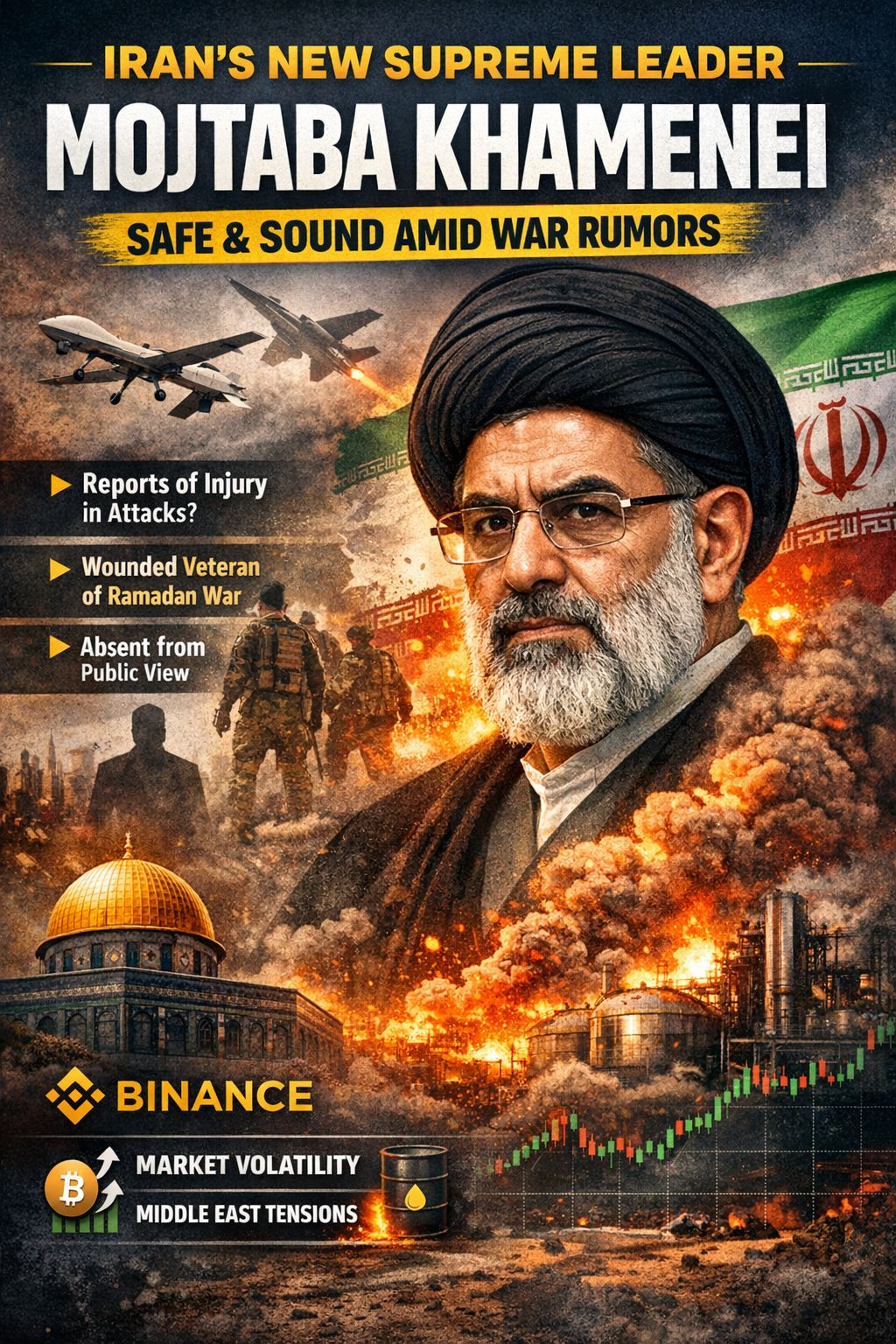
Geopolitical tensions in the Middle East have once again captured global attention as new developments emerge from Iran’s leadership circle. Reports from international media outlets suggest that Iran’s newly appointed Supreme Leader, Mojtaba Khamenei, is “safe and sound” despite widespread speculation that he was injured during the early stages of the ongoing conflict involving the United States and Israel.
According to statements shared on Telegram by Yousef Pezeshkian, the son of Iranian President Masoud Pezeshkian, the 56-year-old leader remains secure and continues to oversee state matters. His comments were widely reported by The Guardian, adding a new dimension to a rapidly evolving geopolitical story.
However, the lack of public appearances by Mojtaba Khamenei since he succeeded his late father Ali Khamenei has fueled speculation about his health, safety, and the stability of Iran’s leadership structure during a critical moment in regional politics.
For global markets — especially cryptocurrency traders — geopolitical uncertainty often translates into volatility and opportunity. Understanding these developments is crucial for anyone navigating the digital asset markets.
The Leadership Transition in Iran
The recent leadership transition in Iran marks one of the most significant political developments in the country in decades. Following the death of Ali Khamenei, who served as Iran’s Supreme Leader for more than three decades, his son Mojtaba Khamenei assumed the role in a move that surprised many analysts.
The Supreme Leader in Iran holds immense power, controlling:
The armed forces
The Islamic Revolutionary Guard Corps
Strategic military policy
Nuclear negotiations
Foreign policy direction
Because of this centralized authority, any uncertainty regarding the health or security of the Supreme Leader immediately raises questions about political stability.
The succession itself sparked debate globally. Critics argue that the rise of Mojtaba Khamenei resembles dynastic politics rather than the revolutionary ideals upon which the Islamic Republic was founded.
Supporters, however, believe his close relationship with the country’s religious establishment and military institutions ensures continuity during a period of heightened international tensions.
Rumors of Injury During Early Attacks
Speculation regarding Mojtaba Khamenei’s condition began shortly after reports surfaced that the United States and Israel had conducted coordinated strikes against Iranian military and nuclear infrastructure.
According to The New York Times, anonymous Iranian and Israeli officials claimed that the new Supreme Leader might have been injured during the opening day of the attacks.
These claims quickly spread across international media and social platforms, triggering uncertainty both politically and economically.
The allegations included:
Possible injuries sustained during the first wave of airstrikes
Movement of leadership figures to underground bunkers
Emergency security measures around Tehran
Although no official confirmation was provided, the rumor mill accelerated rapidly — a common phenomenon during wartime information warfare.
Iranian State Media’s Response
Iranian state television attempted to address the speculation in a carefully worded statement. Instead of confirming or denying the reports directly, state media referred to Mojtaba Khamenei as a “wounded veteran of the Ramadan war.”
This description raised even more questions.
Observers noted several possibilities:
The phrase might refer to previous conflicts rather than recent injuries.
It could be symbolic language used in Iranian political rhetoric.
It may hint at minor injuries without confirming major harm.
The lack of clarity reflects a broader pattern within Iranian political communication, where strategic ambiguity is sometimes used to maintain national morale during crises.
Absence From Public View
One of the biggest reasons speculation intensified is Mojtaba Khamenei’s absence from public events.
Since taking power following the death of Ali Khamenei, the new leader has not appeared publicly.
In highly centralized political systems, visible leadership is often used to demonstrate stability. The absence of such appearances has therefore fueled questions including:
Is the new leader recovering from injuries?
Is he operating from a secure undisclosed location?
Are internal power struggles occurring behind the scenes?
While government officials insist that he remains active and safe, the lack of direct communication has left many analysts skeptical.
Statement From the President’s Inner Circle
The strongest denial of injury rumors came from Yousef Pezeshkian, a key adviser within the Iranian government and the son of President Masoud Pezeshkian.
In a Telegram message circulated widely across Iranian social media, he stated that Mojtaba Khamenei is “safe and sound.”
His message aimed to counter international media reports suggesting otherwise.
However, because the statement did not include photographs, video appearances, or official confirmation from the Supreme Leader himself, it has not completely silenced speculation.
Information Warfare During Conflict
The conflicting reports highlight a broader phenomenon: information warfare.
During modern geopolitical conflicts, narratives can spread rapidly across media channels. Governments, intelligence agencies, and political actors may intentionally release or withhold information to influence public perception.
In this case, several competing narratives emerged:
Narrative 1: Leadership Stability
Iranian officials emphasize that Mojtaba Khamenei is secure and actively leading the country.
Narrative 2: Leadership Vulnerability
Some Western and Israeli sources suggest the new leader may have been injured during the early strikes.
Narrative 3: Strategic Silence
Others believe the absence from public view is a deliberate security strategy during wartime.
Determining the truth often takes time as verified information slowly emerges.
Regional Implications
The uncertainty surrounding Iran’s leadership has major implications for the Middle East.
Iran plays a central role in several regional dynamics:
Proxy conflicts in Lebanon, Syria, and Yemen
Relations with Russia and China
Tensions with Israel
Negotiations surrounding nuclear development
If the leadership were truly unstable, it could reshape power balances across the region.
However, if Mojtaba Khamenei remains firmly in control, Iran may continue its current strategic posture.
Market Reactions and Crypto Volatility
Geopolitical uncertainty often spills into financial markets, and the crypto market is no exception.
Historically, conflicts involving major energy regions have influenced investor behavior.
Traders often react to such events by shifting capital between:
Risk assets
Safe haven assets
Digital assets like Bitcoin
Cryptocurrencies sometimes act as alternative stores of value during periods of geopolitical stress.
For example, rising tensions in the Middle East can affect:
Global oil prices
Inflation expectations
Currency stability in emerging markets
These factors indirectly influence crypto market sentiment.
Why Crypto Traders Watch Geopolitics
Many traders on platforms like Binance closely monitor geopolitical developments because they can trigger sudden market movements.
Major events can cause:
Liquidation cascades
Sudden volatility spikes
Rapid inflows into Bitcoin and stablecoins
For example, when global uncertainty increases, some investors move funds into decentralized assets that are not tied to any single government.
This trend has been observed during past crises including:
Banking collapses
Sanctions events
Military conflicts
Iran’s Role in Global Energy Markets
Iran holds one of the largest oil and natural gas reserves in the world.
Any conflict involving the country immediately impacts the global energy outlook.
Potential consequences include:
Disruption of oil supply routes
Increased shipping insurance costs
Rising energy prices worldwide
When energy prices surge, inflation fears often increase — which historically can boost interest in alternative financial assets like cryptocurrency.
Strategic Importance of the Strait of Hormuz
One of the most sensitive geopolitical choke points linked to Iran is the Strait of Hormuz.
This narrow passage connects the Persian Gulf to global shipping routes and carries a significant portion of the world’s oil supply.
If tensions escalate in this region, global markets could experience major shocks.
Even rumors of disruptions can trigger:
Oil price spikes
Stock market volatility
Crypto market inflows
The Future of Iran’s Leadership
Despite the speculation, Mojtaba Khamenei’s long-term leadership remains an open question.
Several factors will determine his political future:
Support from the Revolutionary Guard
Acceptance among senior clerics
Public perception within Iran
External geopolitical pressures
If he consolidates power successfully, he may lead Iran for decades, shaping the country’s foreign policy and economic strategy.
What Traders Should Watch Next
For crypto traders and investors, several developments will be important in the coming weeks:
1. Public appearance by Mojtaba Khamenei
A televised speech or event could end speculation about his health.
2. Military escalation or de-escalation
Further conflict could increase volatility in global markets.
3. Oil price movements
Energy markets often influence broader economic sentiment.
4. Sanctions or diplomatic negotiations
Any new sanctions or peace talks could shift investor expectations.
Final Thoughts
The reports surrounding Mojtaba Khamenei’s health highlight how quickly geopolitical uncertainty can spread during times of conflict.
While Iranian officials insist that the new Supreme Leader is “safe and sound,” the lack of direct public appearances continues to fuel speculation.
For global markets — especially cryptocurrency traders — such developments are more than just political news. They are signals that can influence risk sentiment, capital flows, and market volatility.
As always, traders should remain cautious, monitor reliable sources, and avoid making decisions based solely on rumors or unverified reports.
The intersection between geopolitics and digital assets continues to grow stronger, and events in the Middle East will likely remain a key driver of global market sentiment in the weeks ahead.