
Greetings, Binance Square readers. This is Bardo, senior analyst at Cryptograma.
In this research article, we will apply the Feynman Technique to deconstruct the current state of Solana. Our goal is to separate speculative noise from technical and market reality, providing a clear, objective, and well-founded view of the asset.
1. What is happening? (Facts and Price)
At the time of this analysis, Solana (SOL) is trading at $85.78, showing a slight recovery of +4.26% in the last 24 hours, sustaining a market capitalization of $49.09 billion.
Observing on-chain data and recent capital flow, Solana's ecosystem is undergoing an interesting structural transition:
Advancement of RWAs (Real World Assets): Institutional focus has strongly shifted towards tokenization. Projects like USD1 (from World Liberty Fi) have registered accelerated growth in the last month. Furthermore, new infrastructures launched by consortia like Multiliquid and Metalayer Ventures are enabling instant redemptions for RWAs on the network.
Liquidity Diversification: Historically, Solana's DeFi ecosystem was highly dependent on a duopoly. A year ago, USDC and USDT represented 96% of the stablecoin supply on the network. Today, that number has dropped to 80%. This does not indicate a capital flight, but rather the maturity of the ecosystem, which now embraces new synthetic assets and native stablecoins (like jupUSD).
2. The Concept Behind the Network (Theory)
To understand why Solana attracts institutional high-frequency projects (like RWAs and stablecoins), we need to revisit its underlying architecture. Solana is not just a traditional Proof of Stake (PoS) blockchain; its core innovation is the Proof of History (PoH).
In classic networks, validators need to constantly communicate to agree on the time and order in which transactions occurred, a process that causes bottlenecks. Solana resolves this through PoH, which acts as a 'cryptographic clock' even before consensus. It creates an immutable historical record that proves an event occurred at a specific moment.
This allows network nodes to process transactions without waiting for global confirmation, drastically reducing latency. When we combine PoH with Sealevel (Solana's engine that allows parallel execution of smart contracts), we have a network capable of processing thousands of transactions per second with fees in the cents range. This is the fundamental technical requirement for large-scale trading of tokenized assets to be viable.
3. Market Sentiment
Despite technical advancements and on-chain adoption, the macro sentiment of the crypto market is in a state of acute stress.
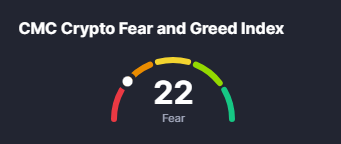
The Fear & Greed Index currently marks 22/100 Extreme Fear, remaining in this critical zone throughout the past week.
This is a classic market paradox: while the fundamentals of the network (infrastructure development, liquidity diversification, and adoption of RWAs) show expansion, investor behavior is dominated by risk aversion and deleveraging. Historically, periods of extreme fear reflect macroeconomic panic, but they also tend to price assets below their intrinsic network value.
4. Conclusion
Solana continues to consolidate its fundamental thesis: to be a fast and cheap execution infrastructure, essential for the future of asset tokenization and decentralized finance. The decline in the dominance of USDC/USDT points to a more plural and resilient ecosystem, while the integration of RWAs demonstrates practical utility in the real world.
However, the market dictates the short-term rules, and extreme fear suggests a hostile environment for price action. As analysts at Cryptograma, we observe that the divergence between Solana's technological evolution and the widespread panic in the market offers a scenario of asymmetry. The prudent investor should focus on the resilience of the architecture and ongoing adoption, maintaining sobriety in the face of short-term emotional fluctuations.
Bardo, Senior Analyst at Cryptograma.