
Global Tensions Rising: Could the United States Use Massive Non-Nuclear Bombs Against Iran’s Underground Military Facilities?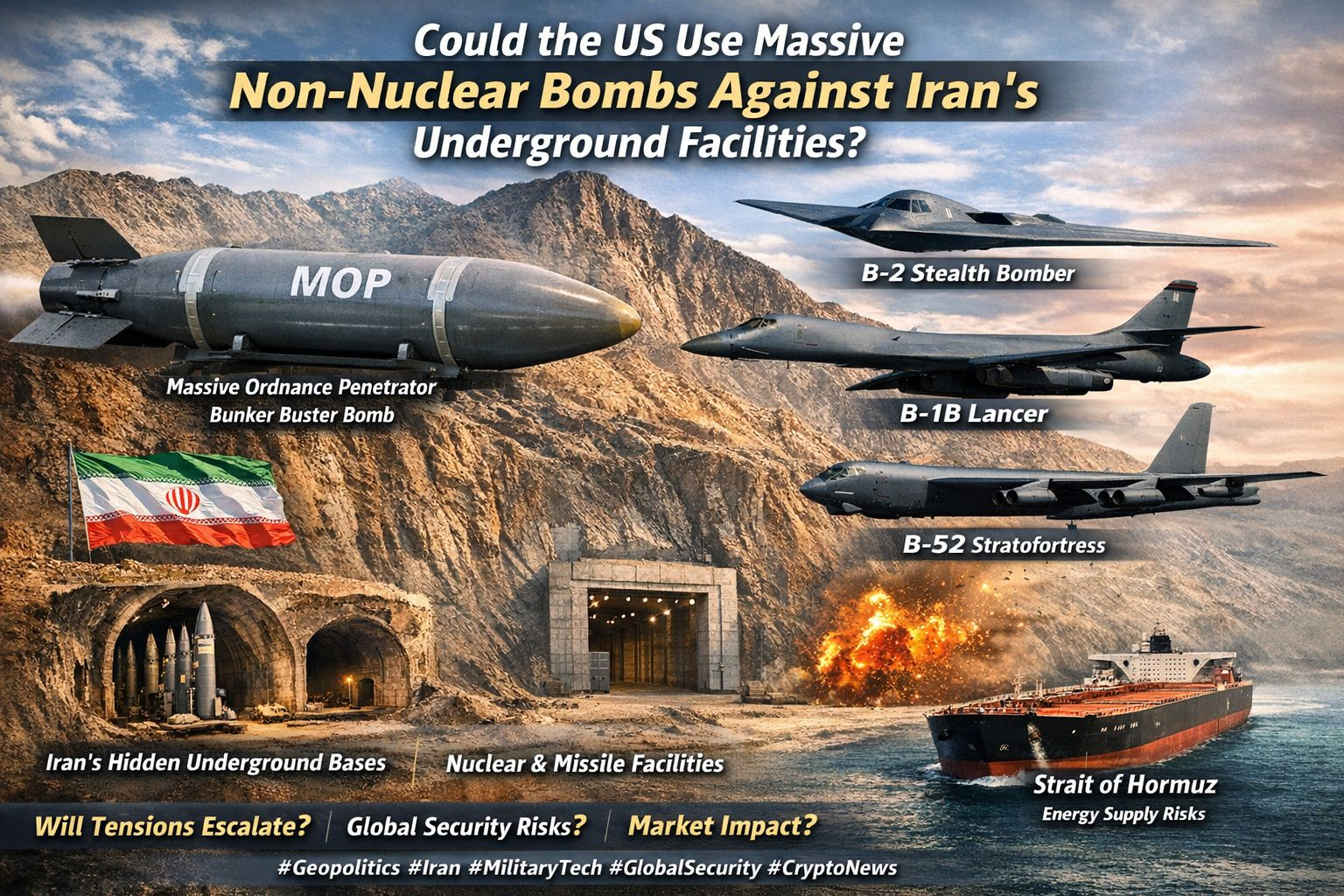
In recent weeks, global geopolitical tensions have intensified as discussions about the ongoing strategic rivalry between the United States, Israel, and Iran continue to dominate international headlines. Military analysts, intelligence observers, and geopolitical commentators have been debating a serious question: If tensions escalate further, could the United States deploy some of the world’s most powerful non-nuclear bombs to target Iran’s underground military infrastructure?
This question has sparked widespread discussion across defense circles, policy institutions, and online communities. Iran is known to possess a large network of deep underground military facilities, which are designed specifically to protect strategic assets such as missiles, drones, command centers, and nuclear-related infrastructure from aerial attacks.
These underground facilities are not ordinary bunkers. Many of them are believed to be constructed hundreds or even thousands of feet beneath mountains, reinforced with layers of concrete and rock. Because of this, conventional airstrikes often struggle to penetrate them effectively.
As a result, military strategists have long considered the possibility that specialized bunker-buster weapons or extremely large conventional bombs would be required to destroy such installations.
This raises an important question for global security observers:
What kinds of weapons could realistically target these facilities, and what would their use mean for global stability?
Understanding the Concept of Massive Non-Nuclear Bombs
The United States possesses several types of extremely powerful conventional weapons designed to destroy fortified targets.
Among the most well-known are massive bombs designed for deep-penetration strikes. These weapons are often referred to as “bunker busters” because they are capable of penetrating underground before exploding.
One of the most famous examples of large conventional bombs is the GBU‑43/B Massive Ordnance Air Blast, often nicknamed the “Mother of All Bombs.”
The MOAB gained global attention when it was used in 2017 against militant tunnels in Afghanistan. It is considered one of the most powerful non-nuclear weapons ever used in combat.
Key Characteristics of MOAB
Weight: approximately 9,800 kilograms
Explosive power: extremely high blast radius
Designed to destroy large surface targets and cave networks
Delivered by military aircraft
However, while MOAB is extremely powerful, it is not specifically designed for deep underground penetration. Instead, it produces a massive surface-level blast capable of destroying wide areas and collapsing shallow tunnels.
For deeper targets, the United States has another weapon.
The Massive Ordnance Penetrator (MOP)
When discussing underground facilities, military experts often mention the GBU‑57 Massive Ordnance Penetrator.
This bomb is designed specifically to penetrate deeply buried bunkers before detonating.
Technical Features
Weight: about 13,600 kg
Penetration capability: designed for hardened underground targets
Purpose: destroying heavily fortified military installations
Unlike the MOAB, the Massive Ordnance Penetrator focuses on precision penetration rather than wide blast radius.
This type of weapon is considered particularly relevant when analysts discuss underground facilities in countries like Iran or North Korea.
Iran’s Underground Military Infrastructure
Iran has spent decades developing extensive underground military systems.
These include:
Missile storage tunnels
Drone bases
Underground air bases
Hardened command centers
Nuclear-related research facilities
Some of the most discussed underground sites include facilities associated with Iran’s nuclear program, such as:
Fordow Fuel Enrichment Plant
Natanz Nuclear Facility
Both facilities are built partially underground or inside mountains, making them extremely difficult to destroy through conventional airstrikes.
This design strategy is intentional. Underground facilities provide protection against:
Air attacks
Missile strikes
Electronic warfare
Surveillance
Because of this, destroying such installations would require specialized deep-penetration bombs or repeated precision strikes.
Strategic Bombers That Could Deliver Such Weapons
If the United States were to conduct a strike against hardened underground targets, it would likely involve long-range strategic bombers.
Three of the most important aircraft capable of carrying heavy payloads include:
1. B‑1B Lancer
The B-1B Lancer is a supersonic bomber designed for long-range missions. It can carry a large number of conventional weapons and is capable of high-speed penetration into hostile airspace.
2. B‑2 Spirit
The B-2 Spirit is one of the most advanced stealth bombers ever built. Its radar-evading design allows it to penetrate heavily defended airspace and deliver precision strikes.
The B-2 is also one of the aircraft capable of carrying the Massive Ordnance Penetrator, making it particularly relevant when discussing underground targets.
3. B‑52 Stratofortress
The B-52 is one of the longest-serving aircraft in military history. Despite being introduced in the 1950s, it remains a crucial platform for long-range bombing missions.
It can carry large quantities of bombs and cruise missiles and is often used in strategic operations.
The Role of the United Kingdom
In many military operations, the United States works closely with NATO allies.
One of its closest partners is the United Kingdom.
The UK hosts several important US and NATO military facilities, including airbases that can support long-range operations.
Bases in the UK have historically been used during major military campaigns in:
Iraq
Afghanistan
Libya
If tensions in the Middle East were to escalate significantly, it is possible that allied bases across Europe could play a logistical or operational role.
However, such decisions are extremely complex and require political approval, international coordination, and strategic planning.
The Broader Middle East Security Situation
The tensions between Iran, Israel, and the United States have deep historical roots.
These tensions involve multiple issues:
Nuclear development concerns
Regional proxy conflicts
Missile programs
Military alliances
Over the years, the Middle East has witnessed numerous moments where tensions nearly escalated into large-scale conflict.
Because of the potential global consequences, world powers typically try to manage these situations through:
diplomacy
sanctions
negotiations
limited military deterrence
Global Implications of Escalation
Any direct large-scale military confrontation involving Iran would have global consequences.
These could include:
Energy Market Disruption
Iran sits near the Strait of Hormuz, one of the most important oil transit routes in the world.
Roughly 20% of global oil shipments pass through this narrow waterway.
Any conflict in this region could cause:
oil price spikes
shipping disruptions
global economic instability
Financial Market Impact
Geopolitical instability often affects financial markets, including:
stock markets
commodity markets
cryptocurrency markets
Traders in crypto communities often monitor geopolitical developments because uncertainty can increase volatility.
The Importance of Accurate Information
In times of global tension, information spreads extremely quickly through social media platforms.
However, not all reports are verified.
Responsible analysis requires:
checking reliable sources
avoiding spreading unconfirmed claims
distinguishing speculation from confirmed facts
This is especially important when discussing sensitive issues such as military operations or war.
Hope for Peaceful Resolution
While geopolitical tensions may rise from time to time, the international community generally seeks to avoid full-scale conflict.
Diplomatic efforts, negotiations, and international organizations continue to play important roles in preventing escalation.
Ultimately, the goal of global diplomacy is to ensure that disputes are resolved through dialogue rather than destruction.
Conclusion
The discussion about massive non-nuclear bombs and underground military facilities highlights the complexity of modern warfare. Technological advancements have created weapons capable of extraordinary destructive power, but their use carries enormous geopolitical consequences.
Whether analyzing defense technology, geopolitical strategy, or market impacts, one thing remains clear: stability in the Middle East is crucial for global peace and economic security.
For observers around the world—including investors, analysts, and everyday citizens—staying informed with accurate and balanced information is more important than ever.
#Trump'sCyberStrategy #JobsDataShock #iran #usa #MarketPullback


