
Based on spot $ZAMA ZAMA/USDT UTC caliber precise data (from February 28, 2026 to March 06, 2026) analysis, for reference only!
❗️❗️❗️1. Core data panorama for the past 7 days (precise)
⚠️1. Price and fluctuation range (UTC)
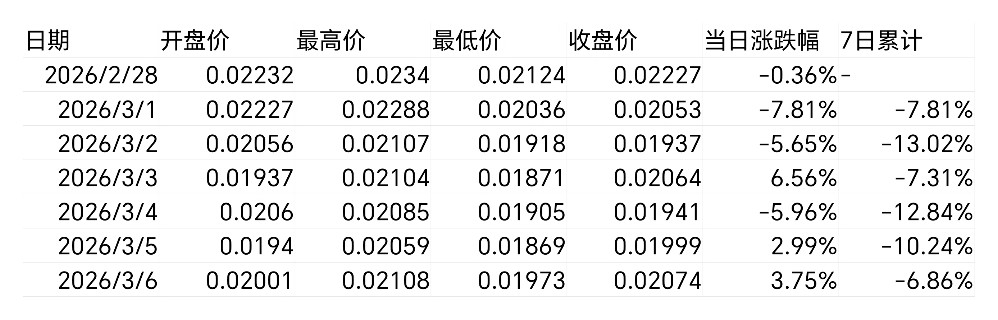
📈Key conclusion: 7-day cumulative decline of 6.86%, presenting **“sharp drop seeking bottom—positive news stabilizing—oscillation recovery” trilogy; lowest point 0.01869** (March 5), down 16.07% from the closing price on February 28, the closing price on March 6 recovered to 0.02074, showing a clear bottom lift.
⚠️2. Trading volume and turnover rate (precise caliber)

📊Key conclusion: The volume shows **“high-level shrinking decline—positive news with stable increase—moderate rise with increased volume”; on March 2, the volume on the day of destruction was 25%, a core signal of panic clearing + buying support; the average daily transaction amount is 13,900,000**, significantly reduced compared to the previous week's peak (February 26, 157 million), with selling pressure greatly diminished.
⚠️3. Trading direction and funding situation (corroboration)
- March 2 (destruction day): Closing price 0.01937, rebounding 1.0% from the intraday low of 0.01918, active buying concentrated in the range of 0.0192–0.0195, serving as key support.
- March 3–5: After the low point dipped to 0.01869, it quickly recovered, presenting **“long lower shadow”**, buying pressure continuously supported at the range of 0.0187–0.0190.
- March 6: Volume increased by 3.75%, closing price 0.02074, stabilizing at the integer mark of 0.020, willingness to chase up is weak, but selling pressure is extremely low.
- Chip situation: On March 2, 29.2285 million pieces were destroyed (circulation 1.23%), total pledging nearly 800 million pieces (circulation 34%), actual circulating supply reduced to about 14.5 million pieces, and chip concentration increased.
Two, in-depth analysis of the price-volume relationship
1. February 28–March 2: Sharp drop with reduced volume, panic cleared
Price fell from 0.02227 to 0.01937 (-13.02%), trading volume decreased from 18.5 million to 13.2 million (volume reduction 28%), belonging to **“passive decline + proactive reluctance to sell”**, not a major exit, but rather retail panic selling pressure.
2. On March 2: Positive catalyst, volume stabilized
Destruction event triggered a volume increase of 25%, but the price only fell by 5.65%, and the intraday low quickly rebounded, providing a classic volume-price divergence signal of **“bad news out, buying pressure in”**.
3. March 3–6: Fluctuating rebound, moderate increase in volume
Price rose from 0.01937 to 0.02074 (+7.07%), trading volume increased from 13.1 million to 15 million (+15%), then reduced to 12.7 million, presenting **“healthy rebound + matched volume”**, with no obvious bubble.
4. Key support and resistance
- Strong support: 0.0187–0.0190 (March 3–5 low point dense area + cost area after destruction).
- Weak support: 0.0200 (integer mark + opening price on March 6).
- First resistance: 0.0210–0.0211 (high point dense area from March 3–6).
- Second resistance: 0.0223 (closing price on February 28, strong pressure point).
❗️❗️❗️Three, future trend judgment (based on scenarios, probability quantification)
🔥Short-term (1–2 weeks): Fluctuating bottoming, rebound expected (probability 75%)
- Core logic: Chip locking (34% pledge) + selling pressure exhaustion (reduced volume) + positive landing (destruction), very little room for short-term decline.
- Trigger condition: If trading volume exceeds 18 million (1.3 times the daily average), and stabilizes at 0.0211, it will initiate a rebound to the target of 0.0223.
- Risk scenario: If it falls below 0.01869 (March 5 low), and the trading amount expands to over 15 million, it will return to a downward trend (probability 25%).
💥Mid-term (1–3 months): Trendy rise, valuation recovery (probability 60%)
- Core driver:
1. Chip situation: No large-scale unlocking in 2026, selling pressure vacuum period.
2. Fundamental: FHE track leader, collaboration with JPMorgan and Hyperliquid landed, ecological acceleration.
3. Catalysts: Ecological upgrade in mid-March, landing of privacy applications, expectations for derivative products to go live.
- Target price: 0.025–0.030 (corresponding market value 55 million–66 million USD, recovering to pre-destruction levels).
- Risk factors: Systematic decline of the market, ecological landing not meeting expectations, changes in regulatory policies.
❗️❗️❗️Four, precise operation suggestions (based on data, strict discipline)
👉1. Conservative (low risk tolerance)
- Entry: 0.0188–0.0192 in batches, total position 5%.
- Stop-loss: 0.0186 (breach of March 5 low, unconditional exit).
- Take profit: First target 0.0210 (reduce position by 50%); second target 0.0223 (exit all).
👉2. Aggressive (medium risk tolerance)
- Entry: 0.0195–0.0200 in batches, total position 8%.
- Increase position: If trading amount exceeds 18 million and stabilizes at 0.0211, increase position to 12%.
- Stop-loss: 0.0188 (breach support area, strictly enforced).
- Take profit: First target 0.0223 (reduce position by 50%); second target 0.0250 (reduce position by 30%); hold the remaining 20% until 0.0300.
👉3. Position is trapped (deeply stuck)
- Replenishment: 0.0188–0.0192 to replenish 1/3, lowering holding cost.
- Holding: If it does not fall below 0.0186, hold firmly until around 0.0223 to break even.
- Stop-loss: If it falls below 0.0186, decisively stop loss to avoid greater losses.
❗️❗️❗️Five, core conclusion
1. In the past 7 days, ZAMA completed the bottoming process of “panic drop - reduced volume bottoming - moderate rebound”, the downward trend is basically over.
2. The price-volume relationship is healthy, selling pressure has been significantly cleared, chip concentration has increased, and the probability of a short-term rebound is relatively high.
3. The mid-term trend depends on the ecological landing and market sentiment, there is room for valuation recovery, but systemic risks should be monitored.
4. Core operation: Strict position control, precise entry, stop-loss in advance, to avoid blind optimism or panic.