
For years, the "last mile" of blockchain adoption has been the primary hurdle for the industry. While decentralized finance (DeFi) flourished in the digital ether, the practical application of these assets at the physical Point-of-Sale (POS) remained a clunky, theoretical exercise. The perennial question for the retail investor has been: Can a decentralized protocol provide a frictionless experience for buying basic goods?
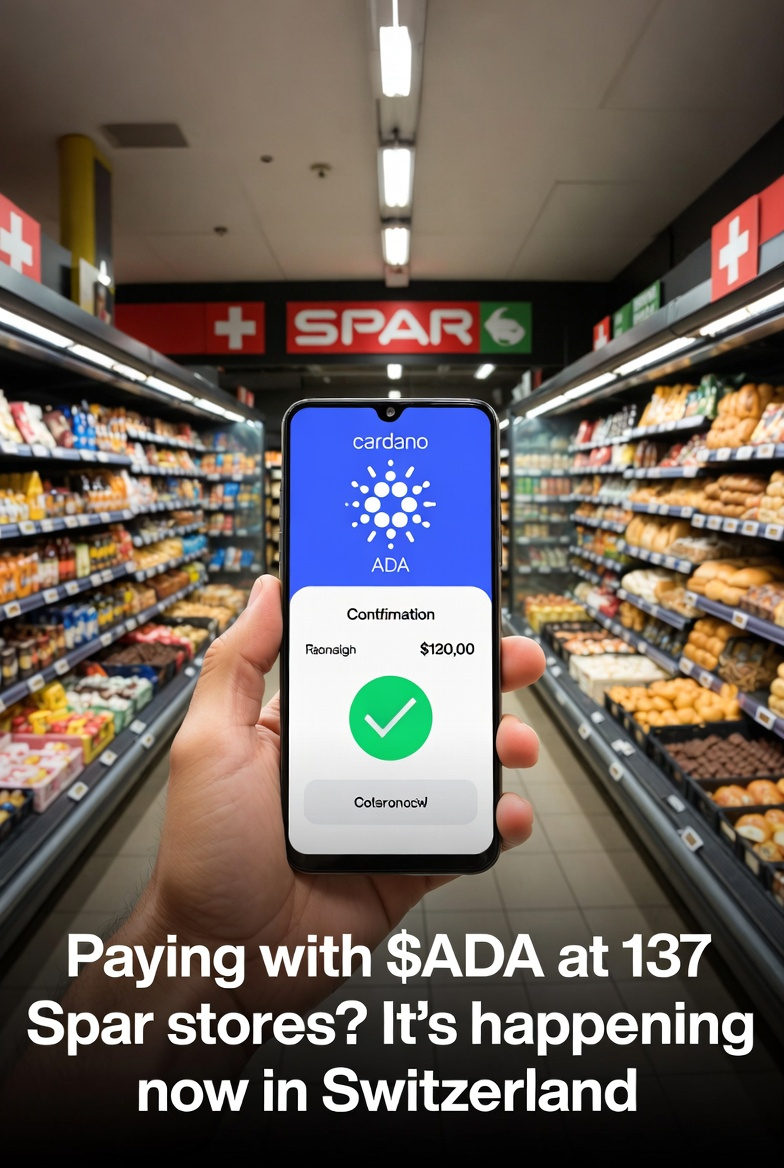
Switzerland has just provided a definitive answer. Cardano (ADA) has crossed a major utility threshold with its integration into 137 Spar stores across the country. This isn't merely a pilot program; it is a significant deployment of blockchain technology into a major retail brand’s daily operations, signaling a shift in how digital assets move from speculative wallets to the grocery aisle.
The Scale of Physical Integration: A High-Density Testing Ground
The acceptance of ADA at 137 Spar locations represents a massive leap in tangible retail footprint. In a country the size of Switzerland, this number reflects a high-density saturation that allows for a legitimate assessment of network performance in a live retail environment.
On-Chain Settlement in the Real World This integration moves ADA from a digital "Store of Value" into a functional "Medium of Exchange." By establishing infrastructure that allows for on-chain assets to be used for daily necessities, Cardano is effectively testing its network velocity—the speed at which money circulates within an economy—against the demands of high-volume retail traffic.
Reducing Friction at the POS For retail adoption to succeed, the transaction must be invisible to the consumer. The widespread acceptance across 137 locations suggests that the underlying POS infrastructure is now capable of handling ADA with the same efficiency as legacy fiat systems. This reduces the friction that has historically kept crypto-payments relegated to niche online forums.
Switzerland: The Strategic Proving Ground for Regulatory Clarity
The choice of Switzerland as the launchpad for this retail integration is no accident. As a "Blockchain Adoption Specialist" would note, Switzerland is the global epicenter of financial innovation, anchored by the famous "Crypto Valley" in the canton of Zug.
The Swiss regulatory environment, overseen by the Financial Market Supervisory Authority (FINMA), provides the precise legal clarity that institutional and retail brands like Spar require to integrate digital assets. This integration reinforces Cardano’s presence in a mature market where the distinction between "crypto speculation" and "financial technology" is clearly defined.
"Cardano price prediction as ADA accepted at 137 Spar stores in Switzerland"
This headline, which recently rippled through fintech circles, underscores why Switzerland serves as the ultimate litmus test for global scalability. If a blockchain protocol can succeed in the rigorous and sophisticated Swiss market, it serves as a blueprint for global expansion.
Adoption as the New Foundation for Price Forecasting
The news of the Spar integration fundamentally alters the methodology behind Cardano price predictions. Traditionally, ADA’s value was a derivative of technical chart patterns and social media sentiment. However, we are now entering an era of utility-driven valuation.
* The Application of Metcalfe’s Law: The value of a network is proportional to the square of its users. By adding 137 physical nodes (stores) where ADA can be utilized, the network effect grows exponentially, creating a more predictable "valuation floor."
* Utility-Driven Stability: Unlike speculative trading, retail usage creates consistent, non-discretionary transaction volume. This volume provides a stabilizer against the volatility often seen on centralized exchanges.
* A Shift in Market Sentiment: Analysts are increasingly looking at "real-world" KPIs—such as the number of active retail integrations—rather than just exchange liquidity to forecast long-term price action.
The Grocery Store Test: A Localized Experiment or a Global Shift?
The integration of Cardano into 137 Spar stores in Switzerland represents a successful passing of the "grocery store test." It proves that blockchain-based payments are no longer a futuristic concept but a functional reality capable of meeting the demands of established global retailers.
The question now facing the fintech industry is whether this Swiss model is an isolated success story or the first domino in a global retail shift. If Cardano can maintain seamless, low-friction transactions at this scale, the move from the "Crypto Valley" to the global high street may happen
sooner than the markets anticipate.
