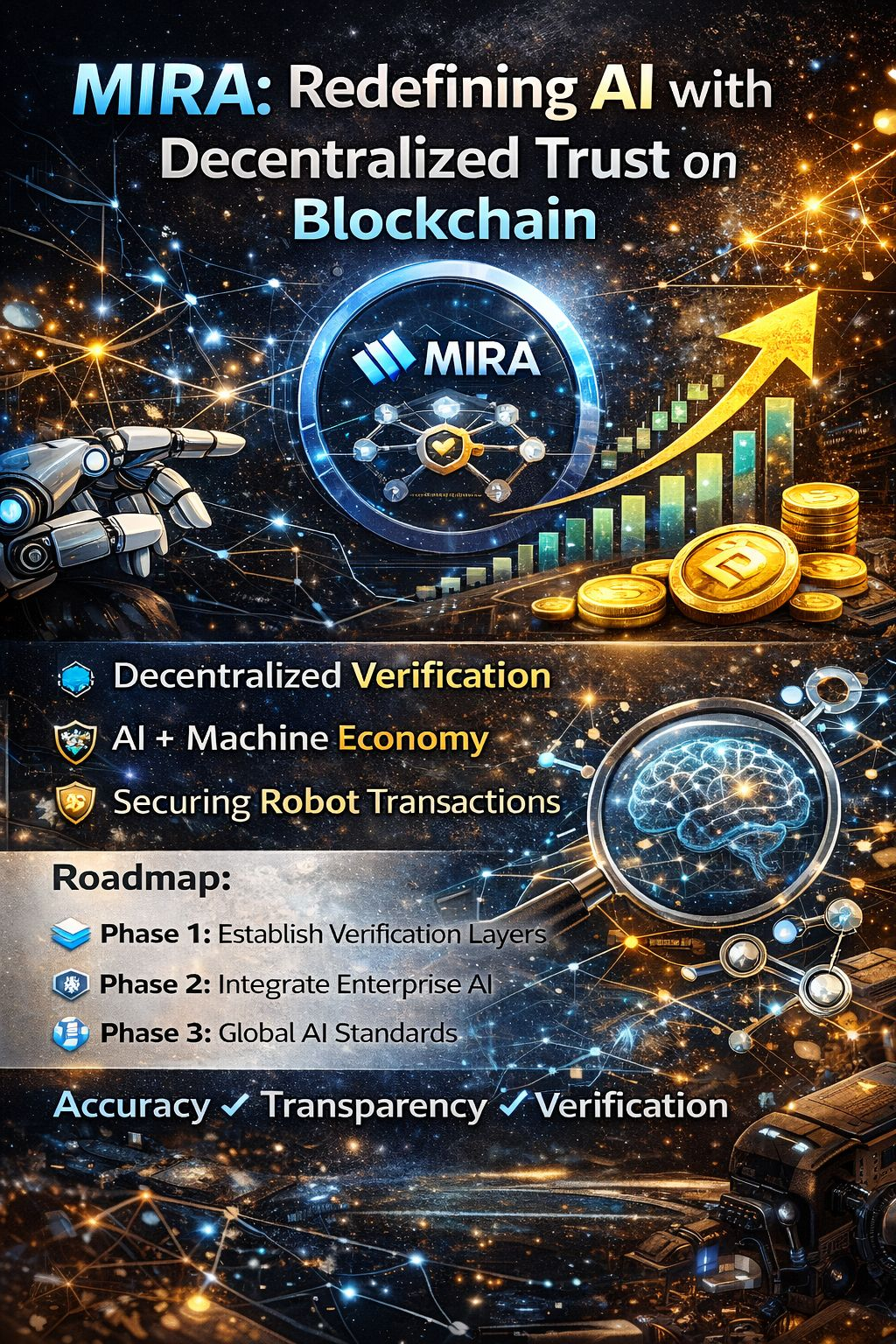
As blockchain and artificial intelligence integrate deeper, the biggest challenge facing adoption is trust. Mainstream AI systems often produce outputs that are impressive but unverifiable — which limits use in high-stakes environments like finance, law, or healthcare. Enter MIRA — a project focused on enabling verifiable AI logic and actions through decentralized networks.
Rather than chasing generative AI token hype, MIRA’s core thesis is establishing a trust protocol for autonomous systems. Its architecture allows independent nodes to validate AI results before they are accepted on chain.This shift from opaque AI outputs to verifiable claims could shape how AI is employed not just in crypto but across global industries.
Core Value Proposition
At the heart of MIRA is the idea that accuracy and verifiability matter. Current AI systems often suffer from hallucinations — where outputs appear convincingly correct but are factually wrong. For mainstream adoption, especially in regulated sectors, systems must be auditable, transparent, and reliable.
MIRA addresses this by enabling:
Decentralized verification of AI outputs
Secure logging of decision paths on blockchain
Incentive mechanisms for third-party validators
This combination allows developers, businesses, and end users to trust the logic used by AI agents.
Progress and Developments
MIRA has achieved a number of foundational milestones:
Exchange Visibility: MIRA’s token listing on major exchanges has broadened its market exposure and liquidity.
Community Growth: Organic discussion of MIRA’s narrative shows up consistently on crypto forums, driven by developers and tech-savvy investors.
Technical Releases: Core testnet phases have enabled early verification modules and partnerships with validator nodes, laying the groundwork for mainnet adoption.
Challenges Ahead
Despite strong fundamentals, MIRA faces some barriers:
Technical complexity — decentralized AI trust is a high-skill problem
Regulatory scrutiny on AI accountability
Competition from centralized AI governance solutions
However, these challenges also highlight why a decentralized trust layer could be valuable — big tech may resist openness, giving MIRA an edge in specific markets.
Roadmap and Vision
MIRA’s roadmap focuses on expanding its trust infrastructure:
Short-Term: Build validator network, enhance accuracy modules
Mid-Term: Integrate with enterprise AI platforms
Long-Term: Establish global standards for AI verifiability
This vision, while ambitious, aligns with how industries are expected to adopt trustworthy AI.
Final Take
$MIRA isn’t about surface-level AI token hype. Its core narrative — enabling verifiable AI logic on decentralized networks — addresses a structural problem in technology. While the path to mainstream adoption is challenging, MIRA’s focus on trust, transparency, and verifiability positions it as one of the more technically grounded projects in the AI + crypto space.
#MİRA $MIRA @Mira - Trust Layer of AI #AIBinance #StockMarketCrash