
🚀 Is Fabric Foundation Building the Infrastructure for AI-Native Economies?
The global economy is entering a new phase — one where artificial intelligence doesn’t just assist businesses but actively participates in economic systems. From autonomous agents making transactions to decentralized AI marketplaces, we are witnessing the rise of AI-native economies 🤖💸
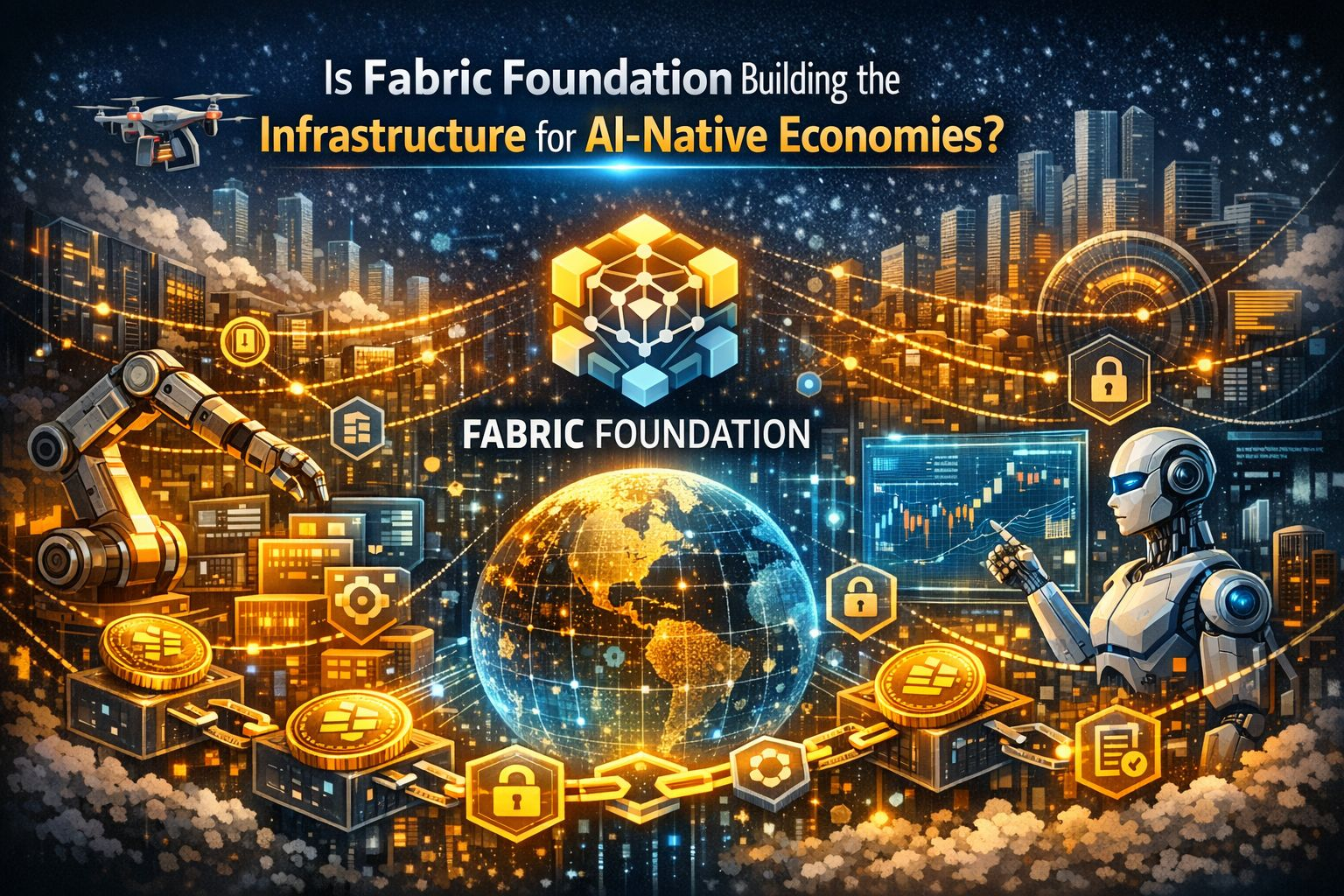
At the center of this evolution is the Fabric Foundation, an organization positioning itself as a foundational layer for decentralized, AI-powered ecosystems.
So the big question is: Is Fabric Foundation truly building the infrastructure for AI-native economies? Let’s break it down.
🌐 What Is an AI-Native Economy?
An AI-native economy is one where:
🤖 AI agents can own assets
🔐 Machines can transact autonomously
📊 Smart systems negotiate, trade, and execute contracts
🌍 Decentralized networks coordinate AI services
Instead of humans being the sole economic actors, AI systems become participants.
This shift requires infrastructure that supports:
Identity for AI agents 🪪
On-chain coordination 📡
Scalable compute ⚙️
Data marketplaces 📦
Secure value exchange 💳
And this is where Fabric Foundation enters the conversation.
🧱 Fabric Foundation’s Core Vision
Fabric Foundation aims to build a programmable economic layer for AI systems.
Their approach appears to focus on:
1️⃣ AI Agent Infrastructure
Enabling AI agents to:
Operate autonomously
Interact with decentralized systems
Execute transactions securely
This could allow AI systems to:
Rent compute 🖥️
Purchase datasets 📊
Provide services in exchange for tokens 💰
2️⃣ Decentralized Coordination Layer
Instead of centralized AI platforms controlling everything, Fabric promotes:
🌐 Distributed networks
🔄 Interoperable AI modules
🛠️ Composable economic primitives
This aligns with broader Web3 principles of openness and permissionless innovation.
3️⃣ Tokenized Incentive Systems
AI-native economies require:
Incentives for data providers 📂
Rewards for compute operators ⚡
Mechanisms for validation and trust 🛡️
Tokenization helps create programmable rewards that align ecosystem participants — both human and machine.
🏗️ Why Infrastructure Matters
Building AI-native economies isn’t just about smarter models. It’s about:
🔐 Verifiable trust
📜 Automated agreements
⚡ Scalable coordination
🧠 Agent interoperability
Without proper infrastructure, AI remains siloed inside corporate platforms.
Fabric Foundation’s thesis suggests that AI needs its own economic rails, much like the internet needed TCP/IP to scale globally 🌍.
🔍 How It Compares to Traditional AI Ecosystems
Traditional AI ecosystems:
Controlled by centralized cloud providers ☁️
Monetized through subscription models 💳
Limited interoperability 🔒
AI-native infrastructure (as proposed by Fabric):
Open economic participation 🌐
Machine-to-machine transactions 🤝
Decentralized governance 🗳️
Tokenized value exchange 💎
This marks a philosophical shift from AI as a tool to AI as an economic actor.
🧠 The Bigger Picture
If successful, infrastructure like Fabric could enable:
🤖 Autonomous AI startups
📈 Self-managing digital funds
🛍️ AI-driven marketplaces
🏢 Decentralized autonomous corporations
In such systems:
AI agents negotiate contracts
Services are priced algorithmically
Economic decisions happen at machine speed ⚡
⚖️ Challenges Ahead
Of course, building AI-native economies is complex:
Regulatory uncertainty 📜
Security risks 🔓
Governance design ⚖️
Scalability bottlenecks 🚧
Infrastructure projects must prove:
Real developer adoption
Sustainable tokenomics
Secure AI execution environments
Without these, vision alone won’t be enough.
🔮 So… Is Fabric Foundation Building the Future?
Fabric Foundation appears to be tackling one of the most important layers in the AI revolution: economic infrastructure.
If AI is going to:
Own wallets
Execute smart contracts
Provide services autonomously
Then it needs programmable economic rails.
Fabric’s strategy suggests it’s not just building tools for AI —
it’s building the financial and coordination layer for machine economies 🏛️🤖
Whether it becomes the foundational layer will depend on adoption, execution, and ecosystem growth. But conceptually, the direction is clear:
The next economy may not just be digital.
It may be AI-native. 🚀🌐
If you'd like, I can also:
📊 Turn this into a LinkedIn-ready version
📰 Format it as a publication editorial
🧠 Make it more technical for a Web3 audience
🎯 Or simplify it for a general tech readership