Executive Summary
Tokenization of Real-World Assets (RWA) without continuous verification mechanisms merely shifts risk from the physical world to the blockchain. The main challenge is not in the token issuance, but in the accuracy of valuations, the integrity of reserves, and dynamic regulatory compliance.
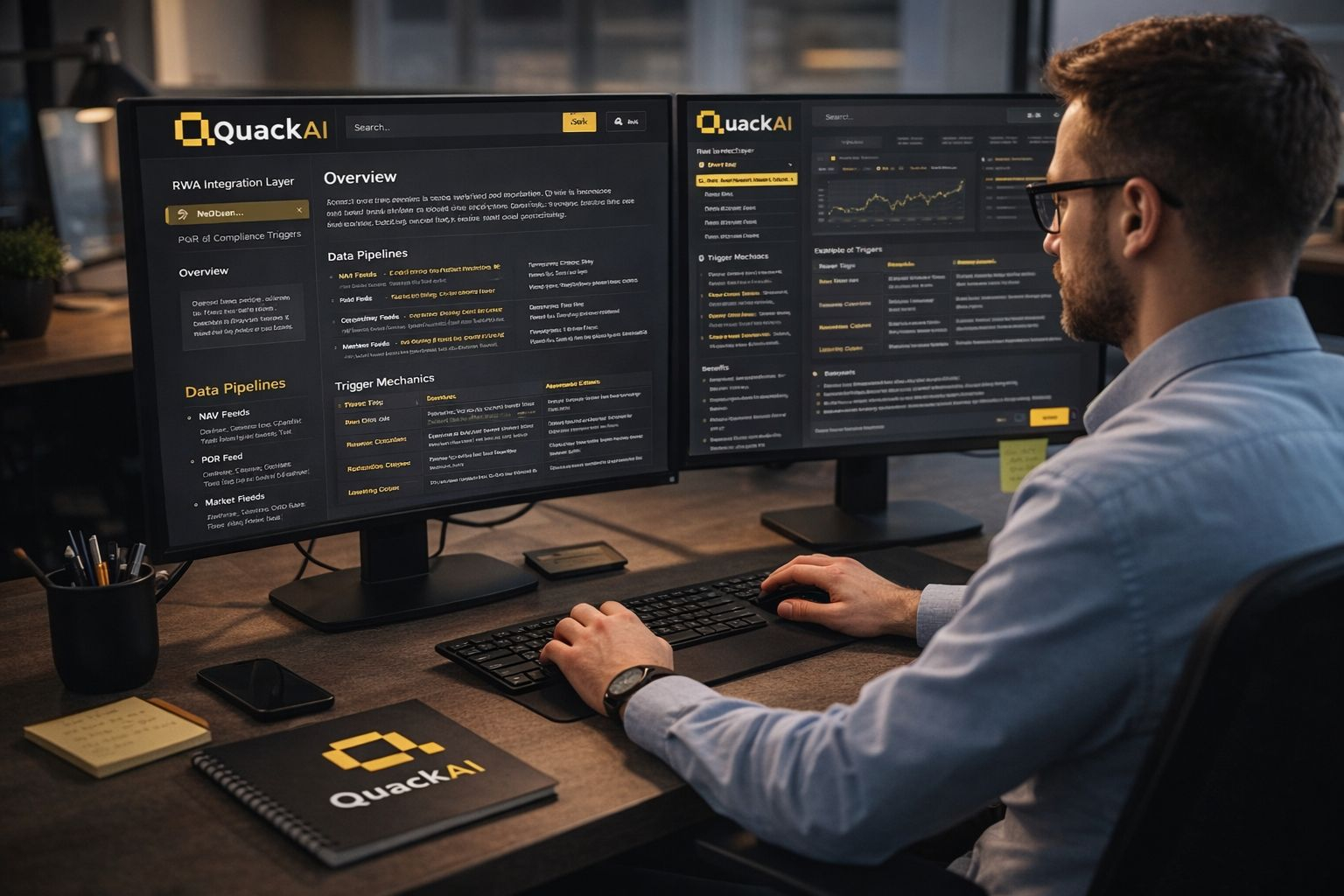
@QuackAI introducing the RWA Integration Layer that combines Continuous NAV Tracking, Proof-of-Reserve (PoR) Verification, and Automated Compliance Triggers. This system creates a direct link between real-world data and on-chain execution, allowing each token to function as a living digital representation of its underlying assets.
Fundamental RWA Issues
Most RWA projects face four structural risks:
Valuation Lag – NAV is updated manually or periodically without real-time synchronization.
Reserve Opacity – No ongoing reserve verification.
Regulatory Drift – Regulatory changes are not automatically reflected in smart contracts.
Liquidity Shock – Market imbalances can cause mispricing or redemption stress.
Without an automatic trigger system, responses to anomalies are reactive and slow.
Data Layer Architecture
1. NAV Feeds
Source: Custodian or fund administrator API
Frequency: Hourly / Daily
Function:
Updating token valuation
Adjusting governance ratios
Calibrating risk parameters
2. Proof-of-Reserve (PoR) Feeds
Source: Attestation from audited banks or exchanges
Frequency: Periodic
Function:
Ensuring reserve adequacy
Reducing under-collateralization risk
3. Regulatory Feeds
Source: Jurisdiction filings or compliance API
Frequency: Event-based
Function:
Updating policy template
Adjusting operational thresholds
4. Market Feeds
Source: Price Oracle from DEX and CEX
Frequency: Real-time
Function:
Cross-check NAV
Detection of market mispricing
All feeds are aggregated through the Oracle Network before being processed by the analytical engine.