

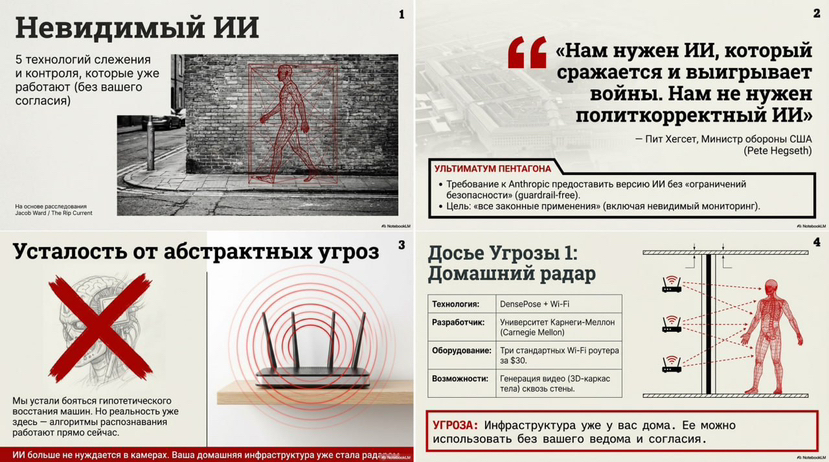
The 'Big Brother' metaphor has long turned into an engineering challenge. Against the backdrop of the conflict surrounding Anthropic and the military's demands to lift restrictions on models like Claude, a more important question remains in the shadows: what real technological capabilities already exist — outside the public agenda.
Below are not fantasies, but areas of development that researchers and defense analysts openly discuss.
1. 'Transparent' walls through Wi-Fi
Modern radio frequency sensing systems use reflections from Wi-Fi and other signals to reconstruct the silhouette of a person behind a wall.
AI learns to highlight micro-movements - breathing, gestures, movement.
This means:
• detection of presence without cameras
• tracking movement indoors
• potential identification by behavioral pattern
The camera is no longer mandatory.
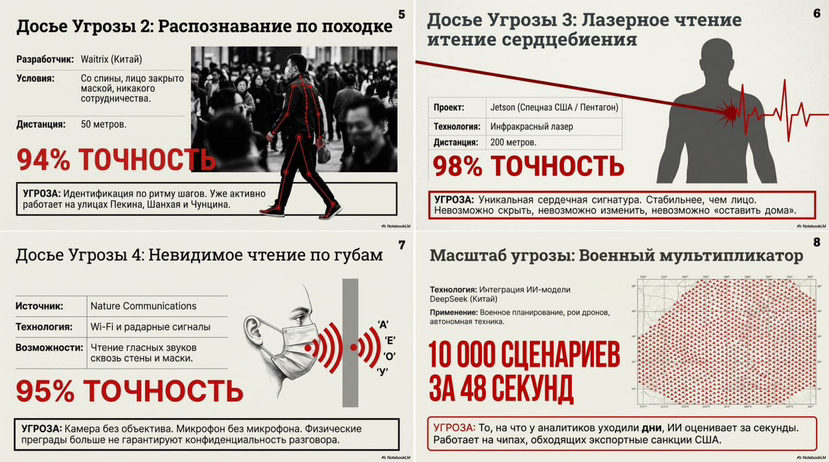
2. Identification by heartbeat from a distance
Laser vibrometry captures micro-vibrations of the surface caused by the pulse.
AI analyzes a unique cardiac rhythm as a biometric fingerprint.
In practice, this is:
• identity recognition without contact
• identification without a face and fingerprints
The heart becomes a password.
3. Gait recognition
Computer vision systems, actively developed in China, analyze:
• step length
• dynamics of movement
• joint angles
Even if the face is covered and a person is standing with their back, the algorithm can determine identity with high probability.
Have you disabled facial recognition?
A person's gait still 'speaks'.
4. Behavioral prediction
Generative and predictive models are capable of:
• build a personality profile
• predict reactions
• identify tendencies towards certain actions
This is no longer just surveillance, but an attempt to model intentions.
5. Autonomous swarms of drones
AI management systems allow:
• distribute targets
• coordinate maneuvers
• adapt to changing situations
Technically, the full cycle of 'detect - identify - strike' can be performed without human micro-control at each stage.
This changes the very architecture of combat operations.
6. Large-scale real-time data analysis
AI is capable of combining:
• cameras
• intercept signals
• financial transactions
• movements
And build a dynamic picture of the activities of millions of people.
Processing speed is the key difference from the past.
7. Information influence at the individual level
Language models can:
• generate personalized messages
• adapt to psychological profiles
• reinforce beliefs
This is no longer mass propaganda.
This is point cognitive engineering.
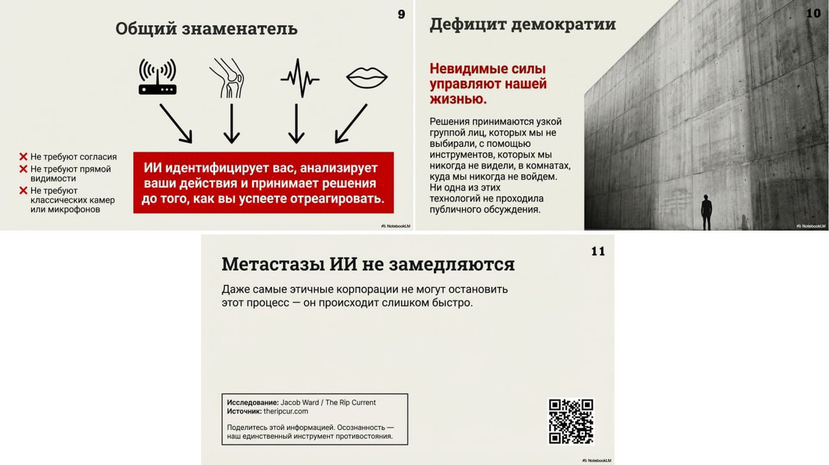
Why is this related to the conflict around AI?
If a private company imposes restrictions on the application of models, while state structures demand access without additional barriers, this is not about marketing.
This is about control over tools that:
• make a person transparent
• allow predicting behavior
• automate critical decision-making
AI is becoming more than just technology.
It becomes an infrastructure for observation and control.
The main question
Technologies already exist.
The question is not whether they are possible.
The question is:
• who controls their application
• what limitations will be embedded
• will a person remain the final instance of decision-making
'Big Brother' is not dead.
It has become a distributed computing system.