
> What if your delivery robot no longer needed your credit card to recharge its battery, or if the AI server you are using paid for its own updates? For the first time in history, the Fabric Foundation gives a wallet to machines. The future is not only intelligent; it is financially sovereign.
> 
The Missing Link of Robotics: Money
So far, robots and AIs, even the most advanced ones, were just tools. They performed tasks but were entirely dependent on their human owners for any financial transactions. A robot could neither own, nor spend, nor invest.
The Fabric Foundation radically shifts this paradigm by integrating a Layer 1 (L1) decentralized financial infrastructure powered by the $ROBO token. The goal: to transform the machine from a mere cost center into an autonomous economic agent.
The Token: The First Fuel for the M2M Economy
It is not just another cryptocurrency for human speculation. It is the benchmark for measuring the value produced by machines, designed specifically for the Machine-to-Machine (M2M) economy. Here are the three technical pillars that underpin its operation:
1. Autonomous Wallets for Machines
Thanks to the Account Abstraction standard—similar to ERC-4337—each robot on the Fabric network has its own autonomous wallet. It is no longer controlled by a complex private key that a human must secure, but by a programmable Smart Contract.
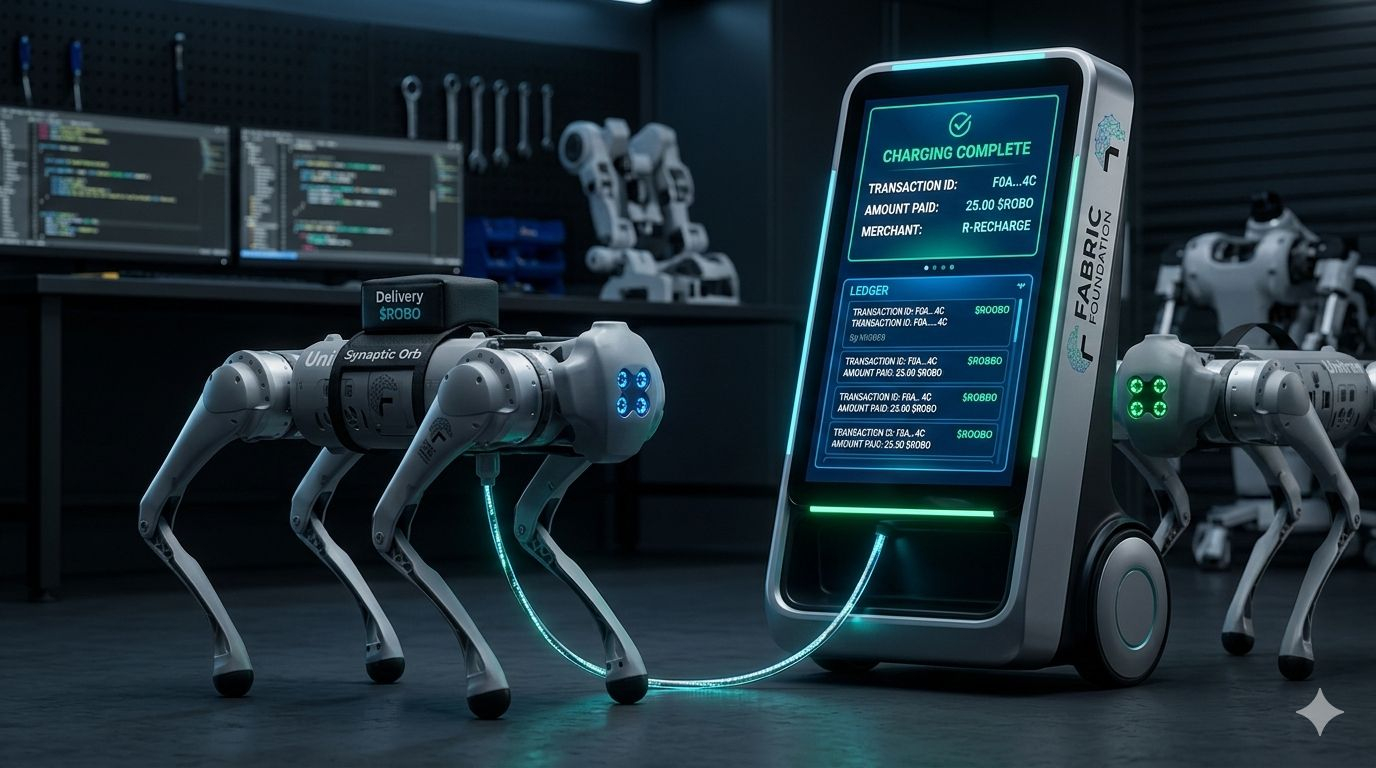
Concrete example: An OpenMind/Unitree delivery robot receives its payment directly at the end of each delivery. It can then, without any human intervention, use these $ROBO to pay tolls, cover its electric charging fees, or finance its maintenance.
2. The $ROBO com as Network Fees (Gas)
Every technical interaction on the Fabric network—whether it’s validating a block of sensor data, executing a payment transaction, or any other operation—requires $ROBO. This generates an organic, intrinsic demand tied to the actual activities of robots. The more they work, the more the token is used.
3. Proof of Robotic Work
Beyond mere payments, the Fabric Foundation introduces a concept of reputation. A robot can “stake” (lock up) $ROBO to guarantee the reliability of its services. An AI-powered trading bot or a production unit can use $ROBO staking as a performance guarantee toward its clients.
Conclusion: The Machine, a New Economic Agent
By equipping machines with a wallet, the Fabric Foundation does not merely create a new class of services; it gives rise to a new economic actor. The token serves as the link that enables an AI to interact not as a program, but as a financially responsible contractor. We are moving from the Internet of Things to the Internet of Sovereign Machines.
#FabricFoundation #ROBOtoken #M2M #EconomyOfThings #DePIN #BlockchainRobotique #AutonomousAI #Unitree #OpenMindAGI#DecentralizedEconomy
