
With a crypto ecosystem already exceeding $7.7 billion, Iran has established itself as the fourth largest global mining hub, moving its operations to tunnels and bunkers to evade energy collapse and sanctions.
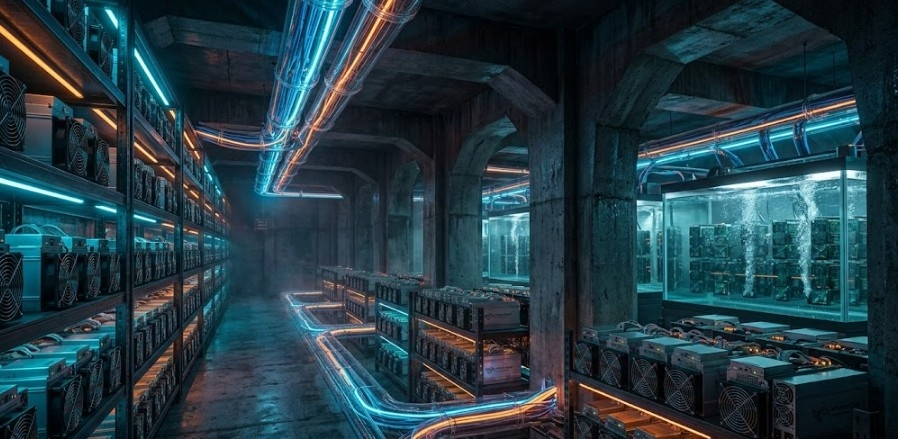
Operations under Permafrost and Concrete
What began as a pragmatic response to the abundance of subsidized natural gas has transformed into a critical "state survival" infrastructure. Recent research and network intelligence data confirm that mining in Iran has migrated from visible industrial warehouses to sophisticated underground complexes. Among the most notable findings from late 2025 to early 2026 is the dismantling of hidden farms in tunnels beneath sports infrastructures — such as the Ahvaz Stadium — and industrial areas on the outskirts of Tehran.
These facilities are not simple rooms with fans; they are engineering works with immersion cooling systems, dedicated water tanks, and satellite connectivity to mitigate national blackouts that have affected 80% of the country. It is estimated that more than 427,000 mining devices operate in the country, of which 95% lack official licenses, operating in a gray area where the boundary between the private sector and state entities, such as the Revolutionary Guard (IRGC), is almost non-existent.
Resilience Against Disconnection
From a network architecture perspective, the Iranian model represents a case study on the resilience of hashrate in the face of geopolitical adversity. Underground mining in Iran has driven forced innovations in three key areas:
Latency Tolerant Pool Protocols: Due to recurring internet blackouts, local miners have adopted protocols that allow the propagation of blocks through data bursts and long-range radio frequencies.
Decentralized Energy Sovereignty: The use of microgrids powered by excess gas (flaring) in remote sites allows these farms to operate independently from the national power grid, which suffers from a chronic deficit of 1,400 MW.
On-chain Obfuscation: The integration of mixing services and the massive use of USDT by the Central Bank of Iran (accumulating over $500 million to stabilize the rial) show a technological symbiosis where mined Bitcoin immediately becomes reserve currency for critical imports.
This deployment changes the game: mining is no longer just an economic activity but a tool for national defense and evasion of sanctions that operates beyond the reach of traditional surveillance.
Towards a "Hashrate Intranet"?
In the next 2 to 5 years, we anticipate that Iran will attempt to formalize this "tunnel economy." With the support of recent technological agreements (such as the $25 billion plan with Russia for energy infrastructure), we are likely to see the creation of Underground Crypto Economic Zones.
However, this centralization under state control poses a risk to the decentralization narrative of Bitcoin. If 50% of the country's crypto flow remains linked to sanctioned entities, international pressure for "block labeling" (blocks mined in specific jurisdictions) could intensify, creating a "two-tier" Bitcoin market. For mass adoption, this means the protocol must demonstrate whether its technical neutrality can withstand global regulatory fragmentation.
Key Data
Operational Capacity: Approximately 4.2% of the hashrate global Bitcoin originates from Iranian territory.
Transaction Volume: The ecosystem reached $7.780 billion in 2025, with projected growth for 2026.
State Control: It is estimated that addresses linked to the IRGC processed more than $3.000 billion in the last year.
Sanctions: More than 187 addresses have been identified and sanctioned by international bodies in the last six months.
