
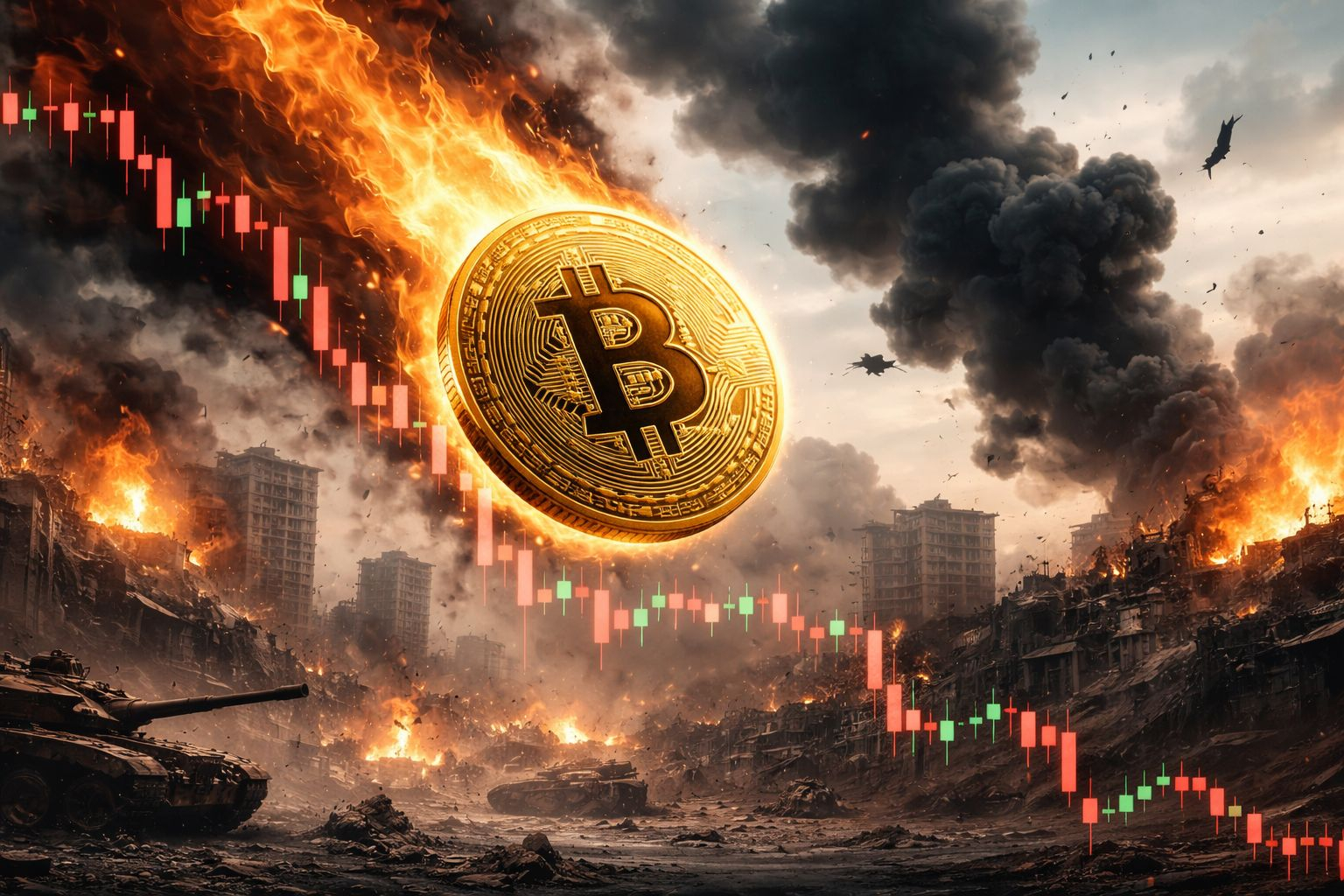
At a moment where politics intersects with markets, $BTC dropped to a level of $66,000 amid a clear wave of risk aversion, driven by escalating geopolitical tensions in the Middle East. This decline was not just a fleeting price movement, but reflects a shift in global investor appetite, raising fundamental questions about the position of cryptocurrencies in the 'safe haven' equation during crises.
📊 First: What happened in the market?
As geopolitical news escalates, global markets have experienced a state of volatility:
📉 Decline in global stock markets.
💵 Increased demand for the US dollar.
🪙 Relative rise of gold as a traditional safe haven.
₿ Bitcoin’s drop to $66,000 follows a wave of profit-taking and a surge in stop-loss orders.
The digital market is inherently more sensitive to sudden shifts in global liquidity. When capital flows to safe assets, high-risk assets – led by cryptocurrencies – are often the first to face selling pressure.
🌍 Geopolitics and its impact on crypto
In times of regional escalation:
The institutional investor tends to reduce exposure to volatile assets.
Hedge funds are rebalancing their portfolios.
Liquidity temporarily withdraws from high-risk markets.
⚠️ Although Bitcoin has often been described as 'digital gold', its behavior in crises is still closer to high-risk technology assets than it is to being a traditional safe haven.
💡 Why did $BTC drop specifically?
There are several overlapping factors:
1️⃣ Risk aversion (Risk-Off Mode)
When tensions rise, the market shifts to a cautious mode. Investors prefer:
Government bonds
The dollar
Gold
While positions are being reduced in:
Cryptocurrencies
Technology stocks
Leveraged assets
2️⃣ Liquidation of leveraged positions
📉 As the price falls below technical support levels, liquidation orders for derivatives contracts were activated, accelerating the decline.
3️⃣ The psychological factor
The digital market relies heavily on momentum and confidence. Significant negative news quickly affects the overall mood, especially with its instant spread via social media.
🧠 Is Bitcoin a safe haven or a high-risk asset?
This question arises with every crisis.
The comparison
Gold 🟡
Bitcoin ₿
Long history
✔️
❌
Relatively low volatility
✔️
❌
Limited supply
✔️
✔️
Increasing institutional acceptance
✔️
✔️
Although Bitcoin shares scarcity with gold, its price behavior is still more related to global liquidity and investor sentiment than it is to the role of a traditional safe haven.
📈 What comes after the level of $66,000?
Possible scenarios:
🔹 Stability scenario
If geopolitical tensions ease quickly, we may see:
Return of risk appetite.
Technical rebound towards levels of $70–72,000.
🔹 Escalation scenario
In case the escalation continues:
The probability of testing lower support levels.
Continued liquidity flows towards the dollar and gold.
Increased volatility in the derivatives market.
🏦 What are the big investors doing now?
Institutions typically do not move emotionally, but according to strict risk management strategies:
🔄 Reallocation of assets.
🛡️ Reduce leverage.
💰 Temporarily holding higher liquidity.
As for the individual investor, they are the most psychologically affected by volatility, sometimes creating counter-trend opportunities at peaks of fear.
⚖️ A deeper reading: The relationship between politics and liquidity
Markets do not just react to the event, but to its impact on global liquidity:
Will energy prices rise?
Will supply chains be affected?
Will the monetary policy forecasts change?
All these factors indirectly affect cryptocurrencies, as they are linked to the global liquidity cycle more than anything else.
🔎 Is this a healthy correction or the beginning of a downward wave?
📌 So far, the drop to $66,000 can be considered within the range of natural corrections in a bullish market, especially if the long-term support trend is not broken.
But the market is watching closely:
Trading volume.
Behavior of institutional investors.
ETFs linked to Bitcoin.
🎯 Summary
Bitcoin's drop to $66,000 reflects the digital market's sensitivity to geopolitical tensions and waves of risk aversion.
But history shows that crises often create two phases:
1️⃣ Fear phase and liquidity withdrawal.
2️⃣ Then repositioning and searching for new opportunities.
The real question is not just: Where is the price heading?
But: How will the role of $BTC change in the global financial system with each new crisis? 🌍
📢 What do you think?
Do you see Bitcoin as a long-term digital haven, or a high-risk asset affected by any global disruption?
#bitcoin #CryptoMarkets #RiskOff #MiddleEastConflict #GlobalMarkets