
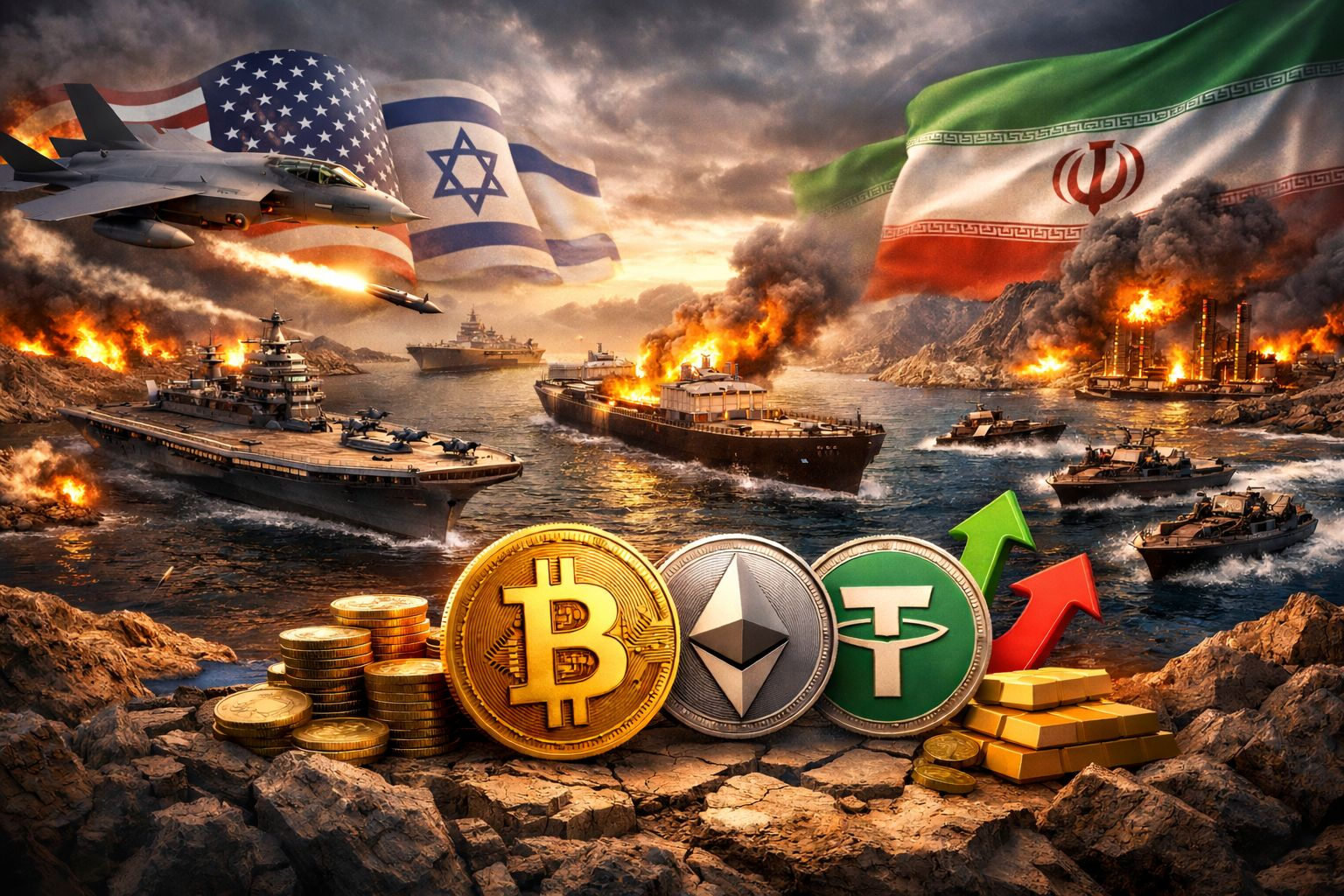
In a world where politics intersects with energy and financial markets, any escalation between the United States and Israel on one side, and Iran on the other, does not remain just a military event… but transforms into a backlash that hits cryptocurrency markets around the world 🌍💻.
This is not just a potential conventional war, but a real test of the idea:
Is crypto a safe haven or a high-risk asset?
⚔️ First: Why does military escalation matter to the crypto market?
Any direct strikes between the parties mean:
Rising oil prices
Tension in stock markets
Flight of liquidity from high-risk assets
Investors searching for hedging tools
And at this very moment, the cryptocurrency market enters the equation strongly.
🌊 Second: The Strait of Hormuz… A spark for global inflation that may reprice crypto
If Iran threatens or closes the Strait of Hormuz, the world will face:
Jump in energy prices
A new wave of inflation
Pressure on the dollar and emerging currencies
📌 Inflation is the number one enemy of traditional currencies… but sometimes it is an indirect friend to digital assets.
🟠 Third: What happens to Bitcoin in wars?
Bitcoin often goes through three phases in crises:
1️⃣ The first shock
Sharp drop due to panic and liquidity exit.
2️⃣ Re-centering phase
Investors' shift from stocks to alternative assets.
3️⃣ Re-narration
The discussion about Bitcoin as "digital gold" against inflation and turmoil returns.
⚡ If markets lose confidence in traditional financial systems, we may witness a strong buying wave.
🔵 Fourth: Stablecoins under the microscope
In any geopolitical tension, demand rises for:
Tether
USD Coin
Why?
Because investors are looking for:
Rapid escape from risks
Holding liquidity within the digital market
Hedging without going to traditional banks
But if the dollar or the global banking system is harmed, the pressure may extend even to stablecoins.
🏦 Fifth: The impact of war on Gulf digital liquidity
The Gulf has become an important investment hub for Web3 and crypto funds.
Any Iranian strikes on oil facilities in:
Saudi Arabia
United Arab Emirates
Qatar
May lead to:
Decline in risk capital flows
Temporary liquidity exit
Freezing emerging investments
But paradoxically, rising oil prices may increase financial surpluses, creating a new wave of investment in digital assets later.
📉 Sixth: Possible digital scenarios
🟢 Rapid containment scenario
Temporary drop in crypto
Rapid recovery
Continuing the long-term upward trend
🟡 Long depletion scenario
Sharp fluctuations
Increase in Bitcoin dominance
Weakness of alternative currencies (Altcoins)
🔴 A scenario of wide-scale war and closure of Hormuz
Collapse of stock markets
A violent sell-off first
Then the possibility of a strong rise if confidence shifts towards decentralized assets
🌐 The deeper dimension: Does war enhance the idea of decentralization?
Wars reveal fragility:
Banking systems
Supply chains
Fiat currencies
In contrast, digital currencies are based on:
Decentralization
Non-reliance on borders
Freedom of online transfer
🔐 In a troubled world, these characteristics become more attractive.
📊 Summary: Military war… or reformation of the financial system?
The escalation between Washington and Tehran will not just be a regional conflict, but it may turn into:
Global liquidity test
New risk pricing
Re-evaluation of the role of digital currencies
📌 The real question is not: Will digital currencies be affected?
But: How will its position change in the global financial system if confidence in the dollar, energy, and traditional markets is shaken?
In times of turmoil, the rules change…
And the crypto market may be the biggest beneficiary — or the first affected. ⚡💰