
Data: February 28, 2026
Featured Assets: $BTC | $USDT
Context: Geopolitics, Regulation, and the Strategic Silence of Washington
📈 1. Overview: More than a Police News, a Market Signal
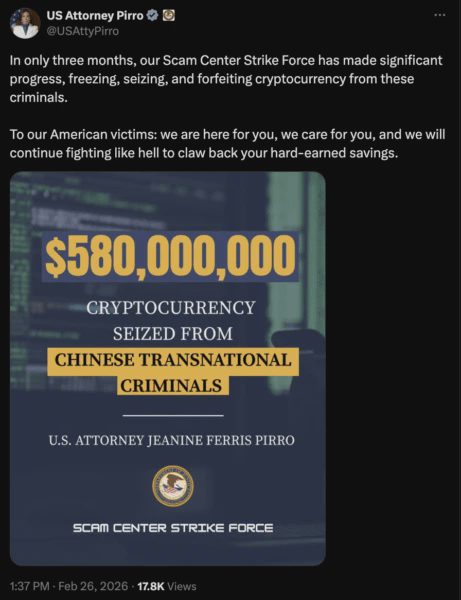
Last night, the U.S. Department of Justice (DOJ) dropped a bombshell: the freezing, seizure, and confiscation of over $578 million in digital assets [textual review of the news]. The target? Chinese transnational criminal organizations operating scams from Southeast Asia against American citizens.
At first glance, it seems just another seizure news. But digging deeper, it reveals important layers about:
The efficiency of the U.S. government's on-chain tracking machine.
The billion-dollar fate of confiscated assets (and why this does not go to the strategic Bitcoin reserve).
The industrial scale of scams that affect the market.
📉 2. In-Depth Analysis: What the $578 Million Tells Us
2.1. The Tracking Machine is Well-Oiled
The operation was conducted by the Scam Center Strike Force, a task force created last November by prosecutor Jeanine Pirro [textual revision of the news]. In just three months, they managed to track and freeze over half a billion dollars. This is no small feat. It shows that collaboration between exchanges (like Binance, OKX), analytics companies (Chainalysis), and the government is at an extremely high level of efficiency.
Data from Chainalysis, cited in the news, shows that impersonation scams (such as "pig butchering") grew by 1,400% in 2025 [textual revision of the news]. The average amount stolen per scam jumped by 600% in the same period [textual revision of the news]. In other words, criminals are more organized and targeting larger victims. The government's response, as we see, is also up to the task.
2.2. Where Will This Money Stop? (The Big Turning Point)
Jeanine Pirro's statement is the most important point of the entire news: "Through the legal process, my office will seek the confiscation of these funds and their return to the victims to the greatest extent possible" [textual revision of the news].
This is a game changer and goes against the expectations of many.
In March 2025, Trump signed an executive order establishing the Strategic Bitcoin Reserve and the stock of digital assets of the U.S. The expectation was that all seized assets would feed this reserve. That's not what is happening. The government is signaling that, at least for large-scale crimes against citizens, the priority is restitution, not just fattening the national stockpile.
The contextual data: According to BitcoinTreasuries.NET, U.S. authorities may hold up to 328,372 Bitcoins (about 1.64% of the total supply), from various criminal seizures over the years (Silk Road, Bitfinex, etc.). This stock, valued at over $20 billion, makes the U.S. one of the largest institutional holders of Bitcoin in the world.
The decision to not incorporate these $578 million into the reserve, but rather to return them to the victims, can be seen as:
A political movement: Show that the government is on the side of the common citizen, and not just accumulating assets.
A legal precedent: Reinforces victims' rights to restitution in cases of fraud.
2.3. The Connection with the Market (and the Price of BTC)
This news impacts the market in several ways:
Selling Pressure Alleviated: If these $578 million (part in BTC, part in stablecoins) were to go to the government's reserve, they could theoretically be sold in the future. With the return to victims, the government does not become a potential seller of that amount.
Trust in the System: Operations like this increase confidence that the system can be used to combat crimes, which, in the long run, attracts institutional investors who demand a safer environment.
🧠 3. Educational Guide: "Pig Butchering" – The Scam That Became an Industry
The news mentions these scams, but it is worth understanding how they work, because their money impacts market flow.
What is "Pig Butchering"?
Fattening (Building Trust): Criminals contact victims via social media, dating apps, or even wrong text messages. They create a false friendship or romantic relationship over weeks or months.
The Slaughter (The Scam): When trust is solid, they present an "irresistible investment opportunity" in cryptocurrencies, often on fake platforms that show huge profits. The victim deposits money (often in USDT), and when they try to withdraw, they find out they have been scammed.
The Money Laundering: The money is quickly moved through a network of wallets to make tracking difficult.
Why this matters to traders: This flow of illicit money creates unpredictable selling pressures and contaminates market liquidity. Operations like the DOJ's help clean the system, making the environment healthier for everyone.
The U.S. government has shown that it has the technology and political will to track and confiscate digital assets on an industrial scale. At the same time, it has signaled that, for mass crimes, the priority is to return the money to victims, not just to fatten the public coffers.
The big question that remains for us investors is: do you feel safer or more surveilled knowing that the government can track and freeze $580 million in crypto in three months?
And you, what do you think? Does this DOJ action increase your confidence in the market or worry you about the level of government control? Comment below!
Disclaimer: This analysis is based on public information and is exclusively educational and informational. It does not constitute investment advice. The cryptocurrency market involves significant risks. Do your own research (DYOR) before making any financial decisions.

#PigButchering #China #ReservaEstratégica #BİNANCESQUARE #Write2Earn!