
I have a friend who is 34 years old this year. To be honest, he used to be that typical loser—spending ten years in Beijing, working as a copywriter at a small advertising company, with a monthly salary of over 6,000, and after paying rent, utilities, and food, he was basically living paycheck to paycheck. The rented apartment is a 20-square-meter studio in an old community in Chaoyang District, with all second-hand furniture. He has had two girlfriends who broke up with him because of 'no house, no car, no savings.' He himself has accepted his fate, working overtime until ten o'clock every day, going home to scroll through Douyin, and sighing, 'This is just my life.'
The turning point was at the end of 2022. At that time, he came across videos from several forex gold KOLs, who were constantly showing their account statements and calling out gold buy/sell signals. At first, he only watched for entertainment. Then one time, when gold prices plummeted, he inexplicably opened a demo account on his mobile app to play around and discovered the leverage was crazy, controlling 100 times the capital with one lot. He thought to himself: with such a low salary, if I could really catch a wave, wouldn't I be able to turn my life around?
But he didn't foolishly rush into real money. He first spent three months self-studying—working during the day and watching quantitative tutorials on Bilibili at night, building the simplest backtesting framework with Python. He didn't know advanced machine learning, so he used the most down-to-earth method: scraping publicly available data like historical gold K-lines, the US dollar index, oil prices, and summaries of Federal Reserve speeches, and feeding it to a free AI model (ChatGPT had just become popular at that time, and he used it to help write code). The core of the model was quite simple, combining 'Bollinger Bands + RSI + news sentiment scores' to automatically calculate the probability direction for the next day. He called this the 'lazy strategy' because he didn't want to watch the market 24/7.
In March 2023, he grit his teeth and charged 10,000 yuan on his credit card to open a real account. He lost 1,800 in the first week and almost gave up. But he didn't delete the app; instead, he recorded every transaction from that week in a notebook, letting the AI rerun the data at night to find the problem—it turned out that the weight of the news sentiment was too low. He adjusted the parameters and added a 'weekend gap filter.' In the second month, due to geopolitical conflicts, gold surged, and he caught the wave from 2,800 to 2,950, boosting his account from 8,200 directly to 28,000.
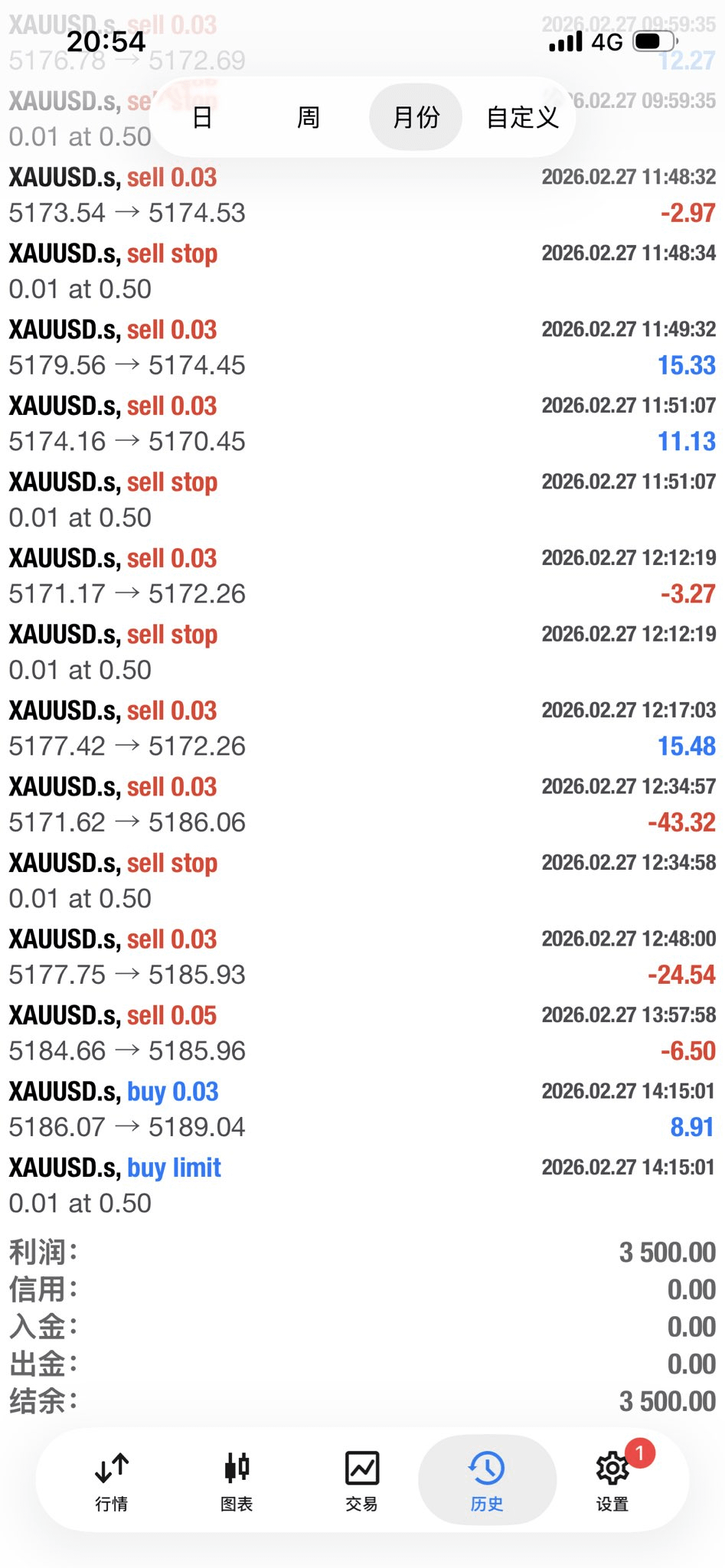
Since then, he started posting short videos on Douyin and Xiaohongshu. It wasn't the exaggerated shouting style; he simply recorded 'What signals did the AI model send me today,' 'Why did I only take 0.5 lots,' and 'How much did I net this week, with real transaction screenshots attached.' The titles were also simple: (A struggling programmer used AI to quantify gold, a true record of going from 10,000 to 20,000 in a month). Unexpectedly, his followers grew rapidly; after his first video broke 10,000 likes, the comment section was filled with 'Dude, teach me' and 'Requesting model parameters.'
He didn't keep it to himself; every few days, he would share the revised strategy logic (of course, not revealing all the core code), and he even started a WeChat group to help the first 50 fans review their trades for free. Gradually, some people were willing to pay to see his AI strategies, and his trading account grew larger and larger—by the end of 2023, the principal had grown to 180,000, and in 2024, because the AI model caught the surge of gold from 2,300 to 2,600, he made a one-time profit of 470,000. At that point, he had already quit his job to trade and create content full-time.
The key detail is that he never goes all in. Risk control is what he repeatedly emphasizes: each trade at most 2% of the principal, stop-losses as rigid as iron, and if the account drawdown exceeds 8%, he forces a one-week market closure. In October 2024, during the gold pullback, his model signal was short, but he only shorted 0.8 lots, resulting in a loss of only 12,000 when the pullback ended, and he quickly recovered. Without this strict rule, he would have been liquidated long ago.
Now in 2025, my friend has completely turned his life around. He relies on trading, a paid community, and taking on some institutional quantitative outsourcing, earning over 3.8 million last year. He bought a house after paying the down payment (three bedrooms and two living rooms, the loan hasn't been fully paid off, but he easily covers the monthly payments), traded his car for a 300,000 yuan electric vehicle, and brought his parents from their hometown to Beijing for retirement. What impresses him the most is that his ex-girlfriend added him on WeChat recently and said, 'I didn't expect you to be so successful'; he simply replied, 'It's just grinding through that data with AI; luck also accounts for a third.'
He often says: 'I'm not a genius, nor a trading god; I'm just an ordinary person. AI quantification isn't magic; it just changes the K-lines I couldn't understand before into Excel spreadsheets that I can understand. The key is to dare to start small and treat every loss as tuition for learning.' He still wakes up at 9 AM every day, lets the AI run through the day's gold signals, and then records a 5-minute review video, leading a routine life like an office worker, but his wallet and mindset are completely different.
No motivational quotes, no flaunting wealth, just taking one step at a time, starting from 10,000 yuan on a credit card, using AI to quantify gold forex margin trading, transforming himself from a month-to-month spender into a middle-class individual. Many people ask him for his secret, and he always says one thing: 'Survive first, then talk about turning your life around.'