
Data from the on-chain derivatives platform Derive shows that Bitcoin options traders are increasing their positions for a recovery scenario up to the $90,000 region, sending an early signal that the market may be attempting to form a bottom.
In a note sent to The Block, Derive's Head of Research, Mr. Sean Dawson, stated that the recent structure of derivative positions indicates that investors are scaling back aggressive deep protective hedging strategies, while still maintaining clear risk protection layers.
According to him, the crypto market is beginning to show signs of stabilization after several weeks of uncertainty. Derivative data indicates that traders are quietly preparing for a recovery phase but still maintaining significant hedging levels against downside risks.
After a short rally in early February, Bitcoin's volatility returned to around 50% — a level that in the past has often been associated with accumulation phases rather than panic sell-offs. At the same time, the 25-delta skew indicator in the options market has strongly recovered from the late February lows, improving from around -15% to about -7%. This trend reflects a less extreme defensive sentiment and a shift towards a more balanced state.
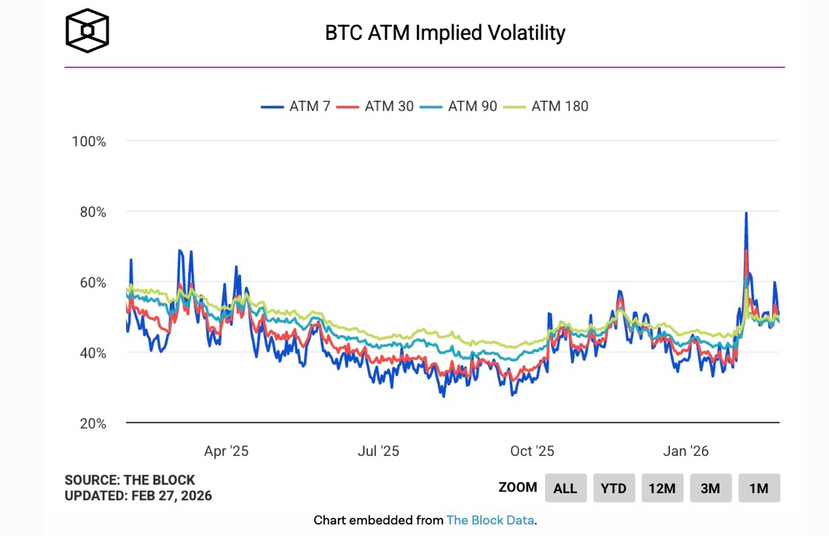
Implied volatility of BTC ATM
The flow of options continues to bolster this cautious optimism. The expiration date of March 27 for Bitcoin — currently having the largest open contract in the market — reported significant accumulation of call options at strike prices of $80,000 and $90,000. According to Derive, this concentration indicates that bulls are positioning for a recovery scenario in the range of $85,000–$95,000 next month as liquidity conditions gradually stabilize.
However, the bearish protective layer remains firmly in place. There is a large concentration of open put options at the $60,000 and $55,000 levels, implying that the pessimistic camp expects that if a correction occurs, it will be within a manageable range, rather than leading to a large-scale capitulation.
The Ethereum market reflects a similar asymmetric structure. Derive noted a strong increase in call options at the $3,500 level, alongside significant demand for put options at the $1,800 mark, indicating that investors are still actively hedging against macro risks and delayed capital inflows.
Data from Bybit and Block Scholes also indicate caution. After Bitcoin dropped to $62,000 and then recovered to the $68,000 high, the implied volatility of at-the-money options for one week increased to about 60%, causing the front end of the volatility curve to slightly invert. The put skew still leans towards bearish protection, while open perpetual futures contracts continue to decline, reflecting limited demand for leverage.
Mr. Han Tan, the market analysis director at Bybit, believes that the psychological threshold of $70,000 has repeatedly blocked buyers this month, putting Bitcoin at risk of recording its fifth consecutive month of decline. However, he noted that the fundamental backdrop of crypto remains positive and the current crisis of confidence could create room for a strong bullish narrative when the macro environment becomes clearer, especially regarding the policies of the US Federal Reserve and US trade.
A recent report from Binance indicated that the level of hedging in the options market has reached its highest since the FTX collapse, despite no new negative catalysts emerging fundamentally. Binance analysts also noted that recent crypto price movements are closely correlated with the high beta tech stock group, reflecting a trend where institutional investors — particularly through ETFs — view Bitcoin as a technology asset rather than a pure monetary asset.
Regarding ETF capital flows, market sentiment has somewhat improved. Although US spot Bitcoin ETFs recorded four consecutive months of net outflows, aggregated data from The Block shows that there have been three consecutive sessions of net inflows, with a total value exceeding $1 billion.
In this context, Thursday recorded a net inflow of $254.4 million, led by BlackRock's IBIT fund and Bitwise Asset Management's BITB, with net creation values of $275.8 million and $69 million, respectively, offsetting capital outflows from other funds.
Mr. Michael Brown, a senior research strategist at Pepperstone, stated that the market continues to closely monitor geopolitical developments and new pressures on the tech stock group, amidst the US-Iran negotiations and the weakening of tech stocks affecting risk appetite. The yield on the 10-year US Treasury bond fell to nearly 4.01% before stabilizing, while oil prices fluctuated during the session but ended almost unchanged.
Summarizing the signals, Mr. Dawson commented that the market is striving to establish a bottom. The narrowing volatility, improving sentiment indicators, and increasingly clear positioning structure suggest that traders are shifting from a state of panic defense to cautious optimism — ready to participate in a new upward trend while still maintaining a layer of protection should the market continue to correct.