
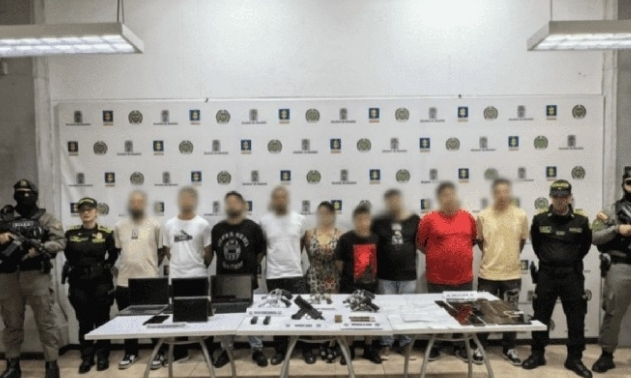
A police operation in the Kennedy neighborhood, in the northwest of Medellín, led to the capture of nine people and uncovered a collection office that, according to authorities, managed selective homicides through payments in bitcoin (BTC). The intervention was prompted by a phone interception in which an informant warned of an imminent execution: "The payment in bitcoin has already been sent."
Authorities indicate that the intervened house operated as a center of operations for a faction of the criminal structure known as 'La Oficina', referred to by the mayor of Medellín, Federico Gutiérrez, as the "premium office."
The National Police and the Prosecutor's Office seized eight firearms, including a Uzi-type submachine gun, as well as 29 cell phones, three laptops, two tablets, and items related to rituals associated with Santería practices.
In the home, investigators found a file cabinet with cards containing detailed information about alleged victims, mainly foreign citizens (including Mexicans and others). Each card included information such as immigration data, email addresses, and family details, along with a box labeled as “value” with three-digit numerical codes (for example, 282, 323, or 378).
According to reports from El Colombiano, an initial hypothesis by the Prosecutor's Office considered that these codes could represent amounts in bitcoin, but the equivalence would result in figures exceeding 17 million dollars per order, which authorities consider disproportionate and are maintaining for analysis as a possible internal code.
‼️🚨Thanks to the Police and Prosecutor's Office, a “premium” office for collection and hitmen serving criminal groups operating in Medellín has been hit.
✅ 9 people arrested.
✅ 8 firearms seized.
According to information, they coordinated and issued orders to execute… pic.twitter.com/XFXhrXHYe8— Fico Gutiérrez (@FicoGutierrez) February 12, 2026
Sources from the investigation cited by El Tiempo indicate that the fees for each selective homicide ranged between USD 400,000 and USD 500,000. Reports from several media attribute to the preliminary investigation that payments were made in bitcoin to reduce financial traceability.
However, sector specialists point out that unlike cash or any other asset, bitcoin operates on a public and permanent accounting network. This feature makes it one of the most transparent assets in the world, as each transaction is recorded inalterably on its network, allowing financial intelligence units to track the flow of funds once the wallet addresses are identified.
The nine detainees, identified as Arley Olvany David David (identified as the coordinator), Laura Yecenia Hoyos Pérez, and seven other men, pleaded not guilty in the preliminary hearings. The defense argues that there is no direct evidence of their participation in specific homicides.
The Prosecutor's Office charged crimes such as conspiracy to commit aggravated crime, homicide, and illegal possession of firearms, and ordered a forensic analysis of the seized devices to trace possible transactions and links.
The structure intervened is part of a criminal organization with decades of presence in Medellín that controls substructures in neighborhoods and communes. Mayor Gutiérrez described the operation as a “blow” to a cell specialized in high-impact hitmen against foreigners and nationals, but not as a dismantling of the complete matrix.
The investigation continues to establish connections with previous homicides and possible transnational networks. There is no official confirmation of the seizure of bitcoin or crypto assets in the operation.
However, as reported by CriptoNoticias, in Medellín, the use of bitcoin also appears in financial inclusion initiatives. Organizations like Satoshi Team offer free educational workshops in sectors like Comuna 13, where access to formal banking services is limited according to data from Colombian government institutions.
\u003ct-89/\u003e\u003ct-90/\u003e\u003ct-91/\u003e\u003ct-92/\u003e