
Everyone should have heard of Solana's Firedancer upgrade to some extent. In fact, by lowering the hardware requirements for validators, Firedancer makes running nodes easier.
The increase in speed, reduction in costs, and higher resilience make it a key factor in solving Solana's scalability issues. The mission of Firedancer is to bring the performance of the Solana network closer to that of traditional financial systems, such as NASDAQ processing 100,000 transactions per second.
However, as of now, the Firedancer upgrade has not been fully implemented on Solana.
Well, why do we need to create a new L1?
Since Solana has the Firedancer upgrade, which is expected to become faster and better after implementation, why do we need to create another Fogo?
However, the problem still exists: even if Firedancer is faster, it cannot change one reality - the multi-client model of Solana means that network speed is limited by the slowest node, and not all validators can switch to Firedancer immediately.
As co-founder Doug Colkitt said: "It's like having a Ferrari, but you're driving it in congested traffic in New York City."
Firedancer is like a Ferrari, but there are other factors on Solana that cause congestion.
Thus, the solution becomes to build a dedicated highway for the Ferrari.
Rather than let Firedancer be dragged down, it's better to give it a dedicated stage. The birth of Fogo is precisely to maximize the potential of Firedancer; after all, everyone could have just used the same client from the beginning.
Therefore $FOGO as an independent new L1, it can no longer be constrained by the multi-client model, nor does it need to worry about whether existing validator nodes will update the client (it was created from scratch), but rather, through a unified client and innovative design, fully release the performance of Firedancer.
Why is a single client model better?
When the blockchain network approaches the physical limits of hardware and network performance, the differences between implementations of different clients can lead to performance bottlenecks.
Therefore, Fogo has always been a "pureblood version" of Firedancer, without needing to undergo a "major overhaul."
So how exactly does Fogo do it?
Fogo's primary innovation lies in choosing Firedancer as the only standard client, completely abandoning the potential performance bottlenecks that the Solana multi-client model may bring.
The meme below presents a good illustration of the latency reduction brought about by performance optimization.
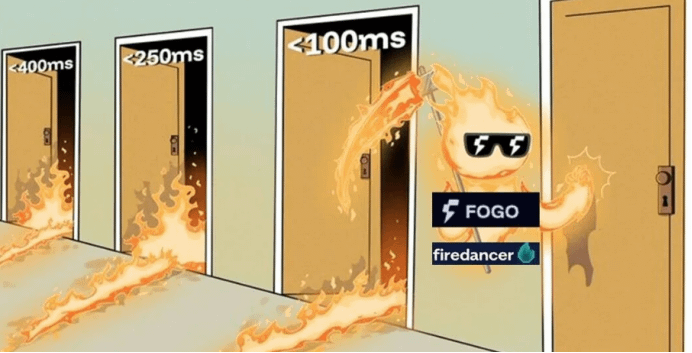
To describe it in one sentence:
"Only use the fastest client to keep the network at its highest performance level."
If you don't understand Firedancer, you only need to have a rough idea of its benefits. First is parallel processing, which allows multiple transactions to be processed simultaneously, significantly increasing throughput; second is memory optimization, which enables the hardware where the node is located to utilize storage and other resources more efficiently, reducing latency caused by transactions. It is worth mentioning that Firedancer focuses more on hardware improvements, such as directly optimizing the interaction between nodes and physical devices to further compress transaction processing time.#fogo