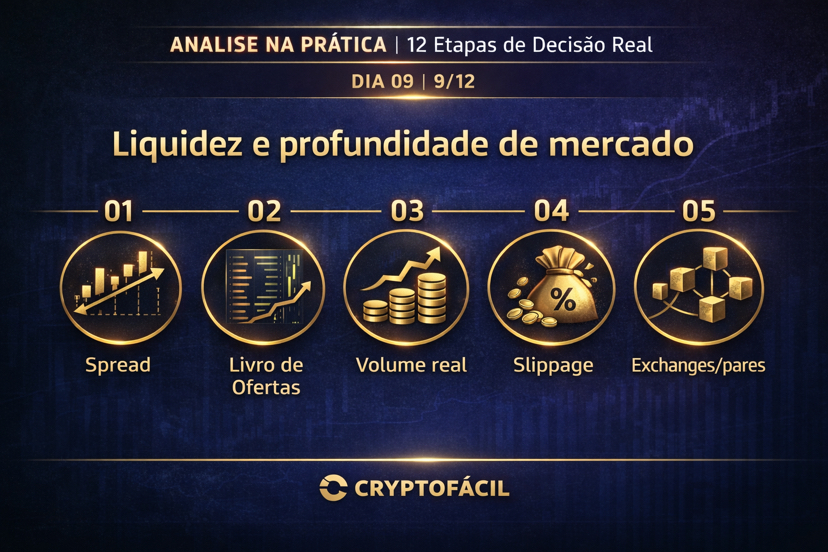
DAY 09 — Liquidity and market depth
Liquidity is not about the price going up, it's about being able to execute.
An asset can have strong fundamentals, but without liquidity, it is not operable at scale.
🎯 1️⃣ Spread
Spread is the difference between the best buying price (bid) and the best selling price (ask).
It is not liquidity itself, but a direct reflection of it.
The higher the liquidity:
✔️ Greater competition among orders
✔️ Deeper book
✔️ Smaller spread
High spread generally indicates:
⚠ Shallow market
⚠ Little competition
⚠ Highest invisible cost of entry and exit
📍 Where to observe:
Binance → Desired pair → Order Book
🎯 2️⃣ Order Book
The book shows the real depth of the market.
Practical question:
If someone sells heavily now, does the market absorb or plummet?
Deep book indicates absorption capacity.
Shallow book amplifies movements.
🎯 3️⃣ Real volume
Volume needs to be:
✔️ Consistent
✔️ Distributed over time
✔️ Present on multiple exchanges
Point volume may just be an event.
Structural volume sustains the market.
📍 Where to verify:
https://coinmarketcap.com
https://coingecko.com
🎯 4️⃣ Slippage (Price slippage)
Slippage is the difference between the expected price and the executed price.
In markets with low liquidity:
• Average orders already move the price
• Large orders distort the chart
Liquidity reduces impact.
Low liquidity amplifies risk.
🎯 5️⃣ Exchanges and pairs
Essential questions:
• Does the token depend on a single exchange?
• Does it have relevant pairs (USDT, USDC, BTC)?
• Is it listed on global exchanges?
Excessive concentration increases operational risk.
Liquidity distributed among exchanges reduces dependence.
🔎 Strategic interpretation
✔️ Low spread + deep book + consistent volume indicate market maturity
✔️ Distributed liquidity reduces structural risk and dependence
⚠ Point volume with shallow book signals fragility
❌ Concentrated liquidity increases vulnerability
Liquidity does not generate appreciation. It protects execution.
Mature markets absorb impact.
Fragile markets amplify movements.
📅 Series Follow-up
✅ Day 1 — Initial filter: Market Cap, FDV, Supply, and Volume
✅ Day 2 — Tokenomics and economic model
✅ Day 3 — Value proposition and competitive advantage
✅ Day 4 — Team and strategic investors
✅ Day 5 — Competition and market positioning
✅ Day 6 — Real use, revenue, and TVL
✅ Day 7 — Value capture of the token
✅ Day 8 — On-chain analysis ( Link to post DAY 08 of the series )
✅ Day 9 — Liquidity and market depth
⬜ Day 10 — Structural risks
⬜ Day 11 — Risk structure and allocation
⬜ Day 12 — Real decision-making