

1. Introduction: The Intersection of Responsibility and Innovation
In the current global economic landscape, the traditional safety nets that once underpinned middle-class stability are visibly receding. We occupy an era characterized by an unprecedented volume of information, yet much of this "noise"—driven by algorithmic social media and legacy media narratives—serves to disinform rather than clarify. In such a volatile environment, individual financial responsibility is no longer a peripheral concern; it is a paramount strategic duty. Wealth preservation must be approached through the lens of structural protection rather than the pursuit of "get-rich-quick" schemes, identifying asset classes that can serve as hedges within a shifting global order.
Authentic financial education provides the analytical clarity required to bypass social media manipulation. By demystifying the mechanics of our current monetary systems, an investor transitions from a passive victim of economic cycles to an active guardian of their capital. However, to evaluate Bitcoin’s strategic utility, one must first look past the price volatility and analyze the fundamental nature of the institutional money it seeks to challenge.
2. The Architecture of Hard Money: 1971 to the 21 Million Cap
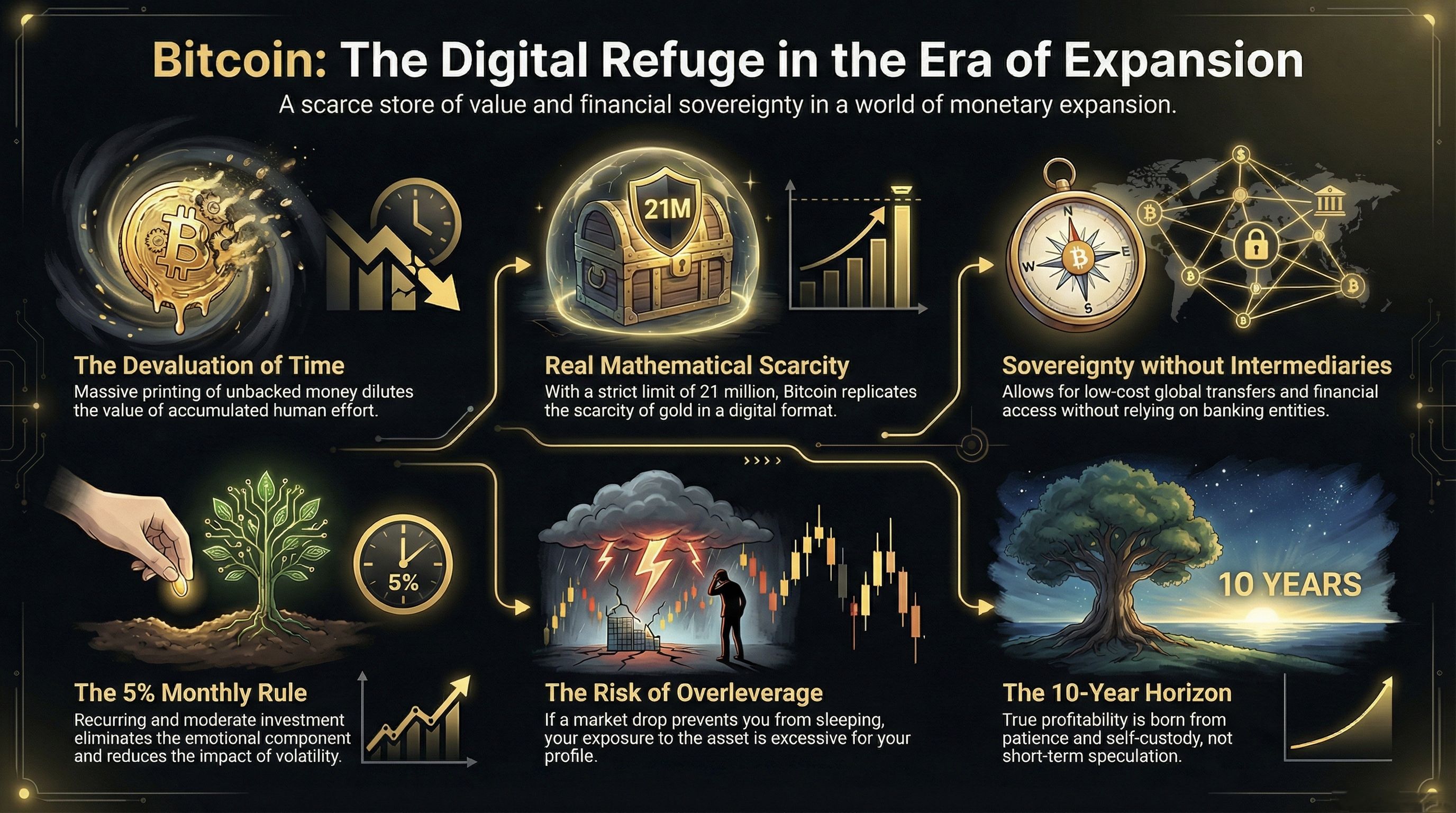
The year 1971 serves as "patient zero" for the modern monetary predicament. The unilateral abandonment of the gold standard shifted the global financial architecture toward a model of uncollateralized monetary expansion. This transition allowed for the creation of currency at the discretion of central authorities, effectively untethering money from the physical constraints of production. This is not merely an accounting shift; it represents a fundamental erosion of labor’s purchasing power.
If we define money as a medium for storing the energy of our past labor, then fiat debasement is effectively a retrospective tax on human time. When the supply of currency is expanded, the value of the hours an individual worked to earn that currency is diluted. Bitcoin was architected as a technical solution to this systemic leak.
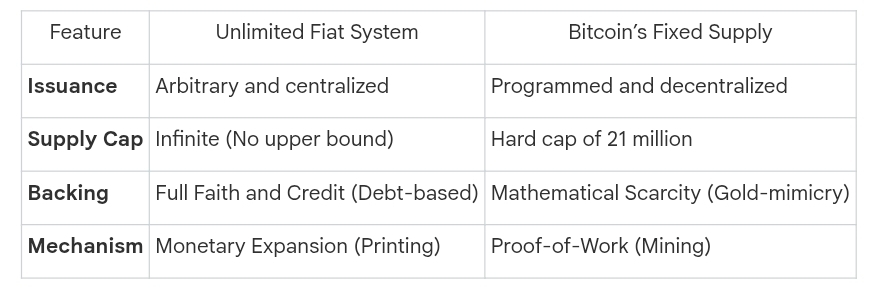
By enforcing an immutable cap of 21 million units, Bitcoin establishes a "hard money" profile. This scarcity is not a marketing feature; it is a strategic countermeasure against a century of currency manipulation. However, scarcity remains a sterile concept without utility. To understand Bitcoin's resilience, we must examine how this theoretical hardness translates into functional sovereignty.
3. Challenging the "Zero Value" Premise: Intrinsic Utility vs. Speculative Price
A recurring critique from traditional macro-analysts suggests that Bitcoin lacks intrinsic value and exists purely as a speculative bubble. While Bitcoin is undeniably sensitive to global liquidity shifts, dismissing it as "valueless" fails to account for the functional utility of the underlying decentralized network.
The intrinsic value of the Bitcoin protocol is built upon four strategic pillars:
Verifiable Scarcity: An absolute supply limit that is auditable by any participant.
Decentralized Network Security: A global, distributed infrastructure without a single point of failure or control.
Global Portability: The capacity to transport significant wealth across borders with zero physical footprint.
Permissionless Transferability: The ability to execute settlement without the mediation or approval of a central authority.
These features solve tangible failures within the legacy financial system. We observe "Ground Truth" evidence of this utility in several contexts:
Sovereignty against "Corralitos": In jurisdictions like Greece or Lebanon, where banks instituted capital controls and froze accounts, Bitcoin allowed individuals to maintain direct access to their liquidity.
Remittance Disruption: Traditional international transfers often extract fees as high as 7%. The Bitcoin network can facilitate these transfers for less than 1%, achieving finality in minutes.
Financial Inclusion: For the "unbanked" in developing economies, a smartphone and internet connection provide access to a global ledger, bypassing the need for a permitted banking relationship.
Crucially, one must distinguish between "Bitcoin the Protocol"—which remains secure and functional—and "Crypto the Industry." Most historical scandals involve the failure of centralized entities (exchanges or speculative startups) rather than a failure of the Bitcoin protocol itself.
4. Market Dynamics: Volatility, Scale, and the Speculative Lifecycle
Strategic investors must view Bitcoin’s high volatility as a symptom of a "young" market rather than a systemic failure. The current total cryptocurrency market capitalization is approximately four times smaller than that of a single entity like Apple. In a market of this scale, even moderate capital inflows or outflows result in significant price discovery swings.
We must also recognize the psychological trap of "investor tribalism." The public tends to celebrate assets during all-time highs—declaring "super-cycles"—only to bury those same assets during 50% corrections. This cycle of euphoria and derision is a hallmark of emerging asset classes. A disciplined framework ignores this noise, recognizing that the current volatility is the price of participating in an asset with significant asymmetric upside potential. This perspective is a prerequisite for any disciplined investment framework.
5. The Portfolio Framework: Allocation and Risk Mitigation
The most vital strategic decision is not the selection of the asset, but the calibration of the allocation. Bitcoin should be treated as a component of a diversified portfolio, not a religious conviction. Prudent risk management demands a "cold-blooded" approach to position sizing.
Consider a "Prudent Allocation Rule" for a hypothetical investor earning €2,000 per month:
Total Investment Strategy: 15% of monthly income (€300).
Bitcoin Allocation: 5% of that investment pool (€15).
By limiting the allocation to a fraction of the investment pool, the investor mitigates the impact of a 50–70% drawdown while maintaining a foothold in the asset's growth.
The Sleep Test: If a sharp market correction keeps you awake at night, you are over-leveraged. The risk is not inherent to the asset, but to the investor's lack of discipline in position sizing.
The only viable psychological anchor for this asset class is a 10-Year Horizon. While the source context notes a 5-year liquidity threshold for the math to work, a decade-long view is necessary to survive the brutal market cycles and psychological pressure inherent in digital assets.
6. Custody and Security: The Responsibility of Sovereignty
The transition to digital assets requires a trade-off between convenience and security. This is essentially a choice between "Counterparty Risk" and "Operational Risk."
Method
Pros
Cons
Level of Responsibility
Platform/Exchange
High convenience; familiar UX.
High Counterparty Risk; platform insolvency.
Moderate (Delegated Trust)
Self-Custody (Keys)
Total sovereignty; no freezing.
High Operational Risk; no "forgot password."
Absolute (Personal Duty)
The "Lost Bitcoin" phenomenon—with approximately 3 million coins inaccessible due to lost keys—serves as a stark warning. Self-custody eliminates the risk of a third party failing (Counterparty Risk), but it places the entire burden of security on the individual (Operational Risk). For most, the path begins with small allocations on reputable platforms before graduating to the technical demands of sovereignty.
7. Conclusion: Navigating the Broken World Order
The geopolitical and economic order established in 1945 is currently experiencing deep structural wear. As noted by analysts like Ray Dalio, we are entering a period of profound transition where legacy debt cycles and fraying alliances create systemic instability. In this context, a decentralized, non-sovereign asset serves as a "structural refuge."
Investors are presented with two distinct paths:
Path A: Inaction and improvisation, resulting in the steady erosion of purchasing power within a debasing system.
Path B: Structural protection and disciplined execution, using a diversified framework to hedge against systemic obsolescence.
Final Reflection A retrospective analysis of the 2008 genesis of Bitcoin—released amidst a global financial collapse—reveals a direct line to our current instability. My own perspective shifted in 2017 when I witnessed a personal allocation grow from €6,000 to €100,000 in months. It was a "mind-opening" event that proved the traditional path of "work, save, and wait until 70" was no longer the sole or safest route to security.
In a world of infinite currency issuance and breaking institutional systems, a finite digital asset is more than a speculation; it is a strategic hedge against the obsolescence of the old world. We must navigate this transition with analytical rigor and calm preparation. While the market's noise is deafening, the signal remains clear: in an era of limitless debasement, scarcity is the ultimate refuge.