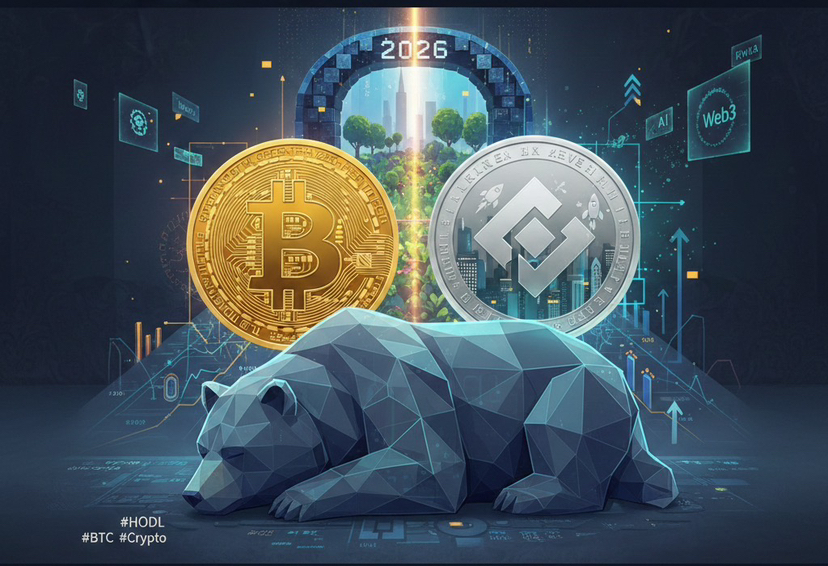
In the cryptocurrency market cycle, **'Bear markets plant seeds, bull markets harvest'** is a common saying, but there are very few assets that can truly withstand the test of time and are worth holding firmly during downturns.
From the market perspective of 2026, after experiencing a high adjustment in 2025, the market is currently undergoing a structural transformation phase. Compared to previous sharp crashes, the current 'evolved bear market' is more characterized by stock game and value return. In this context, Bitcoin ($BTC) and Binance Coin ($BNB) remain the core allocation for long-term holders.
One, Bitcoin ($BTC): The certainty of digital gold
Even by 2026, Bitcoin's status as the 'global digital hard currency' has not been shaken; rather, it has become more solidified due to the improvement of institutionalization.
* The 'safety net' brought by institutionalization: With the maturation of spot ETFs and the attention of sovereign nations (such as potential U.S. strategic reserves), the volatility logic of Bitcoin has shifted from 'retail sentiment' to 'asset allocation'. This structural change means that its downside space in a bear market is layered hedged by institutional buy orders.
* Supply-demand imbalance after halving: The long-term effects of the 2024 halving will enter a deep fermentation period in 2026. The reserves of exchanges are at historic lows, while institutions, corporate treasuries, and long-term holders (HODLers) have locked in substantial liquidity.
* Macroeconomic hedging attributes: With the global debt scale continuously expanding and expectations of long-term depreciation of fiat currencies, BTC, as a decentralized asset of 21,000,000 coins, has more attractive hedging properties amid economic uncertainty.
> Core logic: If the crypto market is a galaxy, BTC is the central sun. In a bear market, it may shrink, but as long as the sun does not extinguish, the system will not collapse.
>
Two, Binance Coin ($BNB): The ecological-driven deflationary flagship
If BTC is the benchmark for value storage, then BNB is the culmination of **'application value + platform dividends + ecological expansion'** in the crypto world.
* Extreme deflationary mechanism: BNB's 'Auto-Burn' mechanism will continue to operate efficiently in 2026. As the total supply approaches the target of 100 million coins, this rigid scarcity provides natural support for prices.
* Depth and breadth of empowerment:
* Launchpool/Megadrop: Holding BNB is equivalent to obtaining a 'free ticket' to new projects, and the passive income (Shadow Dividend) obtained through 'new investments' during a bear market can significantly dilute the cost of holdings.
* BNB Chain 2026 roadmap: With upgrades like Fermi, BNB Chain has achieved sub-second finality and 20,000+ TPS. It is no longer just a sidechain of Binance, but an important base for RWA (real-world assets) and AI intelligences.
* Strong blood production ability: As the world's largest exchange, Binance's profit buyback and ecological empowerment provide BNB with a 'resilience' that surpasses most altcoins. During the market adjustment in early 2026, BNB often outperformed the market.
Three, why hold them in a bear market?
In a bear market, liquidity and vitality are two key dimensions for assessing assets.
| Dimension | Bitcoin (BTC) | Binance Coin (BNB) |
| Role positioning | Global value reserve | Ecosystem energy & platform dividends |
| Holding strategy | Dollar-cost averaging, long-term locking | Participate in Staking, Launchpool to earn cash flow |
| Risk defense | Extremely strong, institutional consensus at the base | Strong, backed by the profitability of leading platforms |
| Future potential | Price discovery, digital gold standard | Intensified burning resulting from the explosion of Web3 applications |
Four, summary and operational recommendations
A bear market is a process of wealth redistribution. BTC is responsible for preserving value, ensuring you 'stay at the table'; BNB is responsible for appreciation and cash flow, ensuring you 'continue to profit at the table'.
For long-term holders, the oscillation period in 2026 is an excellent opportunity for averaging down. Instead of being anxious about various vague new concepts, it is better to return to these two assets with a 'certain core'.