

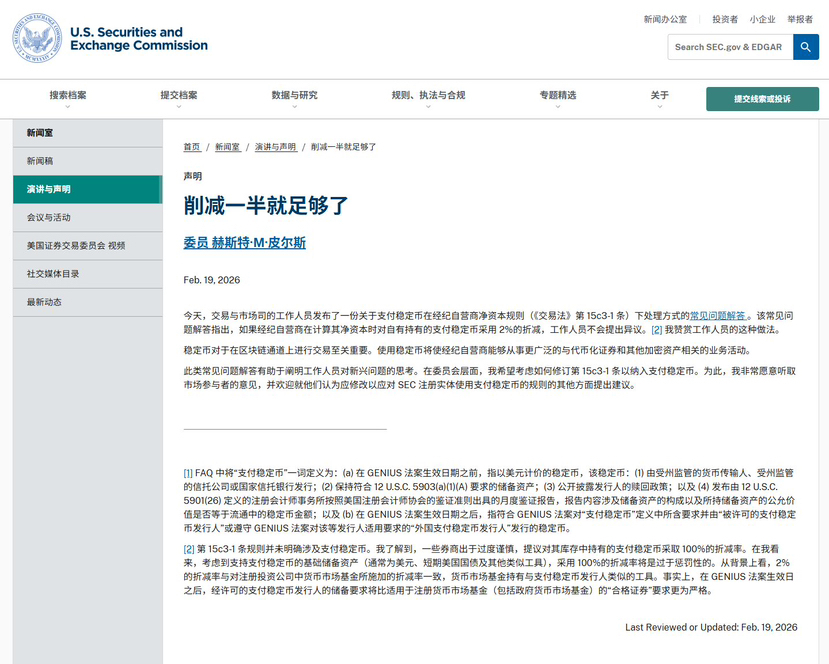
Just today, the SEC's Trading and Markets Division updated the FAQ, clearly stating that compliant 'payment stablecoins' can be treated at a discount rate of 2% in the calculation of broker-dealer net capital rules (staff do not oppose this). Subsequently, SEC Commissioner Hester Peirce issued a statement in response, indicating that stablecoins in regulatory capital measurement have finally begun to transition from nearly unusable assets to something closer to low-risk cash-like instruments.
1. What is the discount rate?
The discount rate is the regulatory pricing of asset risk.
To prevent broker-dealer bankruptcies, regulators require them to hold a certain amount of net capital. When calculating these capitals, the assets on hand cannot be valued at 100% of market price and must be discounted.
In the past, a 100% discount rate for stablecoins meant that regulators considered the risk of stablecoins to be extremely high, with a value counted as 0. For example, if a broker holds 1 million USD in stablecoins, to maintain compliance, they not only spend 1 million USD to purchase stablecoins but also need to prepare an additional 1 million USD in cash as 'margin.'
Now, changing to a 2% discount rate means that regulators consider stablecoins as assets to be very safe, with a value counted as 98%. This is treated the same as money market funds (MMF). If you hold 1 million USD in stablecoins, regulators acknowledge the value is 980,000 USD. You only need to prepare an additional 20,000 USD as margin.
The efficiency of capital utilization has instantaneously increased by 50 times.
2. Who benefits?
For regulated licensed institutions like Goldman Sachs, JPMorgan, or Robinhood, previously a 100% discount rate for institutions meant that allocating stablecoins was a form of self-harm. After the modification, allocating stablecoins has almost no burden for institutions; it becomes an option that can be configured whenever needed.
This result will raise the ceiling for compliant payment-type stablecoins, as both USDC and USD1 currently have the potential to profit.
Especially in RWA and on-chain settlements, for example, the New York Stock Exchange conducts 7x24 small era tokenized US stock trading, allowing institutions to directly conduct instant settlements and collateral transfers using stablecoins, without worrying about occupying double funds due to holding large amounts of stablecoins.
3. When to execute?
Currently, it is not an official change in rules by the SEC, but rather a staff-level 'no objection' stance. Legal certainty will depend on whether it can enter formal regulations in the future.
Moreover, not all stablecoins can be adopted; only payment-type stablecoins are exclusive, primarily the compliant stablecoins marked in the recently passed stablecoin bill. For example, USDC and USD1 that I mentioned earlier are among the possible ones.
Overall, the significance of this matter lies not in the short-term price of the currency, but in the friendliness of the balance sheet. Whether stablecoins can expand institutionally is never about how lively it is on-chain, but rather how it appears on the balance sheets of compliant institutions.
If this plan can ultimately be written into formal regulations, it means that stablecoins have truly entered a phase of institutional prosperity, and Wall Street's funds can reside on-chain with lower compliance costs.