
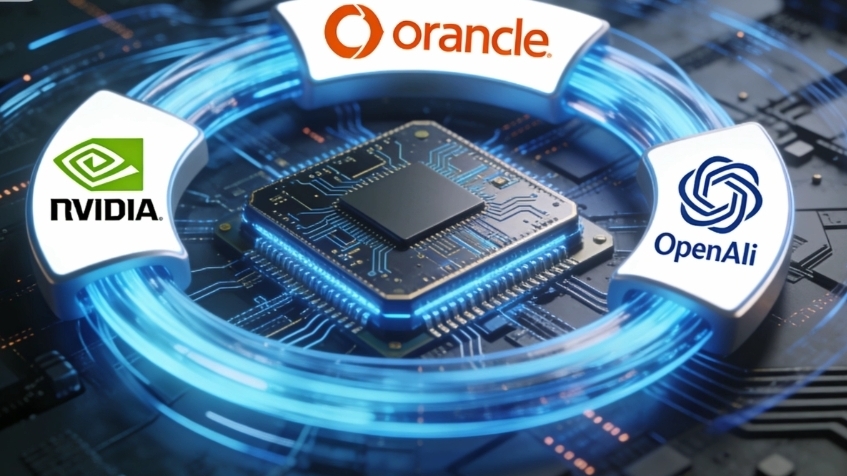
Recently, the hottest narrative in the global capital markets has been the 'Silicon Valley AI internal circulation' created by Nvidia, Oracle, and OpenAI.
Nvidia's investment of hundreds of billions in OpenAI secures long-term chip orders; OpenAI is spending hundreds of billions to procure AI supercomputing services from Oracle; Oracle, in turn, is purchasing high-end GPUs from Nvidia to deliver computing power—these three have formed a perfect closed loop of capital-computing power-demand, tightly holding the supply and pricing power of global high-end AI computing power in their hands.
The US stock AI sector has soared with this wave of favorable winds, and Nvidia's market value has repeatedly hit new highs. However, many users in the cryptocurrency space are facing difficulties: the entry barrier for US stocks is high, making direct participation impossible. So, is there a corresponding layout opportunity in the cryptocurrency space for this epic AI computing power dividend?
Today’s article will clarify the underlying logic of this internal cycle and the core opportunities it brings to the cryptocurrency world, along with the core beneficiaries that benefit directly.

1. First understand: what exactly is this 'Silicon Valley internal cycle' playing at?
Many people only see the cooperation of the three giants but do not understand the core essence of this closed loop—this is a complete monopoly of upstream resources in the AI era, and the core logic can be explained in three sentences:
1. Interests are deeply bound: the three have formed a symbiotic closed loop of 'you cannot do without me, I cannot do without you,' with NVIDIA controlling the core supply of chips, Oracle controlling the infrastructure for computing power, and OpenAI controlling the demand for top computing power, jointly completing the closed internal distribution of profits at the very upstream of the AI industry chain.
2. Production capacity is completely locked: currently, over 50% of the global 3nm high-end GPU production capacity is preemptively locked by this internal cycle, and by 2026, the gap between supply and demand for global high-end AI computing power will still be close to 30%. This means that aside from the three giants using it, the remaining market players will be competing for less than 30% of the scarce computing power, causing prices to continue to rise.
3. Barriers are fully established: this closed loop not only locks hardware production capacity but also synchronously locks the three core resources of capital, technology, and channels, leaving ordinary enterprises without any qualification to enter. The 'digital oil' of the AI era has already been monopolized by the giants.
2. The giants' computing power monopoly is precisely a super opportunity for the cryptocurrency world
Many people will ask, if the giants monopolize computing power, isn't that bad news for the cryptocurrency world?
In the short term, there is indeed a certain impact: GPU production capacity is locked, squeezing the survival space of traditional GPU mining tracks, while the high certainty of the US stock AI sector has also diverted some incremental funds.
However, looking at it over a longer period, the computing power monopoly brought about by this giant closed loop has opened a brand new growth curve for the cryptocurrency world, bringing epic long-term opportunities, with three core logic points:
1. Computing power monopoly has created a rigid demand for decentralized computing power
The high-end computing power of the giants is primarily provided for the top large model training of OpenAI, and the remaining computing power is not only expensive but also comes with strict entry barriers, making it impossible for small and medium enterprises, individual developers, and even many institutions to obtain stable and affordable computing resources.
In the AI era, the demand for computing power is growing exponentially. Aside from training top large models, there is also massive demand for AI inference, small and medium model tuning, film rendering, edge computing, digital content creation, etc., which the giants simply overlook and are unwilling to engage with, representing the core opportunities for decentralized computing power networks.
The decentralized computing power network integrates the global idle GPU computing power through the blockchain's token incentive mechanism, providing demand side with cheaper, more flexible, and more open computing power services, perfectly solving the 'bottleneck' problem caused by the giants' monopoly, and directly excavating a trillion-level incremental market from the gaps of the giants.
2. The pain points of closed-source AI make 'blockchain + open-source AI' a second growth curve
This Silicon Valley internal cycle has created a completely closed-source AI ecosystem: the models are closed-source, the computing power is monopolized, and the rules are black-boxed. Users not only have to pay high fees but also face risks of data privacy breaches, content censorship, and services being cut off at any time.
These pain points can be perfectly resolved through the model of 'blockchain + open-source AI': using blockchain to ensure data privacy and ownership, breaking the closed-source monopoly with open-source models, and using tokens to incentivize a positive cycle of the ecosystem, thus creating a decentralized AI ecosystem that competes with the closed-source ecosystems of the giants.
Cryptocurrency is precisely the core value carrier of this decentralized AI ecosystem, which directly expands the value boundary of the cryptocurrency world from the original financial track to the trillion-level AI track.
3. The value anchor of computing power has ushered in a comprehensive reconstruction
After the Ethereum merge, the traditional GPU mining track continues to shrink, with a large number of mining cards and mining farms facing idle dilemmas. This wave of AI computing power has found a new value anchor for these original computing powers.
Whether it's large mining farms or idle GPUs in individuals' hands, they can connect to AI computing power demands through decentralized computing power networks to realize the monetization of residual value. Many traditional mining enterprises have already transformed into hybrid computing power service providers, realizing valuation recovery and performance growth, bringing a new growth path to the entire cryptocurrency mining industry.
3. Core beneficiaries! Direct layout choices for this wave of dividends
Understanding the underlying logic, we know that the biggest dividend brought by this wave of Silicon Valley internal cycles is the decentralized computing power track. And in this track, the core and direct beneficiary is Render Token (RNDR).
Render Network is the world's first and currently the largest decentralized GPU computing power network, connecting global GPU supply and demand through blockchain technology, perfectly addressing the computing power demands for AI rendering, model inference, scene modeling, and other scenarios.
Why is RNDR considered the core beneficiary of this wave of dividends?
The core logic has 4 points:
1. The demand side has directly exploded, perfectly absorbing the computing power needs that overflow from the giants
Silicon Valley giants have monopolized high-end computing power, prioritizing the needs of top large model training, while the massive demand for AI inference, small and medium model tuning, film animation rendering, digital content creation, etc., cannot be satisfied by the giants. The RNDR network perfectly meets these needs, offering computing power costs that are 30%-50% lower than Oracle and AWS's centralized cloud services, with no entry barriers and greater flexibility, as demand continues to surge.
With the rapid iteration of AI technology, the demand for computing power in content creation and model inference will grow exponentially, and RNDR, as the leader in the sector, will directly benefit from this wave of demand dividends.
2. The supply side continues to expand, and the network moat deepens
The supply side of RNDR consists of a massive amount of idle GPU resources globally; whether it's consumer-grade graphics cards from individual users or decommissioned mining cards from mining farms, they can connect to the RNDR network to contribute computing power and earn RNDR token rewards.
Currently, the RNDR network has integrated over 100,000 GPU nodes globally, and the scale of computing power is still growing, forming a strong network effect—more supply leads to more choices and lower costs for demand side, which will attract more demand side to come in, in turn attracting more supply side to join, forming a positive cycle and deepening the moat.
3. The ecosystem's landing continues to accelerate, and the token's value capture ability continues to strengthen
RNDR has established long-term partnerships with many top film studios in Hollywood, leading AI companies globally, and metaverse platforms, with the ecosystem already very mature and not just a project in the conceptual stage.
As the demand for networks continues to grow, the use cases for RNDR tokens will become increasingly abundant, and its value capture ability will continue to enhance. Users utilizing RNDR network’s computing power services need to pay with RNDR tokens, and a portion of the RNDR tokens obtained by computing power suppliers will be staked, while another portion will be repurchased in the secondary market, forming a complete token economic closed loop.
4. Convenient transactions, ample liquidity, suitable for various user layouts
RNDR has already launched a full range of spot and futures trading on the Binance platform, with sufficient market depth and low trading slippage, making it very convenient for both long-term spot layouts and short-term wave trading.
If you are optimistic about the long-term dividends of the decentralized computing power track and want to seize the opportunities brought by this wave of Silicon Valley internal cycles to the cryptocurrency world, you can participate in related transactions of RNDR on the Binance platform and layout the core leader of the AI computing power track.
\u003cc-58/\u003e
4. Risk Warning
All content in this article is only for industry logic analysis and does not constitute any investment advice. The cryptocurrency market is highly volatile, and investment risks are extremely high; please invest rationally and pay attention to risks.
Relevant risks include but are not limited to: risks of AI commercialization falling short of expectations, risks of intensified competition in the sector, risks of changes in global regulatory policies, and risks of project technology development not meeting expectations.
In summary, the Silicon Valley internal cycle created by NVIDIA, Oracle, and OpenAI has indeed brought certain impacts to the cryptocurrency world in the short term, but in the long run, the computing power monopoly it brings has magnified the core value of blockchain decentralization, opening up a trillion-level AI computing power market for the cryptocurrency world.
In the future, the global computing power market will definitely form a two-polar structure of 'centralized giants monopolizing high-end training computing power, and decentralized networks absorbing inclusive computing power demands,' and the leading projects in the decentralized computing power track will definitely welcome a revaluation of their value.
\u003cc-202/\u003e\u003cc-203/\u003e
\u003ct-153/\u003e \u003ct-155/\u003e \u003ct-157/\u003e \u003ct-159/\u003e #NVIDIA #Cryptocurrency #BlockchainInvestment #OpenAI