
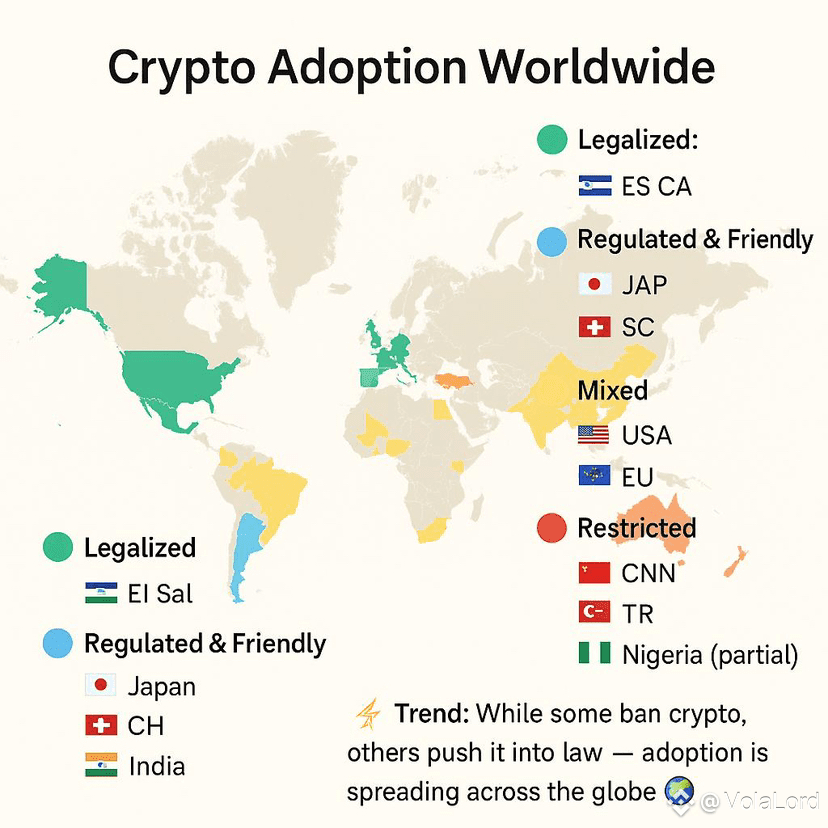
Over the past decade, cryptocurrencies have evolved from a “geek experiment” into a global financial instrument. Today, you can buy coffee in Tokyo with bitcoin, pay taxes in Switzerland, or send salaries in Nigeria. But governments approach crypto very differently — from full legalization to outright bans.
🟢 Pioneers (Full Legalization)
🇸🇻 El Salvador
* In 2021, bitcoin was recognized as legal tender.
* Citizens received the Chivo wallet and access to bitcoin ATMs.
* Goal: improve financial inclusion (70% of the population is unbanked).
🇨🇫 Central African Republic
* In 2022, BTC became an official currency alongside the CFA franc.
* Challenge: weak infrastructure and low digital literacy.
⚖️ Regulators (Clear Frameworks)
🇯🇵 Japan
* BTC recognized as a means of payment.
* Exchanges must be licensed and maintain reserves.
* One of the most transparent markets for crypto businesses.
🇨🇭 Switzerland
* Zug is known as “Crypto Valley.”
* Taxes can be paid in BTC/ETH.
* A crypto-friendly hub for startups and ICOs.
🇦🇪 UAE
* Dubai created the Virtual Assets Regulatory Authority (VARA).
* Hundreds of licensed exchanges and blockchain firms operate.
* Goal: position UAE as a global Web3 hub.
🟡 Cautious Players
🇺🇸 USA
* No unified law; regulation varies by state.
* New York: BitLicense; Miami & Texas actively adopt crypto.
* ⚖️ Ongoing SEC vs. CFTC debate on whether crypto is a security or a commodity.
🇪🇺 European Union
* In 2023, passed MiCA (Markets in Crypto Assets) framework.
* Clear rules for stablecoins, exchanges, and custodians.
* Aiming for a harmonized EU-wide approach.
🇮🇳 India
* Long operated in a gray zone.
* 30% tax imposed on crypto profits.
* Exchanges function under heavy regulatory pressure.
🔴 Restrictive Countries
🇨🇳 China
* Banned mining and crypto transactions in 2021.
* Promotes its own CBDC — digital yuan (e-CNY).
🇹🇷 Turkey
* Banned crypto payments, but trading and holding remain legal.
* Citizens actively use crypto as a hedge against inflation.
🌍 Africa & Latin America
🇳🇬 Nigeria
* In 2021, the central bank prohibited banks from servicing crypto users.
* Despite restrictions, Nigeria is among the leaders in P2P BTC trading.
* Introduced a national digital currency: eNaira.
🇧🇷 Brazil
* In 2022, legalized crypto payments.
* BTC is not official tender, but recognized as a valid means of exchange.
* Exchanges must register and comply with AML requirements.
📊 Key Trends
1. Diverse approaches — from El Salvador’s full legalization to China’s strict ban.
2. Tightening regulation — the US, EU, and India seek balance between innovation and control.
3. CBDCs on the rise — more countries test central bank digital currencies (China, Nigeria, EU).
4. Adoption in developing economies — inflation and weak banking drive crypto use (Turkey, Argentina, Nigeria).
⚡️ Conclusion: Crypto is going global, but its future depends on how the world balances innovation with government control.
#globaladoption #crypto #world #Adoption


