
1. Historical Review of Track Switching (2020-2026)
First Transformation: Privacy Track (2020-2022)
Product: CAPE (Configurable Asset Privacy for Ethereum)
Result: Product market fit failure, CEO Ben Fisch admits "very difficult to find product market fit"
Second Transformation: Shared Sequencer (2022-2024)
Core: Decentralized Shared Sequencing Layer + Sequencer Market
Financing: March 2024 $28 million Series B (led by a16z)
Result: The sequencer market has not launched, FAQ clearly states "Espresso does not currently offer shared sequencing as a product"
Third transformation: Cross-chain interoperability/global confirmation layer (2024-present)
Positioning: "Base Layer for Rollups"
Core selling point: ~2 seconds finality (compared to Ethereum's 12-15 minutes)
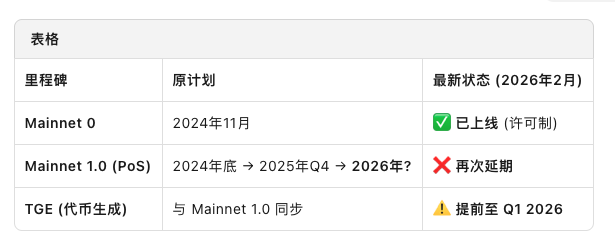
Mainnet status: Mainnet 0 (permissioned, 100 nodes) launching in November 2024
2. TGE confirmed but mainnet delayed again
Major discovery: TGE decoupled from mainnet
According to the official announcement on February 5, 2026, and the Binance Pre-TGE event on February 10, 2026
Total: 7 chains completed mainnet integration (only ApeChain shows significant growth compared to 2024)
Testnet/evaluation ongoing
Celo: OP Stack integration development ongoing, requires governance approval
GIWA Chain: Dunamu (South Korea) OP Stack chain, under testing
LitVM: Custom integration, dual settlement architecture
Performance Data (Mainnet 0)
Finality: ~2 seconds (average)
Validators: 100 nodes (22 operators)
Blocks: 5.3 million+ produced
Transactions: 8.7 million+ confirmed
Throughput: 5MB/second
Runtime: Stable operation since November 2024 for 15 months
4. Token economics risk (pre-TGE)
Structural issues
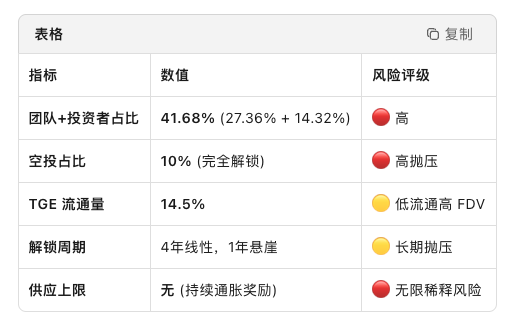
TGE timing risk
Core contradiction:
TGE launched early (Q1 2026) vs Mainnet 1.0 delayed again
This means that tokens will circulate on a centralized permissioned network rather than the promised decentralized PoS network
Violation of white paper commitment: "TGE coincides with Mainnet 1.0 launch"
5. Team and legal risks
Historical litigation (unresolved)
In 2021, Temujin Labs (Findora) sued the Espresso team:
Allegations: Theft of code, breach of fiduciary duty, poaching engineers
Involves: CEO Ben Fisch, COO Charles Lu and other core members
Status: As of February 2026, no public settlement or withdrawal information
Team background (advantages)
Ben Fisch (CEO): Yale professor, inventor of VDF/Filecoin consensus
Benedikt Bünz (Chief Scientist): NYU professor, core contributor to Bulletproofs/Monero
Total funding: $64 million (Sequoia, a16z, Electric Capital, etc.)
6. Multidimensional comprehensive assessment
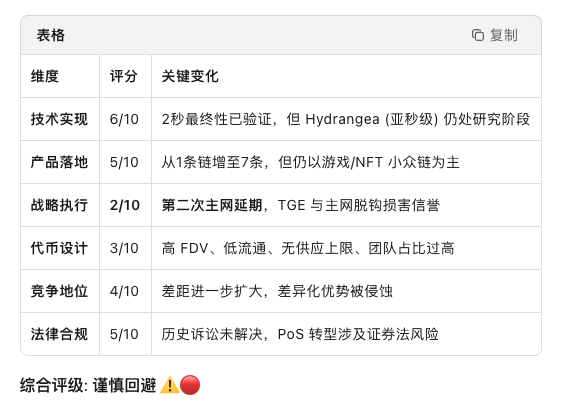
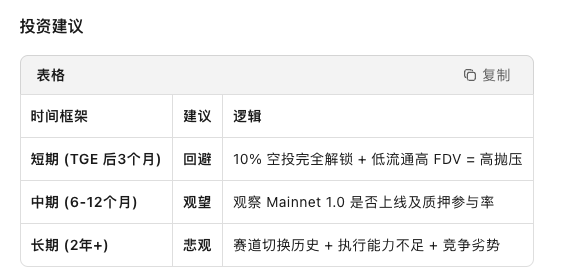
7. Key conclusions and investment recommendations
Mainnet delayed again: Mainnet 1.0 (PoS) from end of 2024 → Q4 2025 → 2026 undecided, constitutes a second major delay
TGE strategy shift: Token issuance decoupled from mainnet launch, potentially reflecting:
Funding Pressure ($64 million financing has been consumed over 4 years)
Investor exit demand
Market timing selection (Q1 2026 crypto market recovery)
Product-market fit remains in doubt: Among 7 mainnet chains, none are leading DeFi or mainstream L2; primarily niche game/NFT chains
Competition window closed: Optimism Superchain, Polygon AggLayer, etc., have established strong network effects; Espresso's 2-second finality advantage is insufficient to overturn the landscape
Disclaimer: This report is based on publicly available information analysis and does not constitute investment advice. Cryptocurrency investment carries high risks; please conduct your own due diligence.