
The XRP token quotes have recovered by more than 30% after bouncing off the local minimum in early February around $1.12. The momentum briefly returned the price to the $1.50 zone. Externally, the movement looked constructive. Momentum indicators improved. A reversal pattern began to form on the chart. Market participants started discussing a potential trend change.
However, blockchain data reveals a different situation. Metrics do not show confident accumulation. On the contrary, statistics indicate that many holders used price increases to exit losing positions.
Sales with negative results continue to dominate. Several groups of investors are still reducing their risks. A logical question arises about whether this bounce was due to real demand or provided an opportunity for 'trapped' sellers to exit their positions.
========
Technical picture and recovery potential
On the 12-hour chart, the asset is trading within the pattern 'descending wedge'. The growth potential upon realization of this figure and breaking the upper boundary is about 56%.
To activate the scenario, the XRP price must settle above the short-term moving average. This refers to the 20-period exponential moving average (EMA), which gives more weight to recent price values. This level acts as dynamic resistance in downtrends. In early January, a clean breakout of this EMA triggered a rally of nearly 30%.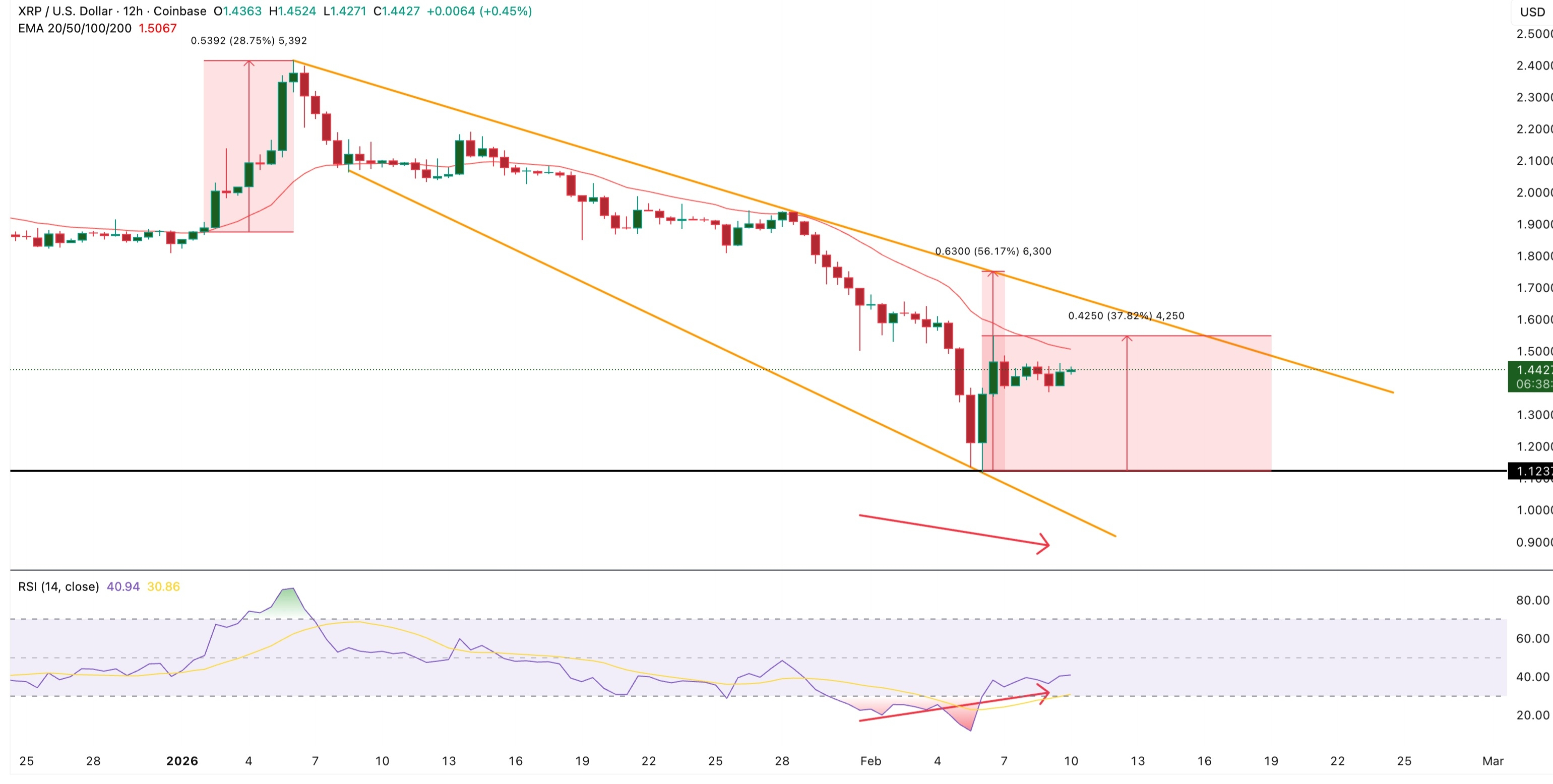
Moreover, an improvement in momentum is observed. From January 31 to February 9, the price updated its local minimum. At the same time, the Relative Strength Index (RSI), which measures buying and selling pressure, formed a higher minimum. Such a 'bullish' divergence usually indicates a weakening of sellers' positions.
This technical setup alone indicates a likelihood of a bounce. However, graphical patterns only work when investors are willing to hold capital in the asset. To assess the sustainability of growth, it is necessary to analyze the on-chain behavior of market participants.
========
Market participants' loss metrics
One of the clearest warning signals comes from the SOPR (Spent Output Profit Ratio) metric. This ratio shows whether the coins moving on the blockchain are sold at a profit or at a loss. A value above 1 indicates profit-taking. A value below 1 confirms realized losses.
Since the end of January, the SOPR for XRP has remained below one for more than ten consecutive days.
This is an atypical situation for a growing market. After a 30% recovery in quotes, short-term traders usually exit with a profit, pushing the SOPR up. In this case, profitability has not recovered. Sales at a loss continued even amidst price growth. Therefore, a significant portion of holders continues to liquidate losing positions.
The market does not demonstrate confident profit-taking. There is an exit from assets under pressure. To understand the structure of sellers, it is advisable to consider the behavior of different cohorts of holders.
=========
Mass exit of short-term investors
The HODL Waves metric groups XRP wallets by the time of holding the coins. This allows identifying which groups of investors are buying or selling the asset. The most drastic changes are recorded in the cohort of daily holders (24-hour holders).
As of February 6, this group controlled about 1% of the circulating supply. Over the course of several days, their share plummeted to 0.09%. The decrease amounted to over 90%.
This refers to highly active traders who entered the market during periods of volatility and rushed to close positions at the first bounce. However, sales were not limited to just this group.
The cohort of holders with a holding period of 1 to 3 months is also reducing its presence. These participants actively accumulated the token in January when the XRP price was around $2.07. Their share in the supply fell from 14.48% in mid-January to 9.48% recently. The decrease amounted to about 35%.
These investors remain at a loss. Instead of waiting for a full recovery, they use local growth to minimize losses. The combined actions of these two groups explain why the SOPR metric remains subdued for a long time. Short-term speculators are exiting unsuccessful trades, while medium-term holders are reducing risks. Such behavior is typical for a distribution phase rather than the beginning of a bull market.
=========
Key resistance levels and forecast
Cost Basis heatmaps demonstrate areas of volume concentration. These levels often become resistance when the price returns to them.
For XRP, a powerful local cluster has formed in the range of $1.42–$1.44. More than 660 million coins were accumulated in this zone. This creates a serious barrier for buyers.
As prices approach this area, many holders exit at breakeven. After spending weeks in the 'red zone', they prefer to sell the asset. Above this cluster lies the level of $1.54, which coincides with EMA resistance. These zones create a 'wall' that the asset has repeatedly failed to overcome. Each attempt to rise in this region is accompanied by an increase in sales.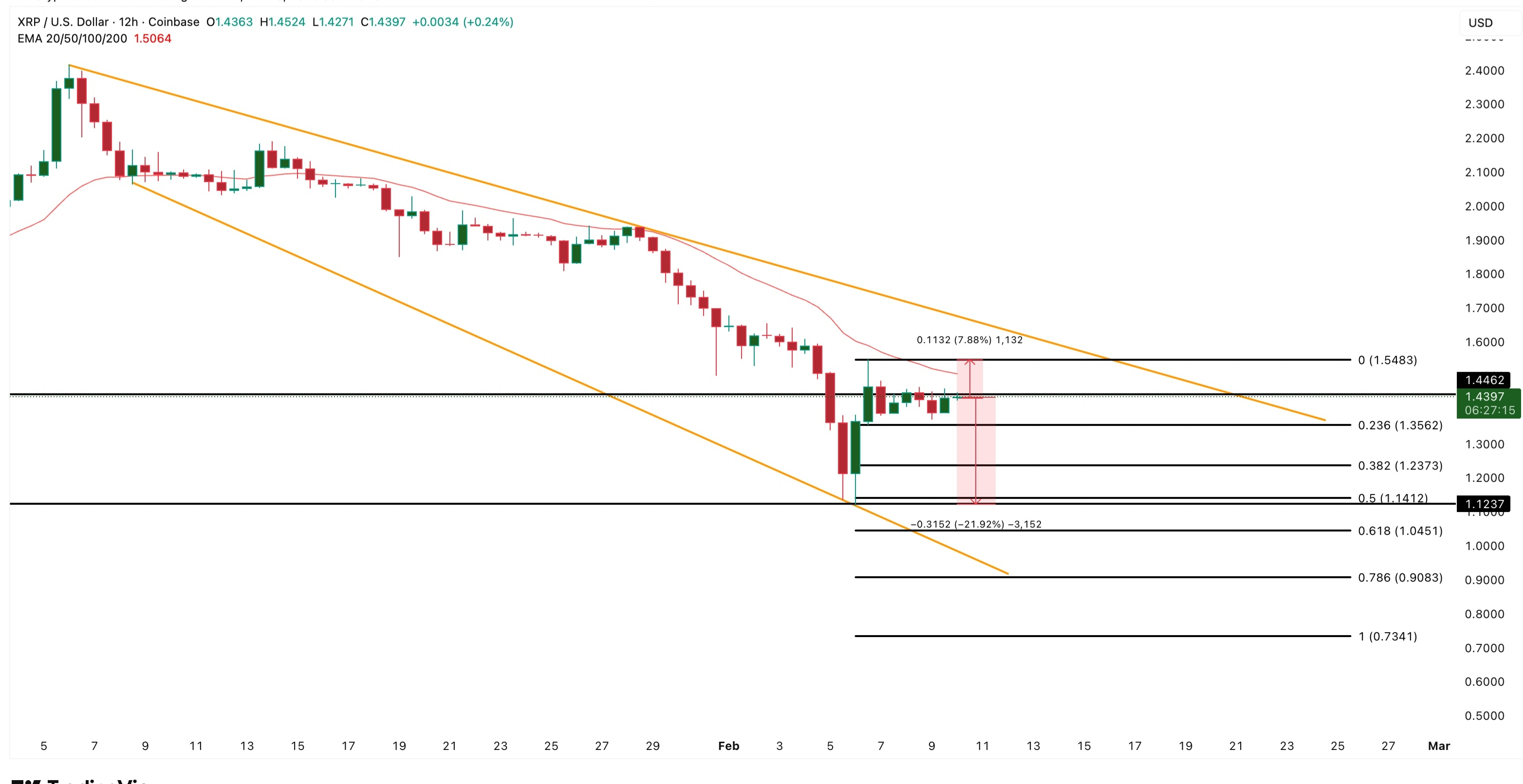
Failure to settle above $1.44 increases the risks of a decline. A rejection of the breakout could send the price back to $1.23 and possibly to the recent minimum of $1.12. This would mean a drop of more than 20% from current levels. Only a confident settlement above $1.54 with support from rising profitability can change the current market structure.