

Author: Qingfeng BTC | Web3 researcher / market analyst
One, why do we need 'on-chain fixed income'?
The crypto market experiences a 'narrative change' every so often: from Layer1 to Layer2, from DeFi Summer to GameFi, NFT, Restaking, AI+Crypto…
Every narrative has ignited FOMO and has experienced bubble corrections. But what remains unchanged is that the basic assets of the crypto world still face a structural problem:
There is no predictable, sustainable revenue model.
Although DeFi provides huge innovation, the vast majority of income sources are still:
Short-term incentive mechanisms (airdrops, token subsidies)
High volatility strategy arbitrage (LP liquidity mining)
The 'risk transfer' of on-chain protocols rather than 'risk pricing'
This makes the entire market's interest rate logic extremely unstable.
In the traditional financial world, the basis of yield models comes from low-volatility, long-term existing yield assets such as bonds, repo rates, and money market funds; however, it has long been missing on-chain.
The mission of Treehouse is to fill this gap.
Two, what is Treehouse? It is not a high-growth protocol, but a 'yield anchoring protocol'
Treehouse is a decentralized platform dedicated to building on-chain fixed income products. Its product logic is not complicated:
Users invest assets (such as USDC, DAI)
The protocol deploys funds to mainstream DeFi strategies (Aave, Lido, etc.)
The yield path has been standardized as 'fixed note' products
Users obtain fixed income assets with clear annual yields and clear periods.
From the perspective of financial structure, it is an on-chain 'yield note factory', and in the future, it may even become:
On-chain short-term debt market + funding rate anchor point + DAO financial management hub
Such projects are naturally not very attractive, but they have extremely high structural value.
Three, can Treehouse run? Look at three major trends
1) Changes in funding structure: from risk preference → stable preference
The DeFi market from 2020 to 2022 was dominated by speculative funds; starting in 2024, an increasing amount of structural, rational funds are flowing back.
DAO treasury needs yield product management TVL
RWA projects hope to connect with on-chain stable funds
High-net-worth investors are starting to allocate 'low volatility + fixed income assets'
These funds do not chase narratives, but rather pursue stable returns.
Treehouse perfectly aligns with the demand pain points of this type of funding.
2) The 'lack of basic income products' brought about by the wave of institutionalization
As traditional financial giants like Coinbase, Circle, and BlackRock gradually engage in on-chain asset management, the market is trying to reconstruct an important dimension:
On-chain interest rate curve
Currently, ETH Staking provides 'basic yield', Pendle guides 'tradeable'; and if Treehouse successfully standardizes fixed income products, it has a chance to become:
On-chain short-term debt issuance layer
Fixed income strategy custody layer
Yield-focused money market entrance
In the context of institutionalization, Treehouse is expected to become 'the Bloomberg of Crypto fixed income'.
3) Market volatility cycles are repeated, asset allocation is becoming more conservative
Since 2024, although the overall market has warmed up, repeated fluctuations have led users to reconsider 'fund safety' and 'controllable returns'.
During the peak of the Restaking model, many users earned points; but as liquidity tightened and regulatory concerns increased, funds began to shift towards low-risk, stable return asset allocations.
This change in behavioral habits is precisely the catalyst for fixed income protocols.
Four, from the product positioning view, the potential ecological value of Treehouse
The value that Treehouse can undertake is not just a product protocol, but a reconstruction of underlying financial logic:
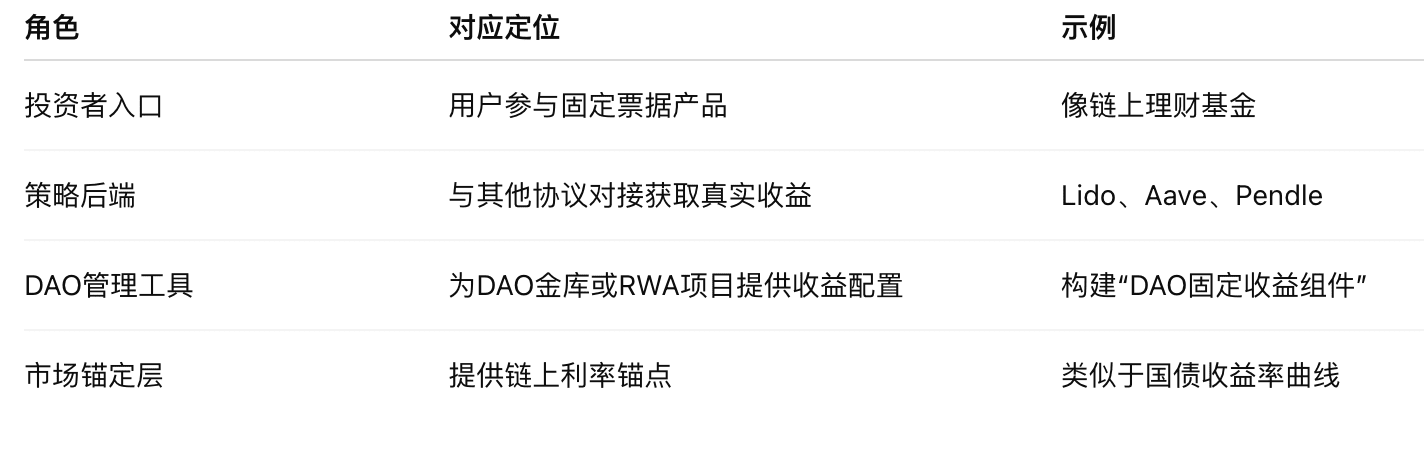
This model has long matured in traditional finance, while on-chain it has just begun, but once started, it will form a huge 'interest rate liquidity ecology'.
Five, project progress and potential opportunities: it is still a 'participation value undervalued area'
Treehouse has not officially launched its token yet, but its 'Early Supporter' activity on Binance's task square has gone through multiple rounds, with tasks including:
Social media attention
Official website visit
Check-in
Community participation
These tasks are the most classic 'interaction behavior registration' methods in crypto projects and are likely to become a priority factor for token incentive distribution in the future.
More importantly, the current number of participants is still not high, and it is still in the stage of accumulating high-quality early users.
For medium to long-term investors optimistic about structural value, this is a typical 'low-cost cognition + behavioral positioning' window.
Six, summary: Treehouse is an important piece in the process of reconstructing interest rates in the crypto market
It is not a 'new concept' of high-risk gambling, nor is it a 'play project' for short-term pump.
It is a type of 'basic financial infrastructure' that has long been missing on-chain.
If we believe that the future of Web3 is not just about memes and Restaking, but rather about adopting some logic of TradFi—then fixed income, standardized interest rates, and composable notes are layers that must be rebuilt.
Treehouse is not a narrative explosion, but it may become one of the benchmark providers of 'on-chain stable income assets' in the next cycle.
At this stage, where the rhythm has not yet truly begun,
Its greatest value may lie in being: early enough, fundamental enough, and necessary enough.
@TreehouseFi #Treehouse $TREE